Siobhán O'Riordan sent her manuscript in without a conclusion.
"I don't like to finish things," she admitted.
Where the ending should have been, there were "a couple paragraphs and a big help sign."
"It was really hard for me to wrap it up and find the right place to land."
Later in the session, Andrew Sloan described the moment his own ending arrived. When he saw his illustrator's final drawing of "safe harbours", he "combusted in beautiful tears".
"This has to be at the end."
That drawing showed him how to write his conclusion.
Sarah Gray knew the feeling. "You are writing and you're writing and you feel like you could write forever."
Three authors. Three very different books. The same stubborn last chapter.
It was one of many threads that ran through our December 2025 Community Book Launch.
How our Community Book Launches work
A Community Book Launch is our way of celebrating new books from inside the Expert Author Community, with the doors open to anyone curious about what it takes to write one.
The authors don't pitch their own books.
Instead, each one reads a fellow panellist's book and shares what stayed with them. The audience then gets to ask about the ideas, the writing and everything in between.
Kelly Irving opened and closed the session. Our hosts were Karen Stein and Melo Calarco, both community hosts and award-winning authors. Melo knows the panel seat well. He joined his own launch in 2023 from an airport.
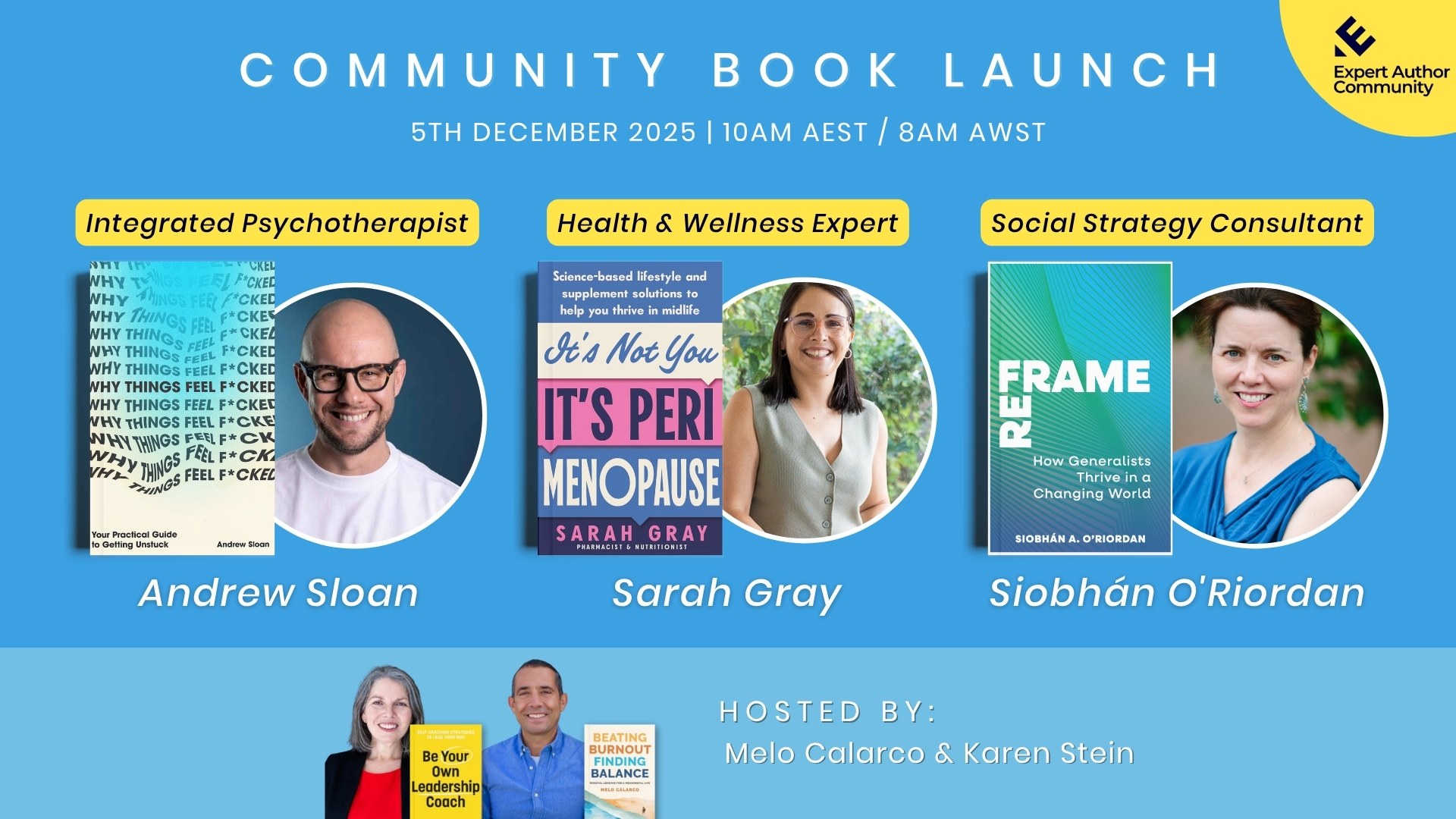
This time, the books in the spotlight were:
- Reframe by Siobhán O'Riordan
- It's Not You, It's Perimenopause by Sarah Gray
- Why Things Feel F*cked by Andrew Sloan
Watch the full launch
Reframe by Siobhán O'Riordan
Reframe is Siobhán's guide for anyone who doesn't fit neatly into one box. She is a strengths coach who works with multi-skilled people, and she had recently graduated the first cohort of her generalist program.
Andrew reviewed it, and he opened with a confession.
"I never, ever in all of my years had I heard of a generalist until you, Siobhán, posted it in the community."
That idea has since changed how he works with his own clients.
"So your book is for the invisible generalists. First maybe to themselves, next to everyone else in a world that has been set up and built for specialists."
He called it "an abundant book of so many insights and perspectives". Siobhán surveyed generalists, interviewed about 20 of them in depth and drew on more than 150 resources.
He also noticed that the book doesn't set generalists against specialists.
"You call us to build high levels of trust, and you ask us to tell better and greater stories so we can truly collaborate with our specialist partners in making the world a better place."
Siobhán wrote from experience.
"I am a generalist. I did not know I was for most of my career... just crushing it, just really excelling at certain points and then completely crashing out. And I never understood why."
A colleague eventually named it for her. A LinkedIn post about that conversation got traction, and the same colleague told her "now you have to write a book".
The theme that kept coming up in her research was talented people "really struggling to communicate their value and what they do well". As she sees it, generalists and specialists need each other, and generalists bring something specific:
"We are the glue, we are, we fill in the gaps, you know, we're thinking ahead, looking around corners..."
And the woman who resists specialising has found a label that fits. She "jokingly" calls herself "the specialist generalist".
It's Not You, It's Perimenopause by Sarah Gray
It's Not You, It's Perimenopause is Sarah's science-based guide to lifestyle and supplement solutions for thriving in midlife. Sarah is a dual qualified pharmacist and nutritionist with more than 25 years' experience, and a certified menopause practitioner.
Siobhán reviewed it, and the book didn't stay where she planned.
"I thought I would read it at my desk and I haven't, I've been reading it in bed..."
She keeps going back to the pantry staples, the recipes and the hormone chapters. For a topic where "there's so much information out there that... I think Googling it just makes it worse", she valued how clear and calm it is. Even the supplements section worked for her.
"I actually saw that section as really helpful because it was simplified, it didn't feel as overwhelming."
She also said it gives readers "agency and authority".
Sarah wrote it because of what she kept seeing in her clinic. Women came in about midlife weight gain, and she found "common hormonal threads and a lot of misinformation and confusion". Sharing clear, evidence-based information felt like her "duty".
Some readers have surprised her. Mothers are buying the book for their daughters so they feel prepared.
At the heart of the book is what Sarah calls cake theory. Nutrition is the flour and sugar. Lifestyle is the eggs and milk. Supplements are the choc chips, carrots or walnuts. HRT and medication are the icing.
"For those of you have heard this before, my husband believes that every single cake that you eat with icing is always better. I disagree because I think things like a flourless almond cake doesn't need icing."
In her professional view, "not everybody needs icing. Not everybody needs HRT or can tolerate it."
Karen called it "a fabulous metaphor for people to get their minds around it."
Writing the book changed Sarah too.
"It's given me that confidence to know that actually I do actually know a lot of stuff. I've written a whole book about it."
Why Things Feel F*cked by Andrew Sloan
Why Things Feel F*cked is Andrew's practical guide to getting unstuck. He is a psychotherapist who, as Karen put it, has "spent years helping people through burnout, overwhelm, and that unsettling feeling that life has quietly kind of tilted off its axis."
Sarah reviewed it. She read some of it twice, and started with the back cover.
"Are you stuck, burnt out or disconnected? Do you feel lost? You are not alone and you are not broken. ... that is so powerful."
Her favourite part was Andrew's nervous system map.
"I've read a lot of science stuff, I've never read it broken down that beautifully."
She also noticed something about the voice. "You can actually hear Andrew's voice as you're reading the book."
That was deliberate. Andrew worked hard to make the book sound like a conversation with him, because he thinks "self-help has a bad rap".
"Some self-help is too thin and it's too euphemistic about how difficult the world is."
Some of it goes the other way and is "impenetrable". He aimed for the middle, with chapter summaries, reflection tools and hand-drawn illustrations by Guy Downes, who read the entire manuscript and produced "125 little gems".
Sarah's favourite chapter was chapter nine, Co-creator. It also holds the most personal story of the night, which we've written about in Breaking up at your own book launch.
Her biggest takeaway:
"I feel like we're all in this together. You know, so you read elements of the book and I think, oh, I thought it was just me that felt like that clearly it's not just me."
The title came up in the Q&A. One audience member admitted it had put her off. Andrew's reply was warm and direct.
"Don't sleep on the subtitle. The subtitle is your practical Guide to Getting Unstuck."
He then offered her, personally, her money back if she was dissatisfied by the end of part three. Her response: "You just pitched it to me beautifully."
What this panel taught us about writing a book
Know who you're writing for, and who you're not
Siobhán's first ingredient for writing a book was clarity on the reader.
"Until you're really clear on who you're writing for, I don't think you should write a book..."
That meant saying no. "I'm not writing for people who manage generalists. I'm writing for mid-career, not C-suite."
Andrew went further and gave his reader a name. "I spent six months structuring this book for my reader, and their name was Blake."
Sarah built hers into the book. "I do have a running character called Sophia who runs through the book and she's an amalgamation of all of my clients. She's my avatar."
The hardest part is deciding what to leave out
Sarah admitted, "I was trying to solve everybody's problems in this book".
She came to see that a book "can only really get somebody from point A to a certain point". So she cut the rarer cases and pared back the supplements.
"I could have written an entire book on supplements in perimenopause, but I chose strategically only to include the ones that I generally recommend and a few that I wanted to bust some myths on."
She was clear on her professional limits too. "Because I'm not a psychologist, I'm very clear in the book of what my scope is."
Commit before you talk yourself out of it
Asked whether she ever expected to write a book, Siobhán said she hadn't. Not a business book, anyway.
"What I did was I activated and did not think about it. And so I committed before I really... talked myself out of it."
Then her pod kept her going. Her second ingredient was "having accountability and having other people... to write with ... that I could show up for other people and they could show up for me."
Our hosts are proof it lasts. Melo says Karen is still his "pod buddy. Even two years later we are still sticking together".
Simple answers take a village
"People actually really just need very simple answers to quite complex issues that they're having," Sarah said. She credits pharmacy, where "we often get between 30 seconds and three minutes" to explain a script to someone.
Andrew found simplicity through his structural and creative editor. "My work with her helped to go, Andrew, what are you really saying?" The nervous system map "took six goes at editing it down, six goes to going, what does the reader really need?"
"I know I need those collaborators and I need a team, I need a village around me to feel good in the world. It turns out I need a village around me to write a really good book that is readable by people too."
Put up the help sign
The endings on this panel didn't come from sitting alone with a blank page.
Siobhán's help sign got an answer. "The editor really helped me do that."
Andrew's arrived as a drawing from a collaborator who had read every word.
If your manuscript currently ends in a couple of paragraphs and a question mark, you're in good company.
Ask for help. Find your village.
As Melo told everyone at the start of the session, "your book does matter".
Writing a book of your own? The Expert Author Community is where authors like Siobhán, Sarah and Andrew plan, write, publish and launch their books alongside each other. See how the community works.
Kerryn Harvey on Mostly Ups
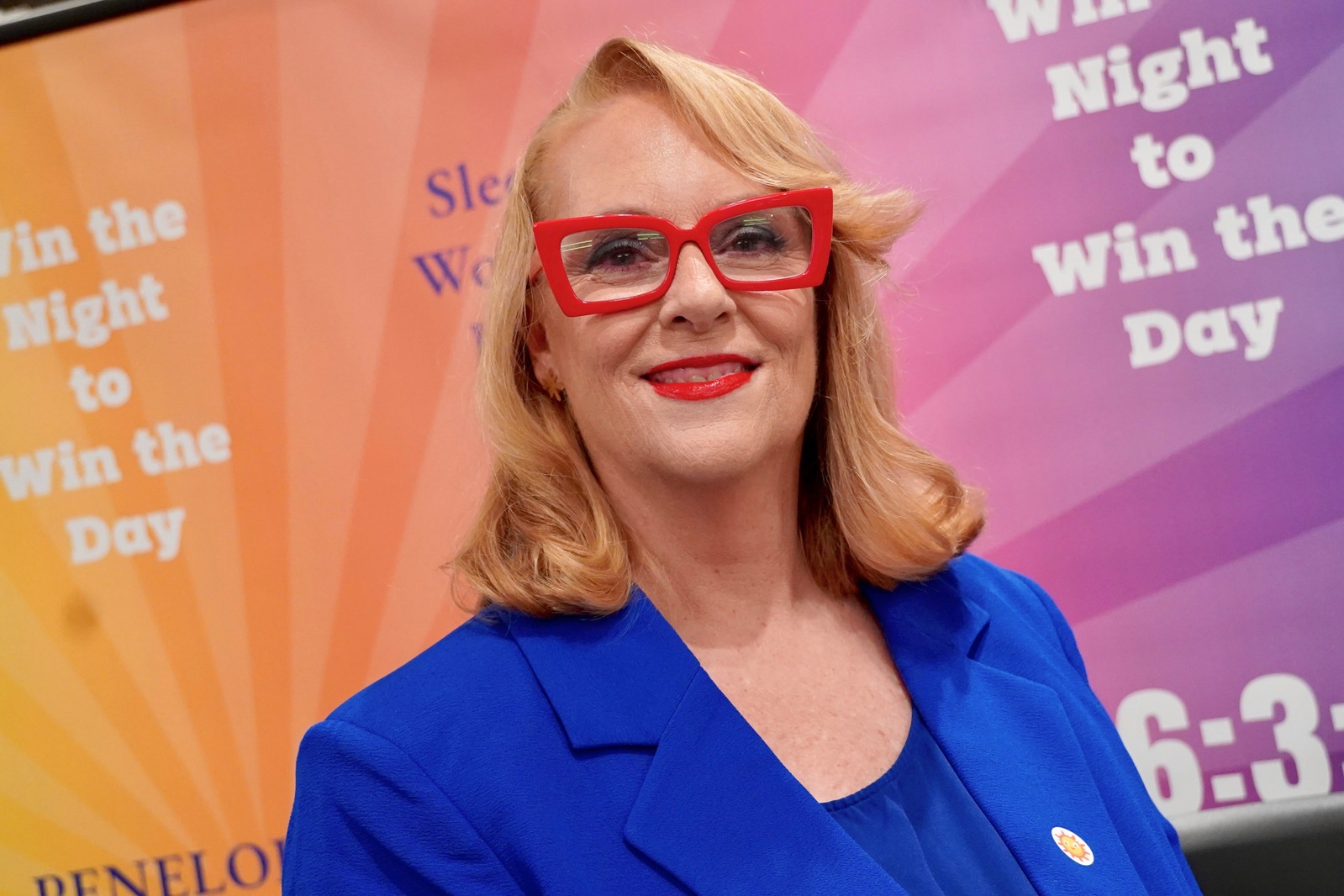
Penelope Barr on Win the Night to Win the Day

Why Are You Writing a Book? The Purpose Question Most Authors Only Half Answer