


Most books promise change but stay safely theoretical.
What does that mean? Well, authors play it safe with:
📚 Generic success frameworks that sound impressive but feel hollow.
📚 Carefully curated personal stories that reveal nothing vulnerable.
📚 Case studies about “other people” while the author stays hidden.
📚 Professional personas that never let readers see the real human.
But recently, author of Why Things Feel F*cked Andrew Sloan did something different - and he took it to a whole new level the night of his book launch.
He didn’t just write about vulnerability - he lived it publicly.

Right there on stage, with his former partner Chris beside him, Andrew read from Chapter 9 of his book. The chapter about their relationship ending. The chapter he wrote in May while they were still navigating their separation. The chapter that became their roadmap for doing the impossible: ending a 13-year relationship without making enemies.
👉 Here's the thing about vulnerability that Andrew taught all 105 people in the room that night: it’s not about oversharing - it’s about the courage to be who you are, to show transformation in real time.
Andrew shared his most difficult chapter because it demonstrated his principles in action. "I sat across from Chris in May, reading him the chapter I'd written about our relationship ending, using the very principles I teach to navigate our own separation."
Then at the book launch, we watched them both support and interview each other, and celebrate the book that documented their relationship. They proved that the concepts Andrew teaches about "no bad guys" and conscious co-creation actually work in real life - even in the messiest circumstances.
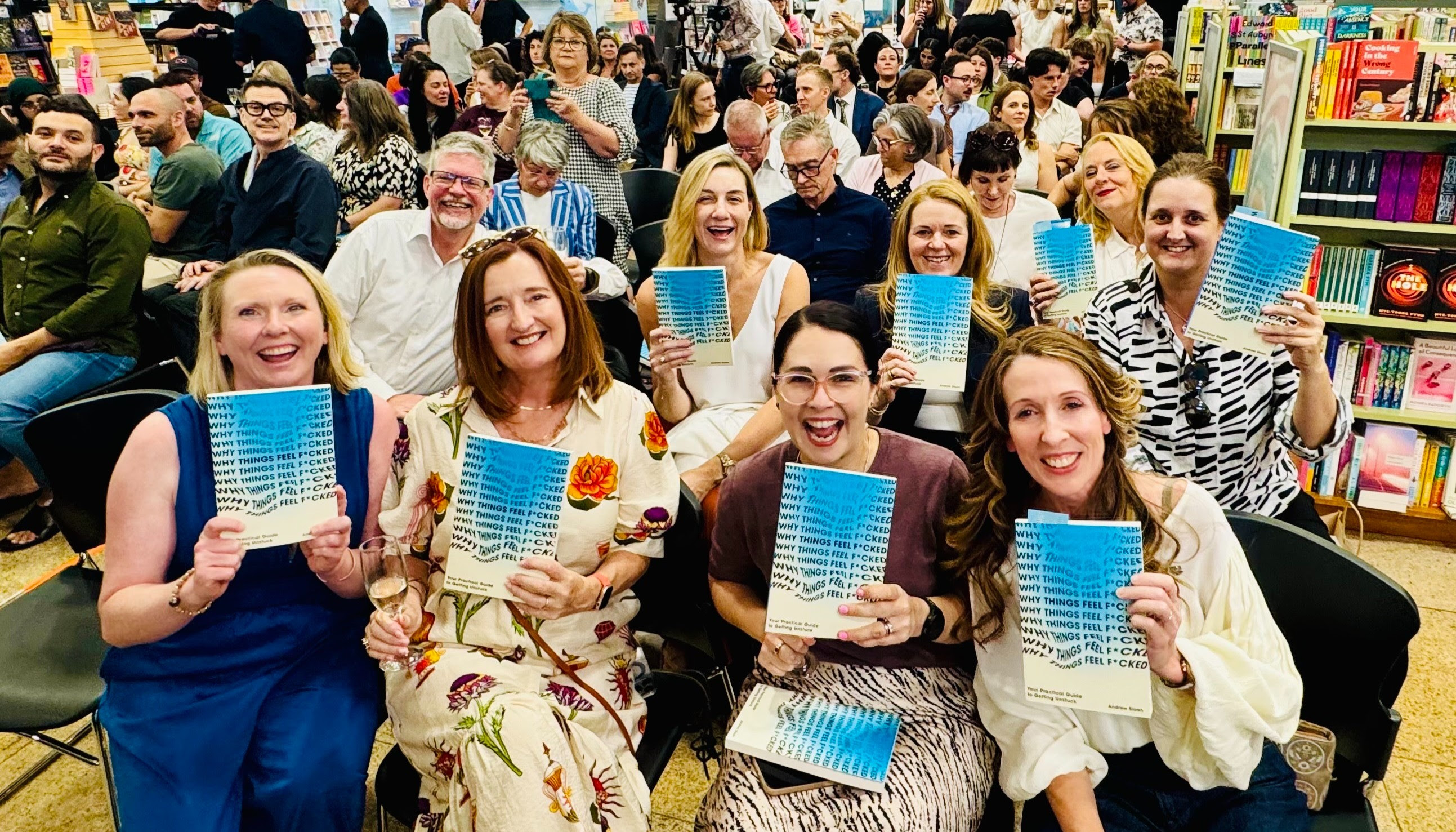
Watching 14 EAC members surround Andrew with support that night reminded me: writing a book is inherently vulnerable, but it doesn't have to be isolating. You're not just putting words on paper - you're putting your expertise, your experiences, and often your heart into the world.
Your mess might be your message. The chapters you're most afraid to write often become the ones that change lives. In a world of polished facades, real stories cut through the noise. And having fellow authors witness your vulnerability makes it feel less scary.
So what is the chapter you're most afraid to write? How can your readers not just learn from your expertise, but experience this transformation in real time?
As Andrew says, things might feel fucked, but that's your sign to get unstuck, together.
Kelly and The EAC Team

Why Are You Writing a Book? The Purpose Question Most Authors Only Half Answer
Thinking About Writing a Parable or Business Fable? Here’s What to Know First

What have I learned about Book Awards by being a judge?