


Graeme Cowan reduces caring leadership to three questions a manager asks daily: Am I okay? Are we okay? R U OK? He explains what Australia's psychosocial hazard laws get right, why he worries care will become a tick-box audit, and why he argues care is a skill that can be taught.
"Care" is a word most leaders nod along to and then quietly file under soft skills. In writing Great Leaders Care, how did you have to define care so that a leader under pressure to hit numbers could actually act on it?
To make care usable under pressure, I had to define it as a daily practice. In the book, care comes down to three questions a leader asks every day: Am I okay? Are we okay? R U OK? That is self care, crew care and red zone care, and each comes with practical actions a busy manager can take this week. Then I had to prove it pays. I saw this first-hand at Ramsay Health Care, where I helped establish their vision of "people caring for people". Former CEO Pat Grier told me that over his 15 years, Ramsay outperformed the ASX by a factor of 15, with half the injury rate of comparable hospital groups. Gallup's research agrees: when people feel part of a caring team, productivity, profit and customer service rise, and people stay longer. Care is a strong skill, not a soft one.
You have been working in this territory for two decades, through Back From the Brink, R U OK? Day and the R U OK? at Work program. What did sitting down to write this particular book force you to understand about safe, high-performing teams that all that advocacy had not yet made clear to you?
Writing the book forced me to see that awareness is only the starting point. R U OK? taught Australians to ask the question when someone is struggling. But a safe, high-performing team is built long before anyone reaches that point, and it is built by the leader. I learnt through R U OK? that most people wanted to help but didn't know how. Writing this book showed me the same is true of leaders: most want great results and a happy team, but nobody has shown them how to achieve both. So the book had to move from awareness to a practical "how". The EAC book proposal and Kelly's "5 Steps to Write Anything" ebook helped me get there, by forcing me to decide exactly who the book was for and what it added that was different. The real power came in a 2 minute pitch to publishers about the book - and the joy came that afternoon - when Wiley contacted me and said they wanted to help me make it happen.
You have spent years interviewing chief executives about what caring leadership looks like from the top. What patterns from those conversations only became visible to you once you had to turn them into a framework on the page?
The biggest pattern was one I didn't expect: every story fitted the framework I already had. I went into almost 100 Caring CEO interviews with three pillars, self care, crew care and red zone care, and I expected the transcripts to break them. They didn't. Leaders from very different industries kept describing the same three things in their own words: how they looked after themselves, how they built a team that had each other's back, and what they did when someone was struggling.
I only saw that once the stories were side by side. Reading 100 transcripts manually felt mind-numbing, so I tested Gemini, ChatGPT, Claude and Copilot on three interviews, chose Claude, and ran the same 10 prompts across every one. The CEOs didn't change my structure. They proved it, with real examples from people who have done it, and that is far more persuasive than theory.
Your own severe depressive episode is the reason you do this work, but Great Leaders Care is written for leaders building teams rather than for people in crisis. How did you decide how much of your own story belonged in it, and where it needed to sit?
I kept my story to the first section of the book, and that was deliberate. As a keynote speaker, I've learnt that my story of crashing and burning as a VP at a global management consulting firm earns real credibility. It shows I'm sharing lived experience as well as theory. But this book is about the reader's team, so my story had one job: to earn the right to be heard, then step aside. The bridge is the Moodometer, a simple tool that shows each of us is in the green, amber or red zone at any given time. It turns my story into everyone's story, because we all move up and down that scale.
My journey from chronic red zone back to green zone shows the overwhelmed reader that recovery is possible, and people tell me they appreciated the authenticity and honesty.
Being able to share research that in the green zone, we are 31% more productive, we sell 37% more, and we're 200% more creative shows the workplace value of a positive mood.
My story as a founding director of R U OK? also shows credibility in building something from a simple idea, into a national movement. Not many people can say that.
I am encouraging people to start their own WeCare movement by committing to asking themselves three questions each day: Am I okay? (self care), Are we okay? (crew care), and R U OK? (red zone care). Everyone of us can play a role in a healthy and more productive workplace.
Psychological safety has gone from an idea to an obligation in Australia, with psychosocial hazards now sitting squarely in workplace law. What does the compliance framing get right, and what worries you about leaders treating care as something to be audited?
The law gets one big thing right: it makes leaders responsible for preventing harm before it happens. What worries me is the jargon, and the risk that care becomes a tick-box exercise. Most leaders don't understand what a psychosocial hazard is, or their role in reducing it.
I posted on LinkedIn that the best way to boost employee mental health is to give people a good manager. It went viral, with 2.9 million views and more than 4,000 comments, and people overwhelmingly agreed. I then ran a poll asking, "Do managers know how to reduce the psychosocial risk in their team?" and 81% said no.
So I wrote a jargon-free chapter on the new legislation. Research shows that simpler language is judged as coming from a more intelligent and trustworthy source (Oppenheimer, 2006). I told readers that psychosocial risk is harmful work stress, with 14 root causes including poor change management, too much work and bullying. Then I gave managers a way to choose one root cause and run a 90-day plan to reduce it. You can audit a policy. You can't audit whether a manager cares, but you can show them how to.
Now that you are starting to put these ideas in front of leaders ahead of publication, which part of the book lands fastest, and which part do you find yourself having to defend?
The idea that lands fastest is the power of a caring team. People understand it intuitively. In my keynotes, I ask people to think of a great team they've been part of. I ask them to picture the faces on that team and remember how they felt arriving at work. Then I ask what made that team different. In 95% of cases, the top three answers are:
We had each other's back.
We encouraged each other.
We cared about each other.
People yearn to be on a team like that, and miss it dreadfully when they're not.
The part I have to defend is that managers can learn this. People often tell me their manager just doesn't get it and only cares about tasks. My answer is that care is a skill, and skills can be taught. The crew care pillar shows managers how to build belonging, psychological safety, and innovation and growth, one practical step at a time.
How did Claude summarize the 58 ‘Great Leaders Care’ reviews on Amazon and Booktopia?
Average rating: 4.9/5.0
3 words that summarise the book
Practical | Human | Essential
100-word summary of reader feedback
Reviewers consistently describe Great Leaders Care as a rare leadership book that combines genuine warmth with practical, immediately applicable tools. Grounded in real-world experience - from CEO interviews to Graeme's helping to found R U OK? - it avoids theory overload and preachiness. The three-pillar framework of Self Care, Crew Care, and Red Zone Care resonates strongly, with readers praising its accessibility and relevance across career stages, from emerging leaders to seasoned executives. Many say they wished they'd had it earlier. The overwhelming message: caring leadership isn't soft - it's a strategic advantage that drives sustainable high performance without burning people out.
5 verbatim quotes
"Read it in a weekend - for a lifetime of leadership hacks. Practical, on-point, written with heart."
"Graeme makes a compelling case that care is not a soft or secondary leadership skill, but a practical and strategic one."
"Self care, crew care, and red zone care are a winning combination for leaders who want both high performance and healthy teams."
"This isn't just another leadership book - it's a perspective shift. One that challenges you to lead with greater awareness, care, and impact on the people who matter most."
"Great Leaders Care is the book every manager should read - before and during the job."
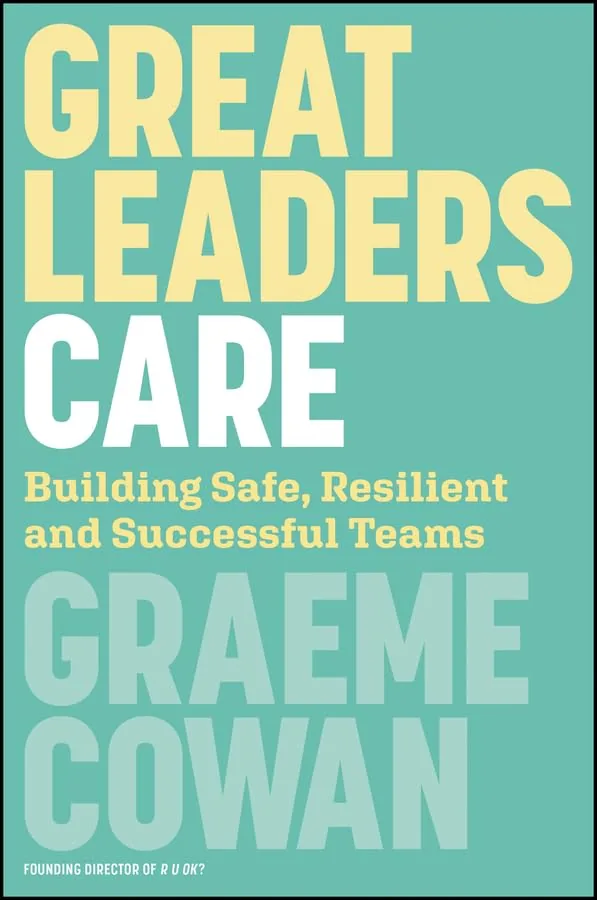
Great Leaders Care: Developing Safe, Resilient and Successful Teams is available from Amazon or Graeme's website.
You can find Graeme at graemecowan.com.au and connect on LinkedIn.
TyAnn Osborn on A Life Aligned


Jo Muirhead on The Entrepreneurial Clinician

Shyam Barr on Educate to Self-Regulate