
Shyam Barr wrote Educate to Self-Regulate to give teachers practical frameworks for building self-regulated learners. Two years of school partnerships later, he talks about the gap between students naming a strategy and actually using it, why changing teaching habits is harder than teaching strategies, and what generative AI means for deciding which thinking to outsource.
Educate to Self-Regulate came out in mid-2024. Looking back at it now, what do you understand about self-regulated learning that you didn't quite understand when you were writing the manuscript?
One thing I understand more deeply now is the importance of modelling self-regulated learning. When I wrote Educate to Self-Regulate, my focus was largely on how educators can develop these capabilities in students. Since then, I’ve increasingly asked: how can we expect young people to become self-regulated learners if we, as adults, aren’t consciously practising it ourselves?
That has shifted my attention from simply teaching self-regulation to helping adults become more self-regulated learners themselves. This means becoming more aware of how we think and learn, the strategies we use, and how deliberately we adapt when things aren’t working. In many ways, that realisation has provided the impetus for my next book (which I'm currently writing), which explores self-regulation well-beyond the classroom as a way of approaching learning, leadership and life.
You built the book around practical scaffolding: chapter summaries, Take Action steps, guidance a teacher can apply on Monday morning. Having since watched schools actually work with it, which parts do educators reach for most, and was there anything you thought would land that didn't?
Educators tend to reach most for the practical frameworks - particularly the NEMO-T model and the specific strategies they can teach students. There’s something powerful about giving teachers and students a shared language for what effective learning actually involves.
What I perhaps underestimated was that knowing the strategies doesn’t necessarily translate into using them. A student might be able to name a strategy, explain when it could be useful, and still not use it when learning becomes difficult. I’ve become much more interested in that gap between knowing and doing - and in how motivation, context and the learning environment influence whether students actually regulate their learning.
So, if anything, the practical elements landed as I hoped. What I understand better now is how much work sits around them.
Your research focuses on teachers' knowledge, beliefs and daily instructional practice, which is a reminder that knowing about SRL and teaching it are very different things. After two years of school partnerships, where does the gap between understanding and practice most commonly open up?
The gap most commonly opens up in the translation from understanding an idea to embedding it in everyday teaching. Most educators I work with quickly see the value of self-regulated learning. The challenge is changing established instructional habits.
It’s relatively easy to teach students a strategy in isolation. It’s much harder to consistently create opportunities for students to make decisions about their learning, explain their thinking, select strategies, monitor their progress and adapt when something isn’t working.
That requires teachers to think differently about their own practice too - when to provide support, when to step back, and how to make the processes of learning more visible. Increasingly, I think the work is less about adding another initiative and more about changing the way we think about teaching and learning in the first place.
The book has travelled further than a book usually does: a TEDx talk, a podcast heard in 40 countries, Project SRL, and now system-level work with Queensland. What did having the book in print make possible that your research papers and workshops alone never did?
The book gave the work a life beyond me. A research paper might reach a particular academic audience, and a workshop reaches the people in the room, but the book has travelled into schools, staffrooms and conversations I had never imagined possible.
It also gave educators something tangible they could return to and share with colleagues. In that sense, the book became a vehicle for knowledge translation - taking a substantial body of research and making it accessible and usable at a scale I couldn’t have achieved through academic papers or individual workshops alone.
Student agency and persistence are under a different kind of pressure now that learners can outsource thinking to a machine. Which arguments in the book feel more necessary because of that shift, and is there anything in it you would now frame differently?
The argument for student agency feels even more important now. With generative AI, learners can increasingly outsource parts of the learning process - generating ideas, solving problems, summarising information or producing a finished product. The question becomes whether they are making deliberate decisions about when technology supports their learning and when it replaces the thinking they actually need to do.
That makes metacognition and self-regulation increasingly important. Learners need to understand the purpose of a task, monitor their own understanding, select strategies deliberately, and judge whether the support they are using is helping them learn.
If I were writing the book now, I would probably frame agency more explicitly in those terms. Self-regulation isn’t about refusing assistance or doing everything yourself. It’s about retaining ownership of the learning process - knowing what to outsource, what not to outsource, and why.
If you were starting the book again, knowing what writing it actually demanded, what would you do differently, and what advice would you give a researcher trying to turn a PhD's worth of thinking into something a busy teacher will finish?
If I were starting again, I’d spend less time trying to include everything I knew and more time thinking about what the reader actually needed.
That would also be my advice to researchers: start with the reader, not the literature. A PhD trains you to demonstrate the depth and comprehensiveness of your thinking, but a busy teacher doesn’t need your entire literature review. They need to understand what matters, why it matters and what they might do differently as a result.
The intellectual rigour still matters enormously. But the challenge is not to prove how much you know or even to simplify the research. It’s to make the complexity useful.
How has writing Educate to Self-Regulate changed the way you think about your own learning?
Perhaps the unexpected consequence of writing the book is that I’ve turned the ideas back on myself. I’ve become much more conscious of how I learn, the environments I create around myself, the strategies I rely on, and the assumptions I make about what works for me.
That has led me to a question I didn’t fully appreciate when writing the first book: if self-regulated learning is so important for young people, what does it look like to practise it deliberately throughout adulthood?
That question now sits at the centre of much of my thinking - and, increasingly, my next book.
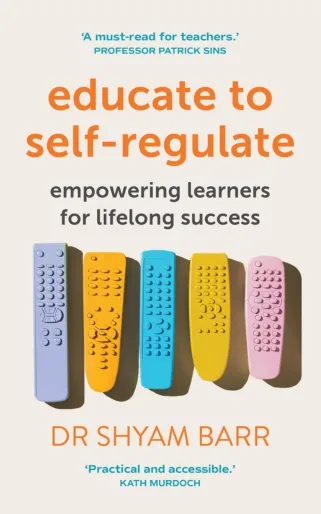
Educate to Self-Regulate is available from Booktopia, Amazon or Shyam's website.
You can find Shyam at shyambarr.com.au and connect on LinkedIn.
TyAnn Osborn on A Life Aligned


Graeme Cowan on Great Leaders Care: Developing Safe, Resilient and Successful Teams
Jo Muirhead on The Entrepreneurial Clinician