
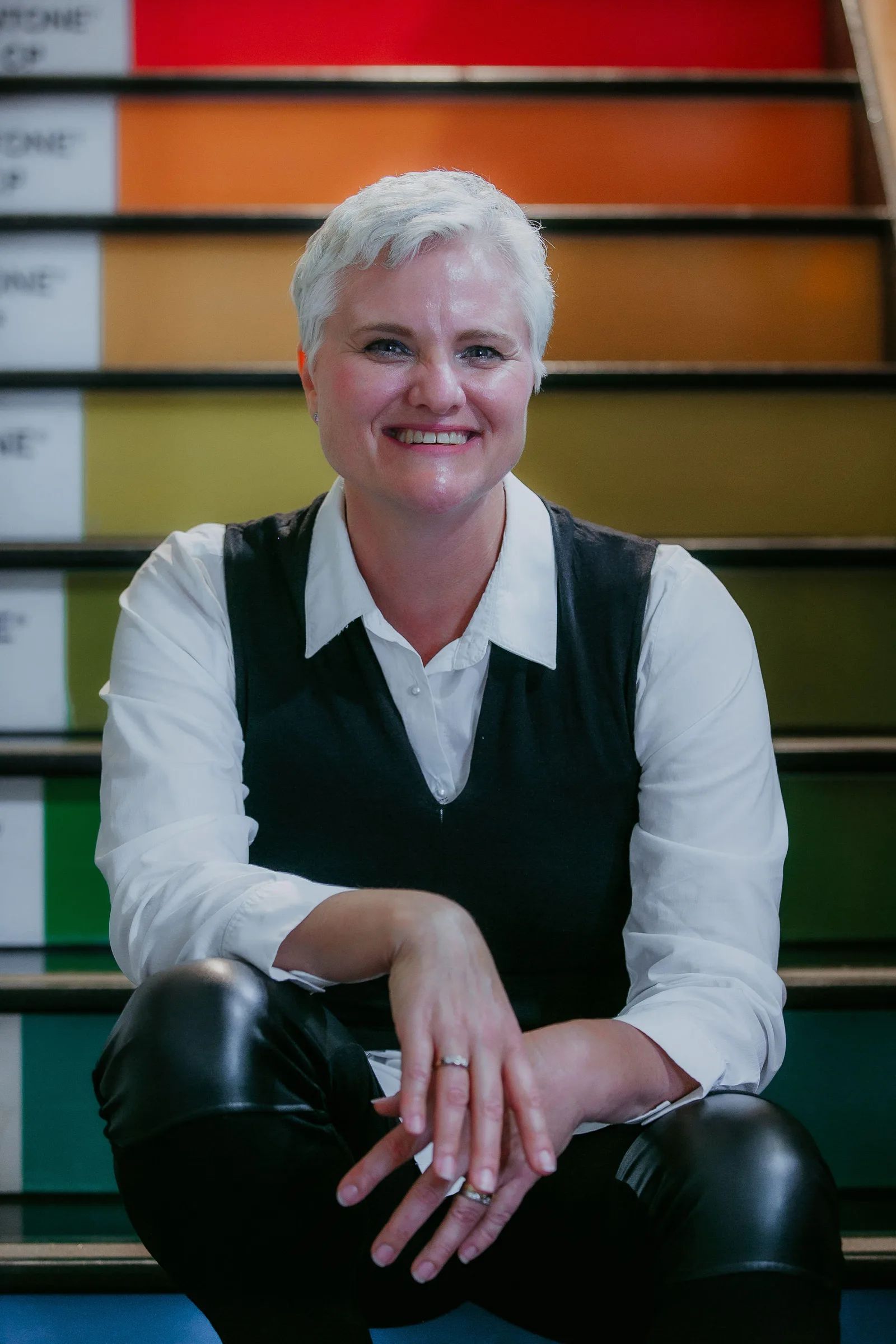
Seven years after The Entrepreneurial Clinician, Jo Muirhead revisits its central advice to build a practice on your own terms, and explains why she now reads undercharging in allied health as a structural signal rather than a confidence problem. She also talks about what selling most of Purple Co in 2024 taught her about whether a practice can stand without its founder.
The Entrepreneurial Clinician came out at the end of 2018 with an argument that health professionals could change healthcare from the inside out by building practices on their own terms. Seven years on, which part of that argument has held up best, and is there anything in it you now read differently?
The part that has held up best is the simplest one. Clinicians can't afford to see business, systems and policy as someone else's job.
In 2018 that was still a slightly uncomfortable idea. Plenty of people felt that caring about money or structure somehow diluted good clinical work. I don't hear that as often now. Most of the clinicians I work with understand that how a service is designed (how it's funded, staffed, paced and measured) shapes the care people receive as much as clinical skill does. If you don't understand those forces, you don't get a say in them.
What I read differently is the word "own" in "on your own terms."
I think the book put a lot of weight on the individual clinician. Build your own practice, set your own boundaries, design the work you want to do. I still believe in all of that. But seven years on, I'm more aware of how much stays outside any one person's control, however well they build.
You can own your practice and still work, in a very real sense, for whoever pays the bill. You can set your own pace and still sit inside a funding model that treats burnout as an acceptable cost of doing business. Again and again, I see systems that don't properly fund or account for something, and then quietly hand that gap to the individual clinician to absorb. Then we call it a resilience problem.
So "inside out" still matters to me. It's just not enough on its own. Change that starts with the clinician has to meet change in the structures around them: how we fund care, what we measure, what we expect people to carry. Otherwise we're asking clinicians to solve, one practice at a time, problems the system created and should be fixing.
I also hold this differently because of my own path. I built Purple Co for fifteen years and sold the majority of it in 2024. I'm proud of what we built. I also know now how much of that work was shaped by conditions I couldn't change, only work around.
If I wrote that book today, I'd still say, "Build something on your own terms." I'd just add: "And then help change the terms."
A thread running through the book, and still through your work, is that clinicians who give people their lives back routinely undercharge for it. Why has that belief proved so stubborn in allied health, and has your explanation for where it comes from changed since you wrote the book?
I think it's stubborn because so many things hold it in place at once.
Some of it is identity. Many of us came into this work because we wanted to help, and somewhere along the way we absorbed the idea that caring about money sits uncomfortably next to caring about people. Charging properly can feel like a betrayal of why we started.
Some of it is training. We spend years learning to assess, treat and support people, and almost no time learning what that work costs to deliver, or what it's worth.
When I wrote the book, I think I placed most of the explanation there. Mindset. Confidence. Our relationship with money. If clinicians could shift how they saw their own value, the pricing would follow.
I still think that's part of it. But I now think it's the smaller part.
In much of allied health, clinicians don't set their price at all. A funder does: an insurer, a scheme, a government program. And undercharging rarely looks like a low fee on an invoice. It looks like unpaid time. The phone call to the employer. The report rewritten three times. The case conference that runs over. The extra session you don't bill because the person isn't ready to finish yet.
That work is real, and it's often what makes the difference to someone's recovery. But the system doesn't fully fund it, and it quietly depends on clinicians absorbing it. Our sense of vocation makes that easier to ask of us. "You're not doing this for the money" sounds like respect. Often it works as a business model.
So my explanation has moved. I used to say clinicians undervalue themselves. Now I'd say we work inside systems that undervalue the work, and we've been taught to take that personally.
That matters because it changes what we do about it. If it's only a mindset problem, the fix is more confidence. If it's partly structural, we also need to get much better at naming the true cost of care and putting it in front of the people who fund it.
Undercharging isn't a character flaw. It's a signal.
Much of your recent writing is about pressure patterns and how people show up when things get hard, rather than pricing, positioning or getting referrals. What did you come to understand about why capable practitioners stay stuck that the book, as you wrote it then, didn't fully account for?
The book assumed that people were stuck because they were missing something. A pricing model. A clearer niche. A better way to get referrals. Give capable practitioners the right information and the right strategy, and they'd move.
Some did. But I kept meeting people who already knew exactly what to do and still weren't doing it. They weren't short of knowledge or intelligence. They were short of capacity.
That's the part I didn't fully understand then. Capable and having capacity are not the same thing.
Most of the practitioners I work with are already full. Full caseloads. Full cognitive load. Full emotional bandwidth. When you're carrying that much, you don't make strategic decisions from a calm, considered place. You fall back on whatever has kept you safe before.
For some people that means taking on more responsibility than is theirs. For others it means holding on to control, or polishing something until it's perfect, or rescuing everyone around them. These patterns are usually the very things that made them good clinicians. Under pressure, they become the things that keep them stuck.
That changed how I work. I spend far less time giving people answers and far more time helping them see how they show up when things get hard. Once someone can recognise their own pattern, the strategy they already knew becomes something they can act on.
I want to be careful here, though, because this can easily turn into another way of blaming the individual. These patterns don't come from nowhere. They form in workplaces and systems that ask too much and recognise too little. Someone who over-functions has usually been rewarded for it, sometimes for years.
So it isn't a choice between "fix yourself" and "fix the system." Seeing your own patterns gives you back some choice inside conditions you can't change on your own. Understanding the conditions stops you mistaking a system problem for a personal failing.
Clarity comes before confidence. And for most capable people, clarity starts with noticing what pressure does to them.
Purple Co has kept growing while you've been coaching other practice owners, so you've been testing the book's ideas on yourself the whole time. What has running your own consulting team taught you that has quietly revised a chapter of the book in practice, even if the page still says what it said?
A small correction first. Purple Co hasn't kept growing in the way the question suggests. In 2024 I sold three-quarters of the business, mainly the private practice side. But that actually makes the question more interesting, because selling a business tests everything you believe about building one.
The chapter that's been quietly revised is the one about [chapter/idea, e.g. building a practice around your vision].
When I wrote the book, I thought about the business mostly from the owner's chair. Your terms. Your values. Your way of working. That made sense, because so many clinicians had spent years building their careers around other people's terms.
Leading a team showed me the other side. Once you employ people, you become the conditions they work in. Your pace becomes their pace. Your pressure becomes their pressure. Whatever you haven't resolved in yourself shows up in your systems, your expectations and how your team experiences their work.
I spend a lot of time talking about systems that shift their costs onto individual clinicians. Running Purple Co, I had to accept that I was that system for my team. Sometimes I got it right. Sometimes I didn't, and I only saw it later.
The sale taught me the rest. When someone looks at buying your business, they aren't buying your vision. They're asking whether it works without you: whether the systems hold, whether the team can lead, whether the quality of care depends on one person being in the room. A practice built entirely on its founder's terms is often a practice that can't continue without its founder.
So if I were rewriting that chapter, I'd still say, "Build on your own terms." But I'd add that the real measure is whether those terms work for the people doing the work, and whether the business can stand without you holding it up.
That's a leadership question more than a business one. It took me a while to see the difference.
If you sat down to revise the book for today's allied health landscape, with everything that has shifted in funding, workforce and the way clinicians actually deliver care, what would you cut, and what would you want to add that wasn't on your radar in 2018?
I'd cut more than people might expect, mostly the tactics. Some of the specific advice on marketing, referrals and setting up a practice was right for 2018, but tactics date quickly. The principles underneath them hold up. The how-to doesn't always.
What I'd add starts with something I understand much better now: systems, economics and cycles.
When you've been in this work long enough, you start to see the same patterns come around again. A scheme tightens costs. Pressure moves down the line to providers and clinicians. Outcomes suffer. There's a review, a reform, a new name for the same approach, and the cycle starts again. In 2018 I was writing mostly about what clinicians could do inside their own practice. Now I'd want them to understand the economic forces shaping that practice, because so much of what feels personal is actually cyclical.
The public-private model is a good example. In Australia, much of allied health sits in an arrangement where the public side holds the control and the private side absorbs the fallout. Government and schemes set the rules, the fees and the expectations. Private providers and their clinicians carry the risk, the unpaid work and the consequences when the system doesn't deliver. I don't think that arrangement serves clients well, and I don't think it serves clinicians well. That needed a chapter in 2018. It needs one more now.
The other thing that wasn't on my radar at all is AI, and it's showing up in three places.
It's showing up before treatment. Many people now look to AI for answers or support before they ever see a clinician, sometimes instead of seeing one.
It's showing up in the treatment room. Clients arrive with AI-generated explanations, plans and expectations, and clinicians are working out how to respond to that thoughtfully rather than defensively.
And increasingly, we're working with difficulties that technology has contributed to: [your example, e.g. isolation, reliance, delayed help-seeking].
None of this replaces good clinical judgement. But a clinician who doesn't understand how people are finding, using and being affected by AI is missing part of the picture.
If the original book was about building on your own terms, a revision would be about understanding the terms you're building within. That's where the real leverage sits now.
Plenty of clinicians now have the tools to produce a book quickly. Having lived with yours for seven years, what do you think a book still has to earn from its author that no shortcut provides, and what would you tell a health professional who is weighing up whether to write one at all?
I'd start with two questions. Is anyone actually reading it? And does reading it change them in some way?
Those are the only tests that matter, and no shortcut passes them for you.
You can now produce something that looks like a book very quickly. But a book that changes how someone thinks has to come from an author who has done the thinking first. You have to know what you believe, why you believe it, and where you might be wrong. That's slow work. It's uncomfortable. It usually means finding out that what you thought was your position falls apart when you try to explain it properly.
That's what a book earns from its author: clarity. Not a polished manuscript. Clarity.
Living with mine for seven years has taught me something else, too. A book holds you to your ideas. People quote it back to you. They ask what you still believe and what you'd change, which is exactly what we're doing now. If you've written something you don't really stand behind, that's a long time to keep defending it.
So my advice to a health professional weighing it up is to be honest about why.
If you want a book mainly as a credential, a business card with a spine, there are faster and less costly ways to build credibility. A book takes real capacity, and most clinicians are already full.
If you have something you genuinely need to say, an idea you keep coming back to that isn't being said well elsewhere, then it's worth it. But do the thinking before the writing. Talk about the idea. Teach it. Test it with the people you hope will read it. Notice what holds up and what doesn't.
The tools can help you write. They can't tell you what you think. That part is still yours to do, and it's the part readers can feel.
Clarity comes before confidence. It also comes before a manuscript.

The Entrepreneurial Clinician is available from Booktopia, Amazon or Jo's website.
You can find Jo at jomuirhead.com and connect on LinkedIn.
TyAnn Osborn on A Life Aligned

Graeme Cowan on Great Leaders Care: Developing Safe, Resilient and Successful Teams

Shyam Barr on Educate to Self-Regulate