

You've been meaning to write your book for months, maybe years. You know your subject. Clients ask the same smart questions. Colleagues tell you, “You should put this into a book.” Then you open a blank document and hit the same problem every expert hits: too much to say, no reliable structure for saying it.
Most templates don't help. They either give you a vague chapter list or they assume you're writing a novel. Neither solves the essential job of a business-led non-fiction book, which is to turn expertise into a clear promise for a defined reader, then deliver that promise chapter by chapter in a way that builds authority and supports lead generation.
Table of Contents
- Start with the reader, not your résumé
- Define the commercial promise of the book
- Build your positioning brief first
- The book blueprint
- The repeatable chapter recipe
- The fillable non-fiction chapter template
- The section-level building blocks
- Phase one and two turn thinking into structure
- Phase three and four make the template do real work
- Phase five prepares the manuscript for handoff
Why Most Writing Templates Fail Expert Authors

Generic templates solve the wrong problem
Most expert authors don't struggle because they lack ideas. They struggle because they have too many. A consultant, founder, academic, coach, or adviser usually starts with years of frameworks, stories, client lessons, workshop notes, and half-finished posts. The blank page isn't the problem. The lack of a decision-making structure is.
That's where most writing book template advice falls apart. It often focuses on fiction plotting, character arcs, or broad chapter prompts. That material can be useful in its own lane, but it won't help a non-fiction author decide what belongs in the book, what should stay out, and how the manuscript should support authority-building once it's published.
This gap matters in Australia. Reedsy's overview of book writing templates is useful context for the broader template offerings, but the stronger commercial point for expert authors is this: IBISWorld estimates book publishing in Australia is a A$1.4 billion industry in 2024, and the ABS reports that 97% of Australian businesses are small businesses, which means a large pool of time-poor operators need structured, outcome-driven non-fiction templates rather than fiction-first planning tools.
A useful template works like a thinking tool
A good writing book template for experts isn't a rigid formula. It's a filter. It helps you test whether an idea deserves a full chapter, whether an example proves the point, and whether a section serves the reader or only satisfies your urge to include everything you know.
A non-fiction template earns its keep when it helps you cut material, not just collect it.
That's why I treat templates less like fill-in-the-box worksheets and more like commercial thinking tools. They should force choices early. Who is this book for? What problem does it solve? What transformation does it promise? What action should the reader take after each chapter?
If you haven't answered those questions yet, chapter planning will feel random. A stronger place to begin is with a positioning lens, especially if the book needs to support speaking, consulting, or service offers. A solid guide to that early thinking is this article on non-fiction book positioning.
Lay the Foundation Before You Outline
Start with the reader, not your résumé
Most weak outlines begin with the author's expertise. They list everything the author could teach, then try to sort it into chapters later. That approach usually creates overlap, repetition, and chapters that feel informative but not decisive.
A stronger start is to define one reader in one situation. Not “business owners” or “leaders”. More specific than that. Think: first-time consultant leaving corporate, allied health practice owner trying to scale, senior executive moving into advisory work, or coach who needs a framework-led book to support higher-trust sales conversations.
Three prompts help here:
- Reader moment: What's happening in their work or life that makes this book relevant now?
- Pain pattern: What do they keep trying that isn't working?
- Desired shift: What do they want to believe, understand, or do differently by the end?
When authors skip this step, they often produce a book that sounds clever but lands softly. Readers don't buy non-fiction to admire your experience. They buy it to solve a problem they can already feel.
Define the commercial promise of the book
Once the reader is clear, define the promise. This is the central change your book will help create. Not the vague topic. The result.
Here's a useful distinction:
- Weak premise: “A book about leadership communication”
- Stronger premise: “A book that helps technical leaders communicate strategic decisions clearly enough to win buy-in across teams”
The second version gives you something to build around. It shapes chapter selection, examples, title options, and later marketing language.
Practical rule: If your book promise can apply to five different audiences, it's still too broad.
This is also the moment to pressure-test your idea against your business goals. Do you want the book to open doors to keynote speaking? Support a consulting niche? Build trust before discovery calls? Generate better-fit leads? You don't need sales language in the manuscript, but you do need strategic alignment underneath it.
If your idea still feels loose, a structured prompt set like these good book ideas examples and exercises can help you separate a topic from a viable authority book.
Build your positioning brief first
Before you write a single chapter heading, create a one-page brief with these fields:
- Working title
- Ideal reader
- Core problem
- Big promise
- What makes your approach different
- Main frameworks or models
- Likely chapter sequence
- How the book supports your broader body of work
This brief becomes the backbone of your template. It stops you from drafting into the fog.
I've seen authors save weeks of rewriting when they pause here. The opposite also happens. They draft three chapters, realise the audience is wrong, and then have to rebuild the entire manuscript from the ground up.
Anatomy of a High-Impact Non-Fiction Book Template

The book blueprint
A strong writing book template has three levels. The first is the book blueprint. This is the strategic layer. It captures the promise, audience, message, sequence, and commercial positioning of the whole manuscript.
The blueprint should include:
- Book promise: What clear result does the reader get?
- Audience definition: Who is the book written for, and who is it not for?
- Core argument: What do you believe that the book will prove?
- Framework inventory: Which original models, methods, or lenses organise the book?
- Chapter path: In what order does the reader need to learn, shift, and act?
This level matters because structural discipline isn't optional in non-fiction. The Australian Publishers Association's industry reporting shows the local trade publishing sector recorded A$1.56 billion in revenue and 65.3 million books sold in the latest reported year, which reinforces why clear structure and market positioning matter for commercially viable books. The same guidance supports a practical rule for experts: each chapter should map to one reader problem, one promise, one framework, and one implementation step. That structure reduces topic sprawl and makes the book easier to position for a defined readership. The supporting reference used for this point is this industry guidance summary.
The repeatable chapter recipe
The second level is the chapter template. Here, most expert authors need the most help.
Each chapter should answer five questions:
- What problem is the reader facing here?
- What promise does this chapter make?
- What framework explains the solution?
- What proof helps the reader trust it?
- What action should the reader take next?
That recipe creates consistency without making chapters sound mechanical. It also helps you avoid a common expert mistake: slipping into broad commentary when the reader needs progression.
For comparison, specialist templates in other fields often work well because they force repeatable evidence and interpretation. A good example is Documind's template for reviews, which shows how much clarity you gain when every section has a defined job. Non-fiction books benefit from the same discipline.
The fillable non-fiction chapter template
Here's a practical version you can copy into Google Docs, Notion, Word, or Scrivener.
| Element | Prompt |
|---|---|
| Chapter title | What is the clearest working title for this chapter? |
| Chapter purpose | Why must this chapter exist in the book? |
| Reader problem | What specific frustration, risk, or gap is the reader facing? |
| Chapter promise | What useful shift will the reader get by the end? |
| Core framework | What model, method, or principle explains the solution? |
| Explanation | How will you teach the framework in plain language? |
| Proof or example | What story, scenario, or demonstration makes the idea credible? |
| Implementation step | What should the reader do immediately after reading? |
| Key takeaway | What sentence captures the chapter's central point? |
| Notes or references | What supporting material belongs here or in the back matter? |
A tool like the book canvas resource can help you draft this at the whole-book level before you lock chapters in.
Keep the chapter template fixed. Let the examples vary.
The section-level building blocks
The third level is the section layer inside each chapter. At this level, drafting gets easier. Instead of asking, “What should I write today?”, you only need to fill the next component.
A practical chapter can be built from these blocks:
- Opening diagnosis: Name the reader's problem in concrete terms.
- Reframe: Show why the problem persists or why common advice fails.
- Framework explanation: Teach the model with clean, simple language.
- Proof block: Add an example, short case, scenario, or contrast.
- Implementation prompt: Turn insight into action.
- Close: Summarise the chapter's lesson and point to the next shift.
That's enough structure to keep momentum without boxing you in. It works especially well for books that need to double as keynote source material, workshop IP, or lead-generation content later.
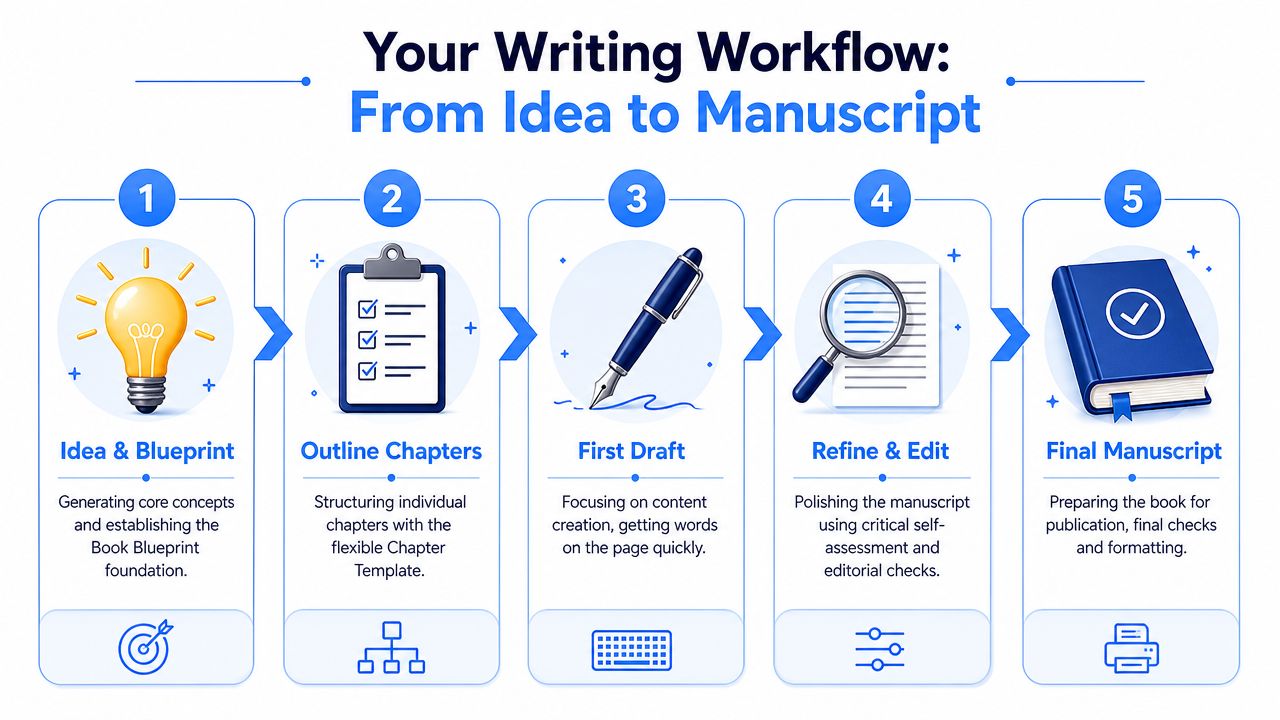
Your Writing Workflow from Idea to Manuscript
A template only helps if it moves with the manuscript instead of sitting in a folder untouched.
Phase one and two turn thinking into structure
In practice, I've found that the most reliable workflow follows five phases that line up closely with the way strong non-fiction books are built: strategy, structure, writing, refinement, and final manuscript preparation.
The first phase is idea and blueprint. In this phase, the one-page positioning brief becomes the master document. You define the reader, the promise, the argument, and the market role of the book.
The second phase is outline chapters. Now the writing book template starts doing visible work. You turn the book blueprint into chapter architecture, making sure each chapter has a purpose and a place in the reader journey. In this phase, weak ideas often reveal themselves early, which is good. Better to remove a chapter from an outline than from a polished draft.
A short walkthrough can help if you want to see a structured process in motion:
Phase three and four make the template do real work
The third phase is first draft. At this point, the template should reduce friction. You're no longer inventing structure every time you sit down. You're filling a known sequence: problem, promise, framework, proof, action.
Many authors overcomplicate things by changing tools too often. Pick a drafting environment and stay with it. Word works. Google Docs works. Scrivener works if you like modular drafting. Notion can help for planning, though many writers still prefer doing final prose elsewhere. If you're comparing options, these writing tool rankings for authors offer a useful starting point.
The fourth phase is refine and edit. The template becomes a quality-control tool here. You review each chapter against the original promise. Is the problem clear? Did the framework earn its place? Did the example prove the point? Is the implementation step practical, or is it decorative?
Drafting is where you discover material. Refining is where you prove the chapter deserves to stay.
Phase five prepares the manuscript for handoff
The fifth phase is final manuscript. This is the handoff stage. Your structure should now support editing, design, indexing, launch planning, and repurposing.
Authors often think the workflow ends when the draft is complete. It doesn't. A usable manuscript has to be coherent for other humans too: editors, proofreaders, cover designers, audiobook producers, and publishing partners. A clean template makes those handoffs much smoother because the logic of the manuscript is already visible on the page.
Essential Checklists to Keep Your Book on Track
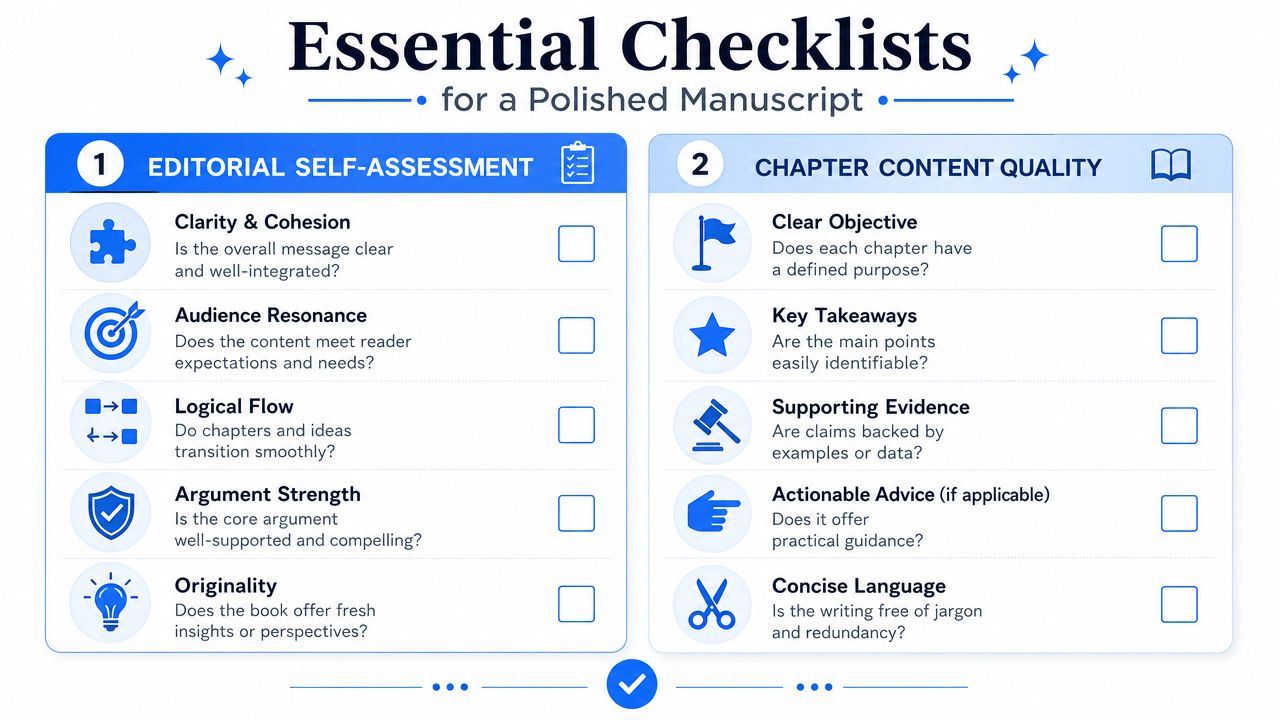
Editorial self-assessment checklist
Good books usually become good through review, not inspiration. Before you send chapters to an editor, run an internal audit.
Use this checklist chapter by chapter:
- Clear objective: Can you state the purpose of the chapter in one sentence?
- Reader relevance: Does the chapter solve a problem the target reader has?
- Distinct role: Does this chapter add something unique, or does it repeat another chapter?
- Framework clarity: Is the central model easy to explain without jargon?
- Proof strength: Have you included an example or demonstration that earns trust?
- Actionability: Can the reader do something concrete after reading?
- Flow: Does the chapter move logically from diagnosis to solution?
- Payoff: Does the chapter deliver the promise it made at the start?
If several answers come back weak, don't just polish the prose. Rebuild the structure.
Editorial note: Line editing can't rescue a chapter that never had a clear job.
Manuscript production checklist
Production problems create unnecessary rework. A solid template reduces that by setting formatting expectations early.
Australian manuscript preparation guidance emphasises planning structure before drafting and using reusable chapter logic. The practical elements commonly recommended include title page metadata, a chapter purpose statement, problem and framework sections, proof or example sections, a summary or action list, and references or notes, which supports easier conversion into proposals, manuscript files, and launch assets. The source used for that production guidance is this Australian writing video resource.
Before handoff, check the manuscript for these production basics:
- Title page details: Author name, working title, subtitle, contact details, and version date are present.
- Consistent headings: Your heading hierarchy is stable from chapter to chapter.
- Paragraph styles: Body text, bullet lists, extracts, and subheads use consistent formatting.
- Chapter components: Each chapter includes its core purpose, main argument, and closing takeaway.
- Front and back matter: You've identified what belongs in the introduction, appendices, notes, and references.
- File hygiene: Version names are clear, comments are managed, and old drafts aren't mixed into the active manuscript.
One practical habit helps more than people expect. Keep a “master template” document for chapters and duplicate it every time you start a new one. That small discipline prevents formatting drift and makes the whole manuscript easier to assess.
Future-Proofing Your Book Template
Treat the template as intellectual property
A book template shouldn't stop being useful once the manuscript is done. If the structure is strong, it becomes a reusable asset across your business.
Each chapter can become something else later:
- Workshop modules: Problem, framework, and exercise turn neatly into session design.
- Keynote outlines: Chapter arguments become speaking segments.
- Lead magnets: A chapter checklist or diagnostic can stand alone as a practical download.
- Course lessons: Repeated chapter logic translates cleanly into lesson flow.
- Audiobook scripting: Structured chapters are easier to adapt for listening.
That's one reason I prefer practical chapter architecture over loose essay-style books. Repurposing gets easier when each chapter has a known promise and a visible internal logic.
Design for AI, collaboration, and accessibility
Modern workflows put new pressure on the template. Drafts may involve AI assistance, multiple collaborators, cloud editing, accessibility review, and publication across print, ebook, and audio.
That isn't a fringe concern. Template guidance often misses these realities, yet they matter in Australia. The ABS reported that 21% of people aged 15 to 74 with disability had difficulty using the internet in 2022, and reporting in 2024 also highlighted rapid uptake of generative AI tools in Australian workplaces, alongside uneven governance and uncertainty around safe use. The reference tied to that combined point is this background article on outlining.
A future-proof writing book template should account for that from the start:
- AI use rules: Decide what AI can help with, such as brainstorming or summarising, and what requires your own judgement and voice.
- Version control: Name files clearly and keep one source of truth when collaborators are involved.
- Accessible drafting: Use clean heading hierarchy, descriptive labels, readable formatting, and plain language where possible.
- Format awareness: Write with print, digital, and audio adaptation in mind. Dense tables, visual-only explanations, and unexplained graphics create avoidable problems later.
The best template isn't the most elaborate one. It's the one that still works when the manuscript leaves your laptop and enters the world.
If you want structured support to turn your expertise into a commercially clear non-fiction book, Expert Author Community (EAC) offers coaching, feedback, accountability, and a proven method to help experts, consultants, coaches, and business owners move from idea to finished manuscript.

Find Your Non-Fiction Book Purpose: A Strategic Guide


Your Non Fiction Book Purpose: From Idea to Impact

7 Author Bio Examples to Build Authority in 2026