
You've got the idea. You may even have the chapter notes, the stories, the framework, and a rough sense that your book could open doors for your business. But if the manuscript still feels slippery, sprawling, or hard to pitch, the problem usually isn't effort. It's purpose.
That's the point where many expert authors stall. They know their field well, but they haven't yet made the harder strategic decision: what, exactly, is this book meant to do for the reader and for the author's body of work? Until that's clear, everything stays fuzzy. The structure bloats. The promise weakens. The marketing becomes generic.
A strong non fiction book purpose gives the project a job. It tells you what belongs, what doesn't, and what kind of change the reader should be able to make because they read it.
Table of Contents
Why Your Book's Purpose Is Your Most Critical Decision
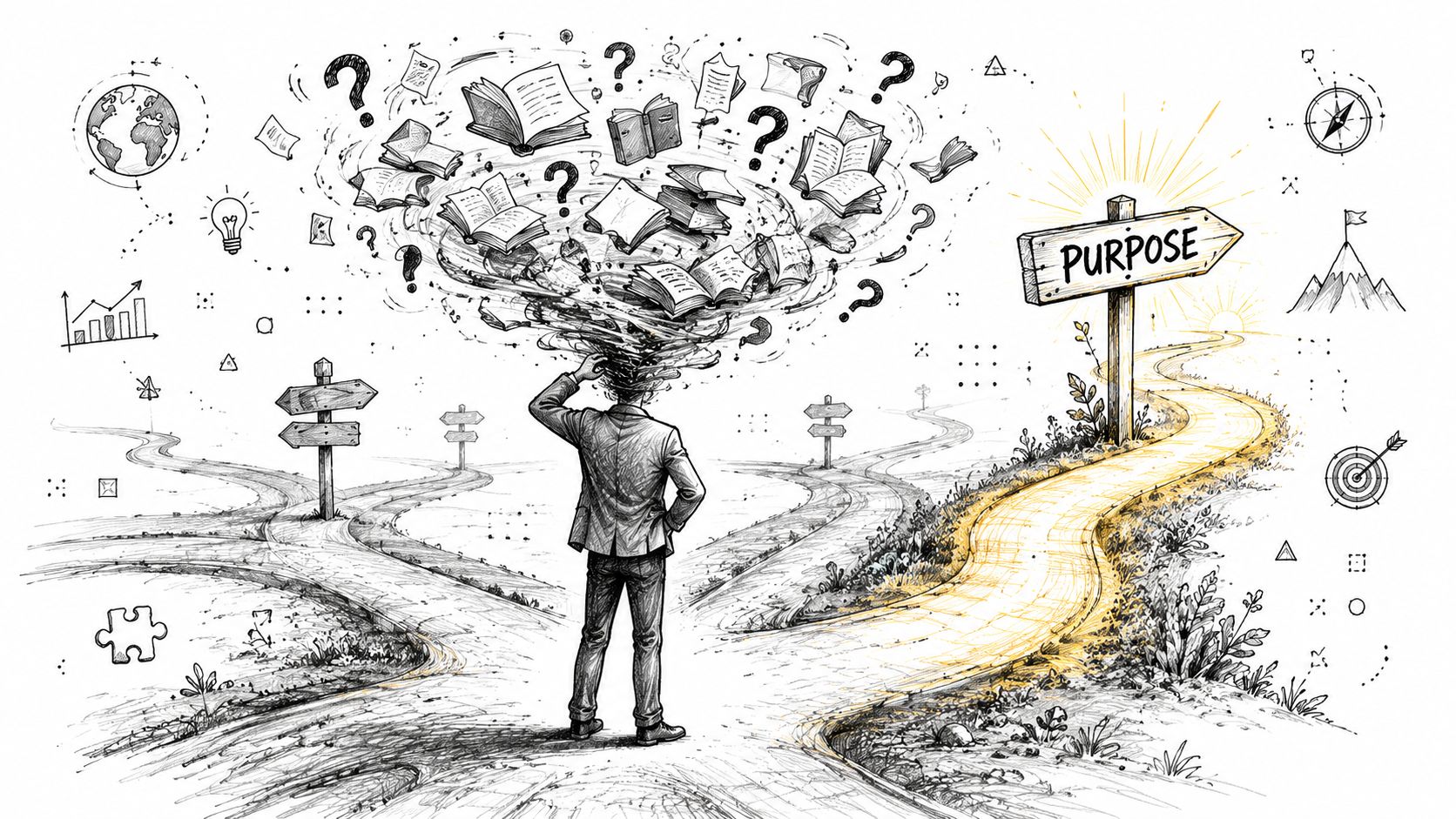
Most expert authors start with a topic. Leadership. Burnout. Team culture. Advisory sales. Change management. The topic matters, but it isn't enough. A topic tells people what the book is about. Purpose tells people why the book needs to exist.
That difference affects every decision that follows. If your purpose is vague, your outline usually becomes a storage unit for everything you know. If your purpose is clear, the manuscript starts behaving like a tool. It has shape. It has sequence. It earns the reader's attention.
In Australia, clarity matters more than many authors realise. A 2021 ABS report found that 93.3% of people aged 15 to 74 had literacy adequate for daily life, while 53.3% scored below the “proficient” level. That gap helps explain why practical, well-structured non-fiction can carry real authority when it translates expertise into accessible guidance, as noted in these Australian reading and literacy statistics.
Purpose is the decision behind the book
A useful way to test your thinking is this: if someone asked what your book changes, could you answer in one sentence without describing your whole industry?
Practical rule: If your answer needs five examples before it makes sense, the purpose still isn't sharp enough.
You can see this in strong instructional books across many industries. A practical business resource like this guide to starting your event company works because it has a visible job. It helps a specific reader move from uncertainty to action. It doesn't try to cover every possible adjacent issue just because the author knows them.
When authors skip this decision, three problems show up fast:
- The structure wanders because chapters are organised by what the author knows, not by what the reader needs next.
- The promise gets diluted because the book tries to teach, inspire, persuade, and memoir its way through the same manuscript.
- The positioning weakens because readers can't tell whether the book is for immediate application, broad thought leadership, or personal reflection.
A non fiction book purpose isn't a tagline. It's the operating brief for the project.
What Is a Non-Fiction Book Purpose Really
A non-fiction book purpose sits at the intersection of three things. What the author knows. What the reader needs. What change the book is designed to create. If one of those is missing, the manuscript usually feels either self-indulgent, overly generic, or commercially muddled.
That's why “I want to write a book about collaboration” isn't yet a purpose. It's a subject area. A purpose sounds more like this: “I want small business leaders to understand why their teams aren't working well together, and to leave with a clearer way to diagnose and improve team dynamics.” That statement creates boundaries. It tells you what kind of examples belong. It tells you what doesn't.
Topic is broad. Purpose is directional.
Emma Kirkwood's early concept is a useful example from the EAC community. Her initial proposal centred on building collaborative teams for small businesses, with steps readers could move through non-linearly. That's a solid starting idea, but it still leaned heavily on delivery format rather than the deeper reader need.
After feedback, she reworked the purpose. The manuscript shifted away from being only a playbook of team-building steps and towards addressing broader challenges and gaps in team dynamics. That change sounds small on paper. In practice, it changes almost everything. The book's central argument becomes clearer. The audience fit improves. The material can be selected around a sharper thesis instead of a loose cluster of related advice.
A good purpose doesn't just describe content. It decides the reader's destination.
You can test whether you've got a real purpose by checking for these qualities:
- A defined reader who can recognise themselves in the problem
- A clear tension the book is trying to resolve
- A practical or intellectual outcome the reader should gain
- A visible lens that shows why you are the person writing this book
Credibility now depends on disclosed perspective
A lot of advice about book purpose focuses on branding. That's too narrow. Readers also want to know how the author sees the world, what assumptions sit behind the advice, and whose viewpoint may be absent. The NCTE explicitly recommends that readers ask “Who wrote this book?”, “Why did they write it?”, and “Who is missing?” in its position statement on the role of nonfiction literature.
That matters for business and expert authors. If your book presents one method, one framework, or one interpretation, say so. If your experience comes from consulting with founders rather than working inside government, say so. If your process works best in small teams rather than large regulated environments, say so.
That kind of transparency strengthens authority. It doesn't weaken it.
Exploring the Four Primary Types of Book Purpose
Most expert books blend several aims, but one purpose usually leads. If you don't identify the lead purpose, the manuscript starts competing with itself. One chapter teaches. The next argues. Another drifts into memoir. The reader feels the confusion even if they can't name it.
The four primary types below offer a practical way to identify your book's dominant job.
The Four Primary Non-Fiction Book Purposes
| Purpose Type | Primary Goal | Example Book Concept |
|---|---|---|
| Teach | Help the reader apply a skill, process, or framework | A consultant's guide to running better strategy workshops |
| Persuade | Shift the reader's thinking about a problem or approach | A book arguing that most leadership issues are really system design issues |
| Inspire | Move the reader towards courageous action or renewed belief | A book for experienced professionals rebuilding confidence after career disruption |
| Chronicle | Share a journey or body of experience to reveal a broader truth | A founder's story about growing a business and what it taught them about decision-making |
How each type behaves on the page
A teaching book needs sequence, clarity, and examples. It often works best when each chapter solves one part of the larger problem. Readers want practical movement. If the author spends too long proving they're credible instead of helping the reader act, the book slows down.
A persuasion book relies on a strong thesis. It doesn't just explain a subject. It challenges a prevailing belief, offers a reframing, or introduces a different lens. These books need careful logic. If they become too abstract, readers may agree in principle but never know what to do next.
An inspirational book often draws power from voice, lived experience, and emotional honesty. These books can be invaluable, but they still need discipline. Encouragement without a clear destination turns into uplift with no traction.
A chronicle book records a journey, but its real value comes from interpretation. The reader isn't there only for the sequence of events. They're there for meaning. If the author doesn't connect the story to a larger truth, the book stays personal rather than becoming resonant.
When a manuscript feels “almost right” but not quite coherent, the lead purpose is often either mixed up or undeclared.
A few decision cues help here:
- Choose Teach if readers mainly need a method they can apply.
- Choose Persuade if your strongest contribution is a reframing.
- Choose Inspire if the reader's main obstacle is courage, belief, or momentum.
- Choose Chronicle if the lived journey is the most powerful vehicle for the truth you want to share.
You can include elements from the others. The mistake is trying to give them equal weight.
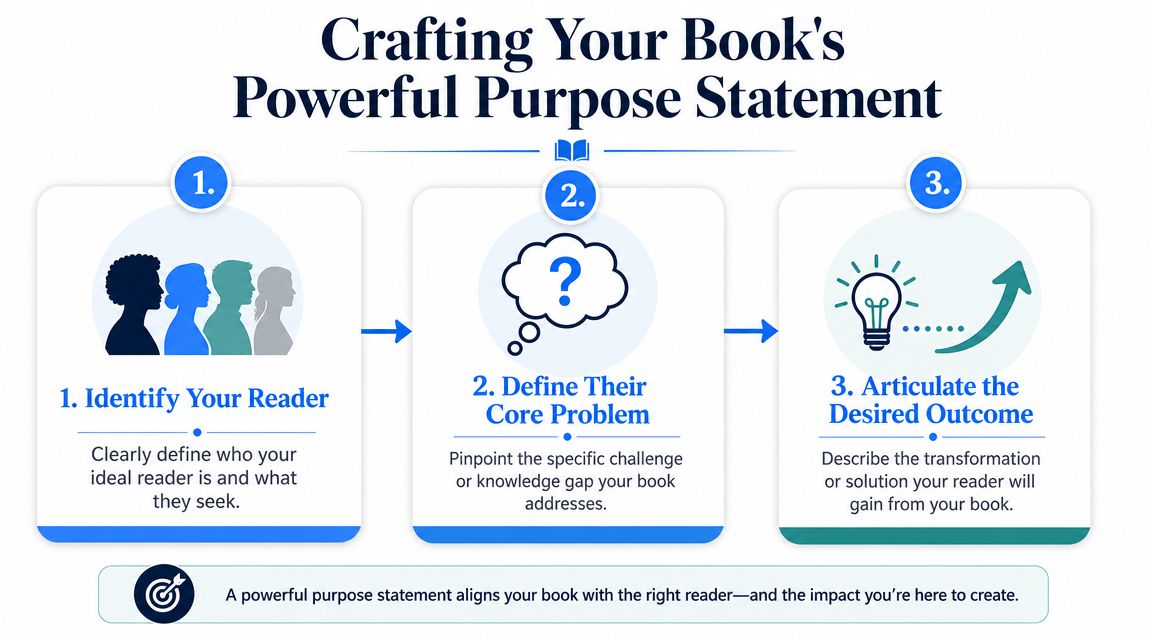
How to Craft Your Powerful Purpose Statement
A strong purpose statement doesn't need to sound grand. It needs to be usable. It should help you cut chapters, write a sharper proposal, and explain the book without circling around your own idea.
One of the fastest ways to get there is through the coaching prompts that surface urgency, loss, and repeatable value.
Start with the question that carries emotional weight
These three prompts are especially effective:
What keeps you up at 3am that you wish someone had explained to you years ago?
This usually reveals the underlying tension behind the book. Not the polished conference version. The actual problem that still feels costly, frustrating, or unfinished.If this idea stays stuck in your head forever, what gets lost?
This exposes stakes. Sometimes what gets lost is practical knowledge. Sometimes it's a way of naming a problem people struggle to articulate. Sometimes it's a body of hard-won judgement that younger practitioners need.What do you say in coaching sessions that you wish was already in a book?
This helps uncover material that's already tested in practice. If clients repeatedly stop, argue, get relief, or take action at the same point in your process, there's probably a book-worthy core there.
A useful companion exercise is to review examples of good book ideas for experts and practitioners and notice which ideas carry a visible reader outcome rather than just an interesting subject.
For authors who think best by listening, this short video can help loosen the language around the idea before you formalise it.
Turn raw insight into a usable statement
Once you've answered the prompts, don't try to write jacket copy. Write a working sentence.
Use this template:
This book helps [specific reader] understand or solve [specific problem] so they can [clear outcome], through [your distinctive lens, method, or perspective].
Here are brief real-world style responses to those prompts:
3am question response
“Why capable teams still avoid hard conversations until the damage is already visible.”What gets lost response
“A practical language for team dysfunction that doesn't shame people or hide behind jargon.”What I keep saying in coaching response
“Collaboration isn't built through more goodwill. It's built through clearer expectations, better decisions, and safer conflict.”
That could become a purpose statement like this:
This book helps small business leaders diagnose hidden breakdowns in team dynamics so they can build healthier, more effective collaboration through clearer conversations, decision rules, and shared responsibility.
Write the statement. Then test every chapter against it.
If a chapter doesn't serve the sentence, it probably belongs in a talk, newsletter, client workshop, or your second book.
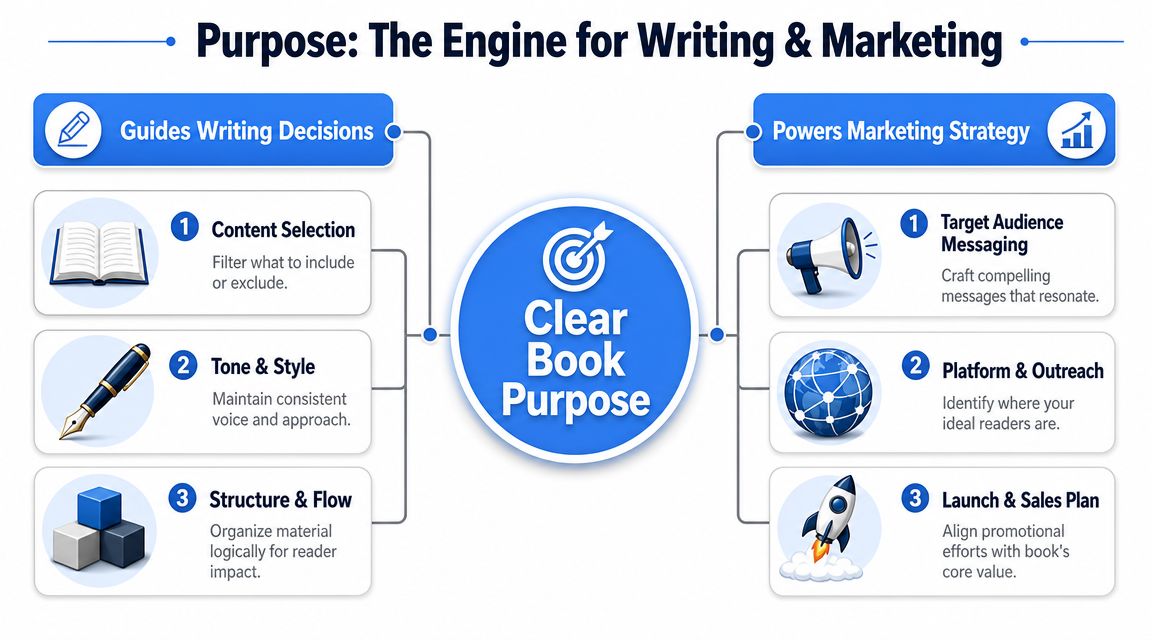
How a Clear Purpose Drives Your Writing and Marketing
A business author gets 25,000 words into a manuscript and hits a wall. The chapters are strong on their own, but the book is trying to do four jobs at once. It wants to prove expertise, bring in leads, open speaking doors, and say something meaningful. That is usually the moment purpose stops sounding abstract and starts acting like a commercial decision.
Purpose changes the manuscript itself
A clear purpose cuts revision time because it gives the author a standard for what stays, what moves, and what gets dropped.
I see this in business books all the time. An author starts with a broad promise because broad feels safer. Then the draft sprawls. Case studies overlap. Chapters repeat the same lesson in different language. The book becomes harder to finish because every section can still argue for its place.
Emma Kirkwood's project is a strong example. Once the purpose shifted from a general book about collaborative teams to a sharper examination of the hidden gaps behind team dynamics, the manuscript changed shape. The chapter sequence tightened. The examples became more selective. The tone became more confident because the book no longer had to serve every possible reader with a people problem.
That is the trade-off. A narrower purpose excludes some material. It also makes the right material stronger.
Justin Clarke and Chloe Temple went through a similar refinement in coaching conversations around their proposals. The practical gain was not theory. It was speed. Once the book had a defined job, decisions that had been lingering for weeks became easier to make. Authors stop debating every chapter when the purpose gives them a clear filter.
The same discipline shows up in adjacent fields. These ClipCreator.ai content insights explain how a defined strategic intent improves selection and sequencing. The medium is different, but the working principle is the same. Clear purpose creates consistency.
Purpose also decides the book's commercial job
Many expert authors get themselves into trouble. They say the book is for impact, but they expect it to generate consulting leads. Or they say it is for authority, but they structure it like a short tactical giveaway. Readers feel that mismatch quickly.
A business book can support several outcomes, but one outcome has to lead. Authority books usually need stronger ideas, more context, and a point of view worth quoting. Lead generation books usually need a faster path from problem to action, with language that mirrors what a buyer is already trying to solve. Impact-driven books often ask for a broader emotional and intellectual reach, even when that means sacrificing some direct conversion value.
That distinction is part of non-fiction book positioning for expert authors. Positioning is not a layer you add after the draft. It starts with the purpose because purpose decides what kind of promise the market can believe.
Steve Pratt's Earn It shows the commercial value of that alignment. The book did not chase an easy, mass-market promise. It committed to a harder message about effort, discipline, and creative honesty. That choice shaped the voice, the expectations it set, and the readers it attracted. It was a stronger authority move because it was willing to be specific about what it believed.
Authors who get this right write better books and market them with less friction. The message on the cover matches the message in the keynote, the podcast interview, the lead magnet, and the sales conversation.
That coherence is what purpose buys you.
Your Next Steps to Defining a Purpose with Impact
Purpose rarely arrives fully formed. Most authors find it by drafting, testing, cutting, and refining. That isn't a sign the idea is weak. It's part of the work.
What matters is that you stop treating purpose as a nice introductory sentence for the proposal. It's a strategic decision. It governs the reader promise, the structure, the tone, and the commercial role of the book. Without it, even strong material can feel scattered. With it, the manuscript becomes easier to write and easier to use.
A simple way to move today
Take the three prompts from earlier and answer them in plain language. Don't try to sound clever. Aim for honest and specific.
Then draft one sentence using the template. After that, review your current outline and ask three hard questions:
- Which chapters directly support the promised outcome
- Which chapters are interesting but not necessary
- Which parts reveal my real perspective and limits clearly enough
If you're still in the idea stage, sketch the project visually in this book canvas resource. It helps turn a vague concept into a more workable book plan.
Expect refinement, not perfection
Authors such as Emma Kirkwood, Justin Clarke, and Chloe Temple illustrate the same underlying truth. The first version of the idea is rarely the final one. Feedback sharpens purpose because other people can hear the drift that authors often miss in their own material.
That's worth remembering when the project feels messy. You don't need a perfect purpose statement on day one. You need one clear enough to start making better decisions.
A non fiction book purpose with impact does two things at once. It serves the reader with clarity, and it gives the author a sharper, more defensible position in the market.
If you're shaping a serious non-fiction book and want help refining its purpose, structure, and commercial role, Expert Author Community (EAC) offers a practical environment for that work. It supports experts, consultants, coaches, and business owners through book strategy, writing, publishing, and positioning so the manuscript doesn't stay as a good idea with no clear job.
7 Author Bio Examples to Build Authority in 2026

Non-Fiction Book Positioning: Find Your Unique Angle

Thinking About Writing a Parable or Business Fable? Here’s What to Know First