
Most authors treat the bio like admin copy. That's the gap. If your bio only says who you are, it's underperforming. A strong author bio can help a non-fiction book earn trust faster, support speaking enquiries, reinforce your positioning, and move the right reader towards the next step.
That matters because a bio isn't just a byline anymore. Publishing guidance increasingly treats it as a brand asset, one that can include qualifications, career history, prior publications, and even audience signals such as platform size, with social handles becoming especially relevant once an author has grown beyond about 20,000 followers. For experts, consultants, and operators writing non-fiction, that shift changes the job of the bio completely.
You also need different versions. Industry guidance commonly recommends a short bio of about 1 to 2 sentences and around 50 words or under, while a longer bio can run 2 to 3 paragraphs and up to 250 words. That's why generic author bio examples often fall flat. They ignore context.
If you want a stronger digital footprint around your author identity, this bio page backlinks tutorial is a useful companion.
Table of Contents
1. Meet Our Authors | EAC
If you want author bio examples that feel usable, not theoretical, start with Meet Our Authors at Expert Author Community. It works because the profiles are brief enough to scan quickly, but specific enough to show how real experts position authority in public.
This isn't a page of celebrity bios or polished jacket copy written for mass-market fiction. It's a live gallery of consultants, coaches, executives, and business owners presenting their expertise in a way that supports books, speaking, and professional credibility. For non-fiction authors, that's far more relevant.
Why it stands out
The strongest pattern on the page is simple. Each profile tends to combine a clear role, a subject focus, and a reader-facing value statement. That mirrors broader guidance on effective bios: industry advice commonly recommends that web bios stay in the 50 to 100 word range and lead with trust markers such as job title, years of experience, published work, and relevant degrees.
You can see those decisions in action across different niches without having to translate from novelist examples or US-centric celebrity branding. If you're refining your own positioning, that matters more than abstract theory.
Practical rule: Steal structure, not wording. When a profile works, note the order of information. Role first, topic second, proof third, personal detail last.
There's also real value in the variety. Some profiles lean heavily on executive authority. Others lean on practitioner credibility, lived experience, or a niche outcome. That range helps you answer a question most roundups skip: which credibility signals matter for your kind of non-fiction book?
Best use case
This is the page I'd use when an author says, “I know my subject, but I don't know how to say it without sounding stiff.” The short profiles show how to sound credible without drifting into inflated language.
Its limitations are also clear. The entries are intentionally concise, so you won't get deep backstory, full publishing histories, or advanced filtering by niche. But for swipe-file value, it's strong. If you want to see more of how the community presents its authors, the broader EAC authors page is worth reviewing alongside it.
Pros
- Authentic examples: Real member profiles with headshots and headline-style taglines feel more useful than invented templates.
- Wide niche coverage: Consultants, coaches, executives, and founders appear across different authority models.
- Fast to scan: You can compare positioning approaches in minutes.
- Dual purpose: It works both as inspiration for your bio and as evidence of how an author community presents outcomes.
Cons
- Short by design: Great for inspiration, less useful if you want deep case studies.
- Scroll-based format: Easy to browse, less efficient if you want search or filters.
2. Kindlepreneur
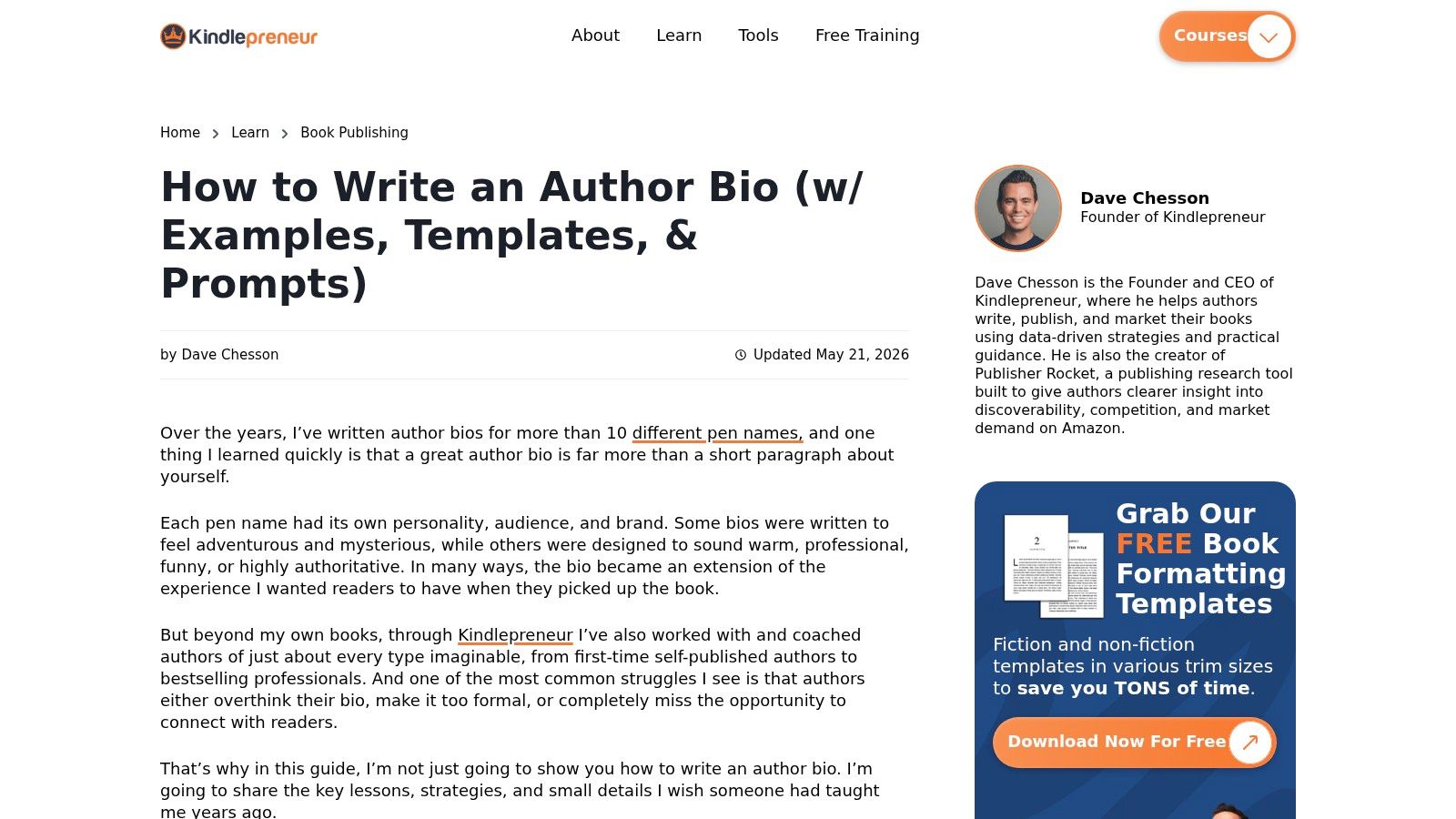
Kindlepreneur's author bio guide is one of the cleanest practical resources for authors who need multiple versions fast. It's especially useful when your immediate concern is retail pages, book jackets, and author websites rather than broader thought-leadership positioning.
What I like is the level of scaffolding. Some bio guides tell you to “show credibility and personality” and stop there. Kindlepreneur gives enough structure that you can draft without staring at a blank page.
Where it helps most
This is a strong option if your bio needs to support a book launch. The templates help you distinguish between short, standard, and longer versions, which is where many authors blur contexts and end up with a bio that's too long for a retailer page and too thin for a website.
It's also useful when you're still clarifying your book idea. A weak bio often reveals a weak positioning statement. If that's where you are, this guide pairs well with EAC's thinking on what makes a non-fiction book idea commercially strong.
A good bio doesn't list everything you've done. It selects the proof that makes this book believable.
The trade-off is audience fit. Kindlepreneur leans more towards indie and self-publishing contexts, so consultants and executives writing authority books may need to adapt the examples. You'll still get a solid framework, but you may need to sharpen the B2B angle yourself.
Pros
- Step-by-step drafting help: Good prompts and usable sentence structures.
- Strong retail focus: Helpful for Amazon, jacket copy, and author-site basics.
Cons
- Indie tilt: Better for book-market execution than for corporate or advisory positioning.
- Less B2B nuance: Fewer examples suited for consultants and senior operators.
3. Chapter
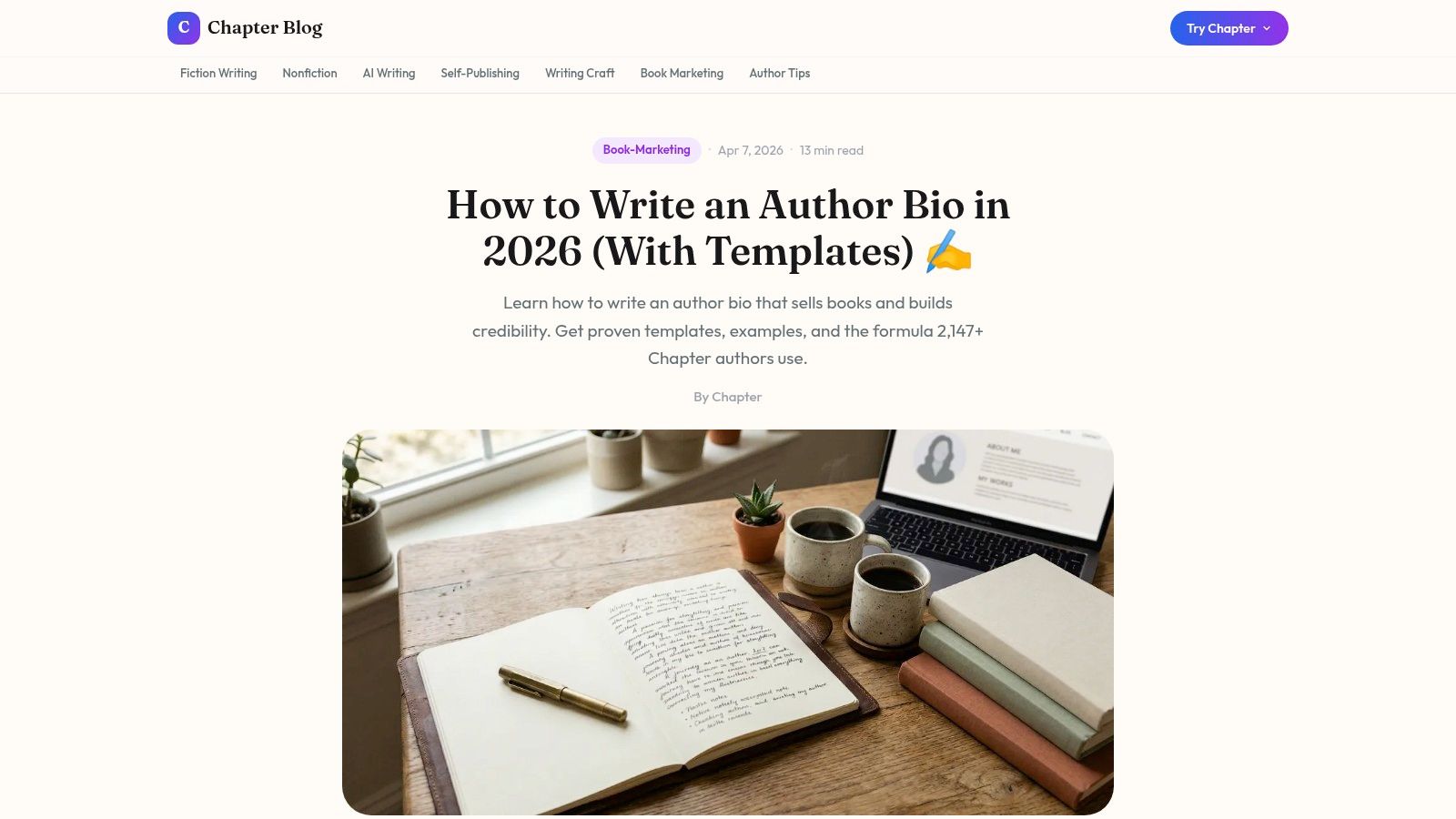
Chapter's author bio guide is a practical choice for experts who need one clear framework they can adapt across formats. It does a good job of separating a short bio from a fuller About page, which matters if you are writing for a LinkedIn profile, a book jacket, a speaker intro, and your website at the same time.
That format awareness is where many author bio guides fall short. They give one generic template and leave you to force it into every context. Chapter is more useful than that. It recognises that each version has a different job, and your credibility needs to be shaped around that job.
For non-fiction authors, consultants, and subject-matter experts, that is a strong starting point. A short retailer bio needs a fast proof point. A speaker bio needs authority and relevance to the audience. A website About page can carry more narrative and personality. If you miss those distinctions, the bio often turns into a compressed CV with no clear purpose.
What makes it useful
Chapter is especially helpful for first-time authors with real expertise but limited author credentials. If you have not published before, you still need to show readers why they should trust you. The guide gives workable ways to foreground professional experience, client work, lived experience, or research focus without sounding defensive about what is missing.
I also like its restraint. Some bio advice pushes authors to cram in every achievement they can justify. Chapter nudges you towards selectivity instead. That usually produces a stronger result because relevance beats volume.
- Short bio use: Well suited to profile boxes, podcast guest pages, conference listings, and online retailer summaries.
- Long bio use: Better for your website About page, media materials, and the author page inside a non-fiction book.
- Drafting help: Useful sentence structures for authors who know their expertise but struggle to phrase it clearly.
The trade-off is depth. Chapter gives you clean guidance and usable examples, but it offers less annotated analysis than a strategist would want. If you are trying to build authority across five different bio formats and tie each one to a business goal, you will still need to make those decisions yourself.
That said, it is a solid resource for getting the core architecture right first. Once the structure is sound, it is much easier to tailor the same foundation for social profiles, book back covers, speaker packs, and client-facing pages without losing credibility or voice.
4. SelfPublishing.com
SelfPublishing.com's About the Author resource is one of the better choices if you see the bio as a conversion asset, not just an identity statement. It gives more attention to what the bio should do after trust is established.
That's useful for experts selling services, workshops, speaking, or advisory work from the back of a book. A non-fiction bio should often point somewhere. Not with hype, but with direction.
Best for conversion-minded bios
This guide is strongest when you're writing for the back matter or About the Author page inside the book. Those placements give you a little more room to connect credentials with a next step, whether that's a website, newsletter, media contact, or speaking enquiry.
I also like that it encourages authors to study what changes between fiction and non-fiction examples rather than assuming one formula works for all. For business and authority authors, that usually means stronger emphasis on proof, positioning, and reader benefit.
If your book supports a business, your bio should make the bridge visible.
The limitation is obvious. Some examples come from highly established authors, so debut experts need to translate the lesson rather than imitate the surface. Still, the core advice holds up well: stack relevant credibility, keep the tone aligned to the book, and give the reader a sensible next move.
Pros
- Business-friendly lens: Helps you treat the bio as part of your offer ecosystem.
- Useful analysis: Better than many roundup posts at explaining why an example works.
Cons
- Longer-format bias: Less useful for very short speaker intros or social bios.
- Big-name examples: You may need to adapt the logic to a smaller platform.
5. Foglio Print
Foglio Print is useful for authors who need a cleaner, more readable bio fast. Its examples favour clarity over performance, which makes this a good reference when your draft has drifted into autobiography.
That matters more than many experts realise. A bio is not a storage unit for every qualification, media mention, and career step. It is a positioning tool. The job is to help the right reader understand who you help, why your perspective carries weight, and what kind of book or expertise they are about to trust.
Where it helps most
I would point non-fiction authors here when the core problem is focus. Consultants, coaches, subject-matter experts, and first-time authority authors often have enough credibility. What they lack is selection. Foglio Print pushes toward a tighter structure built around role, relevance, and reason.
Its strongest lesson is narrative control. Instead of listing background in chronological order, shape the bio around the detail that best explains the book. Sometimes that is a professional role. Sometimes it is a specific experience that gave the author unusual insight into the problem they solve.
That approach works well across several formats in this article's framework, especially book jacket bios and About the Author pages. It is less useful for short speaker intros or social bios, where compression matters more than story.
A few ideas here transfer well:
- Start with the most relevant identity: Lead with the role that supports the book's promise.
- Choose one meaningful origin point: Include the experience that explains why this topic matters to you.
- Connect the author to the reader's outcome: Show how your background relates to the problem the book addresses.
- Keep the voice consistent across formats: Your jacket bio, website bio, and retailer profile should feel like versions of the same person.
The trade-off is scope. Foglio Print helps with writing decisions, but it offers less guidance on strategic adaptation across business goals. If you need one bio for a back cover, another for a speaker page, and a third for a media kit, you will still need to adjust the emphasis yourself. That is exactly why comparing examples by format matters. A strong bio is not just well written. It is fit for purpose.
6. Apex Authors
Apex Authors on better author bios is built for professionals who need a repeatable pattern. If you write bios for retailer pages, podcast guest sheets, event listings, and media kits, that pattern-based approach is a strength, not a weakness.
Many experts don't need more inspiration. They need a reliable sequence that stops them from overexplaining. Apex Authors does that well.
Where it earns its place
The core structure is practical: positioning line, proof points, human detail, single CTA. That sequence works especially well for consultants, executives, and founders because it forces a hard decision about what belongs in the bio and what belongs elsewhere on the site.
I'd choose this resource when someone has too many credentials and no hierarchy. Bio clutter usually comes from trying to make every achievement carry equal weight. A pattern like this makes you rank your proof.
Strong bios don't sound impressive by accident. Someone chose what to leave out.
The trade-off is that you get fewer fully developed examples than in some other guides. It's better as a drafting framework than as a swipe file. Even so, for press-ready consistency across platforms, it's a useful reference.
Pros
- Cross-platform logic: Works well across books, websites, speaker pages, and PR materials.
- Prevents bloat: The structure helps you foreground the right proof quickly.
Cons
- More pattern than prose: Better for builders than for people who want finished templates.
- Not the newest dated guide: Still useful, but not as current in presentation as some newer posts.
7. Search Engine Journal
What should an author bio do once it leaves the book jacket and starts working on your website?
Search Engine Journal's guide to author bios answers that question well. It treats the bio as part of a credibility system that includes author pages, internal links, topical relevance, and visible expertise. For non-fiction authors, consultants, and subject-matter experts, that framing matters because a website bio often has a harder job than a back-cover bio. It needs to support trust, search visibility, and conversion at the same time.
That makes this resource a strong addition to a framework like this one, which compares bios across different formats rather than treating every example as interchangeable.
Where it earns its place
Search Engine Journal is most useful when your bio needs to carry authority in a digital setting. I recommend it to authors whose book supports a consulting business, speaking pipeline, training offer, or expert-led brand. In those cases, the bio is not just descriptive copy. It helps visitors decide whether you are credible enough to read, hire, quote, or book.
Its strongest contribution is context. The article shows that a good website bio depends on more than a polished paragraph. Placement, supporting links, and a clear author page all shape how your expertise is understood.
For non-fiction experts, that is the trade-off. A short, elegant bio can read well and still underperform if it sits on a weak page with no proof, no pathway to related content, and no clear connection to your core topic.
If your book feeds a bigger authority strategy, sort out your message first. EAC's guidance on non-fiction book positioning is a useful companion because positioning determines which credentials belong in the bio, which belong on the page, and which should be left out.
Pros
- Strong web-first perspective: Useful for experts who need bios that support search visibility, trust, and lead generation.
- Good implementation detail: Goes beyond wording and examines page structure, authorship signals, and supporting context.
Cons
- Less helpful for book retail copy: I would not use this as a primary model for a back-cover or retailer bio.
- More digital than literary: Authors looking for stylistic polish alone may need a second resource with more finished prose examples.
7 Author Bio Examples Compared
| Title | Implementation complexity | Resource requirements | Expected outcomes | Ideal use cases | Key advantages |
|---|---|---|---|---|---|
| Meet Our Authors (EAC) | Low, browseable gallery | Minimal, time to scan | Fast inspiration, bio formulas, peer discovery | Prospective members, authors refining short bios | Real member profiles, diverse niches, quick visual comparison |
| Kindlepreneur | Low, followable templates | Low–moderate, adapt templates | Plug-and-play bios for retailer and jacket contexts | Indie/self-publishing authors, Amazon-focused marketing | Actionable templates, book-market focus, up-to-date guidance |
| Chapter | Low, template-driven | Low, copy-ready formulas | Marketing-focused bios with 5-part structure | Nonfiction authors building authority, debut authors | Word-for-word templates, clarity on bio lengths and CTA |
| SelfPublishing.com | Medium, analytical guidance | Moderate, apply deeper examples | Strong About-the-Author pages that convert readers to leads | Business/authority authors using bios as BD tools | Deep example analysis, conversion and tone guidance |
| Foglio Print | Low, example-rich post | Low, ready-to-adapt phrasing | Retail/back-cover-ready bios with market-focused purpose | Genre authors (memoir, parenting, novels) preparing launches | Specific phrasings, focus on turning point and purpose |
| Apex Authors | Medium, pattern and checklist-based | Moderate, assemble proof points and press kit items | Concise, press-ready bios that scale across platforms | Consultants, executives, experts needing press-ready copy | Scalable pattern, proof-point emphasis, consistency checklists |
| Search Engine Journal | Medium–High, includes site implementation | Moderate–high, requires SEO/schema work | Improved discoverability, stronger E-E-A-T signals | Experts prioritizing search visibility and topical authority | SEO and structured-data guidance, cross-industry trust signals |
Your Action Plan From Examples to Execution
What should an expert author do after reading a stack of bio examples?
Turn them into a working bio system. A single paragraph copied onto your website, book jacket, LinkedIn profile, podcast one-sheet, and speaker page usually underperforms because each format has a different job. A jacket bio needs to build trust fast. A speaker bio needs to signal relevance to event organisers. A social bio needs to be brief and searchable. A website bio has room to convert attention into enquiries.
Start by choosing your five core formats and writing each one on purpose: social, book jacket, speaker, website, and media or podcast bio. That gives you a practical framework instead of a random collection of versions. It also makes the examples in this article more useful, because you can study each one by function rather than by style alone.
Write the shortest version first. Short bios expose weak positioning very quickly. If you cannot explain who you help, what you are known for, and why your perspective is credible in a sentence or two, the longer version will only hide the problem.
Then choose one lead credential. Not your whole career. The one proof point that best matches the reader's question. For a business book, that might be the results you have delivered, the category you are known in, or the role that gives you authority on the subject. As noted earlier in the Search Engine Journal guidance, relevant trust markers placed early do more work than a long list buried in the middle.
Use the middle of the bio to support the promise, not to recite a résumé. Strong proof can include qualifications, lived experience, leadership, publications, client results, media recognition, or audience reach. The trade-off is simple. More detail can increase credibility, but too much detail can make the bio feel unfocused or self-important. Keep only what strengthens the case for this specific book, talk, or platform.
One mistake I see often is context blur. An author lifts a polished website bio and pastes it onto a back cover, where it reads too long and too promotional. Or they use a jacket bio as a podcast guest bio, where it lacks personality and topical relevance. Examples help, but only if you study why each version works in its own setting.
A useful editing pass is to annotate your draft. Mark the role of each sentence: positioning, proof, personality, topic fit, or call to action. If two sentences do the same job, cut one. If a format has no clear next step, add one. If the bio sounds impressive but generic, replace broad claims with specific evidence.
Your bio is a bridge. It connects expertise to trust, and trust to the next business goal, whether that goal is book sales, consulting leads, media invitations, or speaking opportunities.
If you also want help refining your professional profile beyond the book ecosystem, this guide to create a professional LinkedIn bio may help.
If you're writing a non-fiction book to build authority, attract clients, or open speaking opportunities, Expert Author Community (EAC) gives you the structure, coaching, and feedback to turn a rough expert bio into a credible author platform. It's built for consultants, coaches, executives, business owners, and subject-matter experts who want more than generic templates. You'll get support on positioning, book strategy, and the kind of author identity that makes the right readers take you seriously.
Your Non Fiction Book Purpose: From Idea to Impact

Non-Fiction Book Positioning: Find Your Unique Angle

Thinking About Writing a Parable or Business Fable? Here’s What to Know First