

You've been thinking about writing a book for months, maybe longer. You know your field. Clients ask the same smart questions. You've got frameworks, stories, lessons, and a point of view worth publishing. But the draft keeps stalling because one question hasn't been settled. What is this book for?
That's the hinge point for a purpose non-fiction book. Not whether you feel ready. Not whether you've chosen between self-publishing and a proposal. The important issue is whether the book has a clear job to do. If it doesn't, the manuscript sprawls, the chapters compete with each other, and the marketing feels bolted on at the end.
For expert authors, purpose isn't soft or abstract. It's a commercial decision. It shapes what you include, what you leave out, who the book serves, and how it supports your business after publication.
Table of Contents
Why Your Book Needs a Purpose Before You Write a Word
A book without purpose usually starts with energy and ends in fragments. One chapter sounds practical. Another sounds memoir-like. A third tries to teach the whole industry from first principles. The problem isn't a lack of expertise. The problem is that the destination was never defined.
That matters even more now because books are no longer reserved for traditional trade pathways. In Australia, self-published ISBN output reached 6,600 titles in 2018, up from 1,748 in 2010, an increase of about 278%, according to the cited data in this Bowker-based reference. For experts, consultants, and coaches, that growth signals something important. More professionals are using books as practical authority assets.

Direction beats motivation
Motivation gets you through a writing sprint. Purpose gets you through a whole manuscript.
When an expert can't answer what the book must achieve, they tend to make weak decisions in three places:
Scope creeps early because every useful idea feels relevant.
Chapter selection gets muddy because there's no filter for what belongs.
Marketing gets postponed because the author hasn't decided what outcome the book supports.
A strong book purpose cuts faster than an outline. It tells you what to remove.
A purpose non-fiction book gives the manuscript a centre of gravity. If the purpose is lead generation, you write differently than if the purpose is to leave a legacy, educate existing clients, or open doors for speaking. The tone changes. The evidence changes. The stories change. Even the ending changes.
The Australian context matters
In practice, Australian expert authors aren't competing for attention in a quiet market. They're publishing into an ecosystem where more professionals can get books into circulation, and where readers need a reason to choose one title over another.
That's why “I've always wanted to write a book” isn't enough. It may be emotionally true, but it's not operational. A book with no defined purpose often becomes a respectable document instead of a useful asset.
What works is choosing the business function before drafting in earnest. A clear purpose helps the book do one thing well. It can still have heart, range, and depth. But it won't drift.
What a Strategic Book Purpose Really Means
A lot of writing advice tells authors to find their why. That's fine as far as it goes, but it usually stops too soon. It helps with personal meaning. It doesn't always help with market fit.
For Australian expert-authors, many of whom are small business owners, the more useful question is whether the book functions as a business asset for lead generation, consulting, or speaking, not just personal expression, as noted in this discussion of nonfiction topic strategy.

Purpose as meaning and purpose as positioning
These are related, but they aren't the same.
Purpose as meaning is internal. It covers the reasons the book matters to you. You want to share what you've learned. You want to leave something useful behind. You want to put language around an approach you've spent years refining.
Purpose as positioning is external. It defines what the book does in the market and inside your business. It might help readers understand a method, pre-qualify prospects, support keynote opportunities, or sharpen your niche.
The strongest purpose non-fiction book combines both. Meaning gives the project stamina. Positioning gives it traction.
Here's a useful test:
If the purpose only energises you, the book may feel sincere but vague.
If the purpose only serves the market, the book may sound polished but generic.
If both are aligned, the writing usually becomes cleaner and the offer around the book becomes easier to articulate.
A short video can help if you're still thinking about purpose too narrowly.
Give the book a job description
I coach authors to define purpose the way a business defines a role. Every useful role has a clear function, a set of expectations, and a reason it exists. Your book should too.
Practical rule: If you can't finish the sentence “This book exists to…” in one line, the purpose is still too loose.
A book can carry more than one benefit, but it shouldn't try to perform five primary jobs at once. That's where expert manuscripts become overbuilt. They try to educate beginners, impress peers, tell a personal story, sell services, and shift an industry conversation all in the same draft.
What works better is selecting the primary role first, then allowing secondary benefits to support it.
For example, a book whose main purpose is to build authority might still generate leads. A book designed to educate clients might still raise your speaking profile. But the book needs one main job. That decision becomes the standard you use for chapter choices, examples, proof, title development, and launch planning.
The Five Common Purposes for an Expert's Book
Most expert books sit inside one of five commercial purposes. That doesn't mean every book looks the same. It means the underlying function is usually recognisable once you strip away the surface topic.
The five commercial purposes compared
| Book Purpose | Primary Goal | Ideal Business Outcome |
|---|---|---|
| Authority building | Establish a credible point of view and demonstrate expertise | Stronger professional positioning, easier trust-building with clients, media, or partners |
| Lead generation | Attract the right readers and move them toward an offer or next step | Better-fit enquiries, warmer sales conversations, clearer client pipeline support |
| Product or IP launch | Introduce a framework, method, program, or training model | Clearer rollout of services, workshops, courses, or licensing opportunities |
| Movement building | Shift thinking around an issue, practice, or industry problem | Community growth, stronger message adoption, wider influence around a core idea |
| Legacy creation | Capture hard-won knowledge in a durable form | Long-term authority, preserved body of work, an enduring resource for future readers |
Not every purpose suits every stage of business.
An executive moving into advisory work may need an authority book. A consultant with a signature method may need a product or IP book. A coach with a clear pathway may need a lead-generation book that educates before the first sales call.
What works and what doesn't
Some purposes are easier to execute than others.
Authority building works when the author has a clear lens on a defined problem. It fails when the book becomes a broad survey of the field. Readers don't hire experts for coverage. They hire them for judgement.
Lead generation works when the reader can see a natural next step after the book. It doesn't work when the call to action feels detached from the manuscript. If the book teaches one thing and the business sells another, readers notice.
Product or IP launch works when the framework is teachable and repeatable. It struggles when the method exists mostly in the author's head and hasn't yet been named cleanly enough for readers to use.
Movement building can be powerful, but it needs a sharp message. A movement book without a clear stance usually reads like opinion without momentum.
Legacy creation matters more than some authors realise. It gives shape to decades of practical knowledge. But it still needs reader service. Legacy isn't permission to become archival and unfocused.
The mistake isn't choosing the “wrong” purpose. It's refusing to choose at all, then expecting the draft to organise itself.
If you're torn between two purposes, ask which one should lead and which one can remain secondary. That single decision often removes weeks of friction.
How to Choose and Validate Your Book's Purpose
Most authors don't need more ideas. They need a way to decide among good ones.
The first pass is internal. The second pass is market-facing. Both matter if you want the book to become more than a private writing project.
Start with three coaching questions
These three questions are simple, but they quickly surface the strategy.
Why are you writing this book?
This gets underneath the topic. It reveals whether the book is being driven by urgency, frustration, conviction, transition, or opportunity.What do you want your book to achieve?
This forces an outcome. Not “be helpful”. Not “reach people”. Something more specific, such as supporting consulting conversations, clarifying a method, or improving how prospects understand your work.Who is your target audience, and how will your book serve them?
This pulls the focus away from the author's expertise and onto the reader's problem. A purpose non-fiction book works when the audience can recognise themselves in the promise.
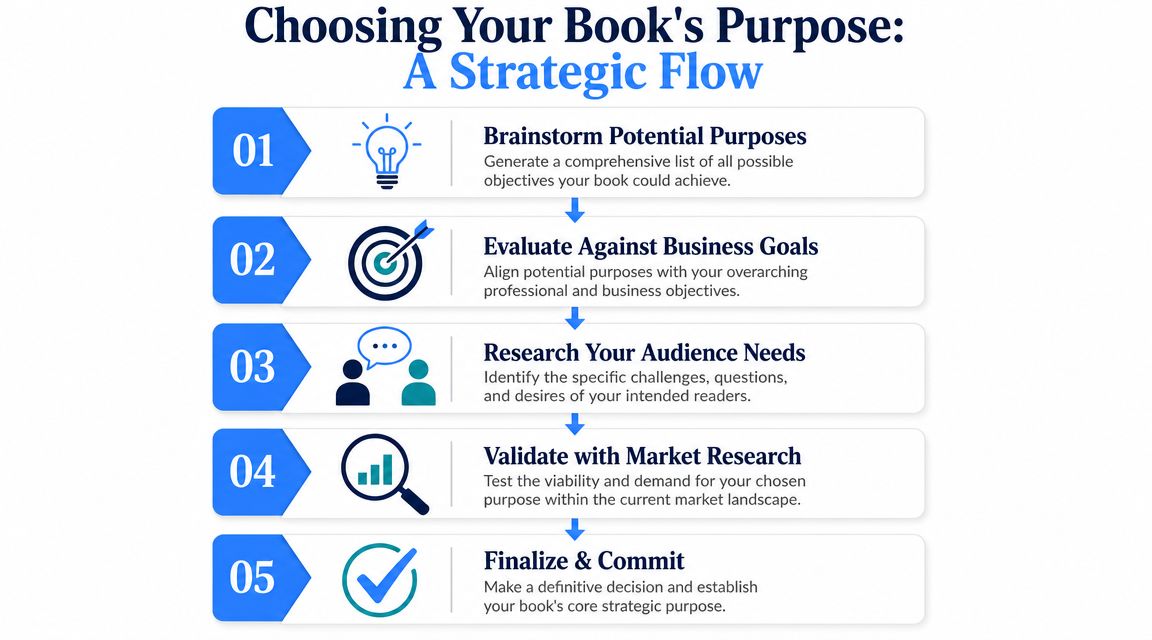
Authors often answer these questions too broadly on the first try. That's normal. Broad answers are still useful because they show where the fuzziness lives.
If you're still at idea stage, reviewing good non-fiction book ideas for experts can help you separate a compelling topic from a strategically useful one.
Validate before you commit too far
After you have a draft purpose statement, test it. Don't wait until the full manuscript is written.
A practical validation process looks like this:
Check audience language by listening to the exact questions readers, clients, or participants already ask.
Review comparable books and notice where your angle is sharper, narrower, or more useful.
Test the promise out loud in conversation, on a podcast interview, or in workshop language. If people understand it quickly, that's a good sign.
Pressure-test chapter relevance by asking whether each likely chapter directly supports the purpose.
A clear purpose gives the book a better chance of becoming a durable knowledge asset. Australia's cataloguing infrastructure, including the Australian National Bibliographic Database, which has catalogued books published in Australia and New Zealand since 1978, creates a formal pathway to long-term visibility, as described in this discussion of the ANBD and discoverability.
A vague book can still be published. It's much harder for it to remain useful, searchable, and citable over time.
Turning Purpose into Your Book's Structure
Once the purpose is set, structure stops being a creative guessing game. It becomes an architectural choice.
That's where many expert authors relax, because they realise they don't need to include everything they know. They need to arrange the right material in the right order so the reader can achieve the promised result.
What changed when the purpose changed
A helpful example is Kylie Paatsch's project. She began with a draft and proposal framework for The Connect Effect, centred broadly on building loyalty, ownership, and engagement with leaders. As the project evolved, the purpose sharpened. The focus moved more clearly toward the role of individual relationships in creating strong, connected teams.
That kind of shift changes more than wording. It changes chapter logic.
Before the purpose is refined, authors often build books around topic buckets. Those drafts can sound informed but scattered. After the purpose is clarified, the manuscript usually tightens around a more specific transformation. The result is better sequencing, clearer examples, and stronger chapter boundaries.
When the purpose sharpens, authors stop asking “What else should I add?” and start asking “Does this earn its place?”
That is one reason mid-project refinement can be productive rather than disruptive. A better purpose can rescue a messy draft.
Build the manuscript like a decision tool
For purpose-led nonfiction, a hybrid structure often works best. Guidance cited for this article notes that a useful model for busy professional readers is a book built around a core promise, broken into 3 to 5 proof-backed pillars with clear signposting, using problem-solution logic alongside evidence in a navigable format, as outlined in this nonfiction structure guidance.
That structure is especially effective for expert authors because it respects how professional readers use books. They don't always read linearly. They scan headings, revisit sections, and look for applied clarity.
A practical structure often includes:
A sharply defined opening problem that names the stakes and the reader's current frustration.
A central framework that gives the book its organising logic.
Proof-backed chapters built around a small number of major pillars.
Signposting throughout so readers can move quickly without getting lost.
A final application section that shows what to do next.
If you're designing this on paper before drafting, a planning tool such as the book canvas can help connect purpose, audience, positioning, and chapter flow in one place.
What doesn't work is choosing a purpose that promises transformation, then delivering a manuscript that reads like a loose collection of essays. Readers feel the mismatch immediately.
Using Purpose to Drive Positioning and Launch
A clear purpose doesn't just help you write the book. It helps people find it, understand it, and act on it.
Many launches underperform. The manuscript may be solid, but the positioning is blurred. The title sounds inspirational when the content is practical. The subtitle is clever but not descriptive. The category choice doesn't match the reader problem. The author knows what the book means, but the market can't see what the book does.
Purpose belongs in your metadata
In Australian nonfiction, discoverability is tied closely to metadata and category choices. Practical guidance for this article notes that the book's purpose should be encoded into the title, subtitle, keywords, and categories, and that a useful benchmark is to map the manuscript against 5 to 10 comparable books in the same niche before selecting the best-fit categories and promise, based on this nonfiction writing and positioning guidance.
That changes how you prepare for launch.
Your purpose should show up in:
Title and subtitle so the reader can identify the problem and promise quickly
Back-cover copy so the book's role is obvious
Category selection so the book appears in the right commercial context
Interview talking points so your message stays consistent across podcasts, events, and media
Lead magnets and follow-up content so the book connects naturally to your business ecosystem
Scott MacMillan's guidance in EAC sessions reflects a pattern I see often. When the book's purpose aligns with business goals, authors make faster decisions. They know what to say yes to. They know which partnerships fit. They know what kind of content supports the launch.
Launch gets easier when the book knows its role
If your book is meant to build authority, your launch should emphasise credibility signals, clear point of view, and strategic visibility. If it's designed for lead generation, the launch should make the next step obvious and low-friction. If the purpose is to introduce IP, your launch should teach the framework consistently across every channel.
For authors thinking beyond the book page, these actionable content strategy tips are useful because they help turn one core message into repeatable launch content without losing clarity.
Positioning also improves when you define the book against alternatives instead of describing it in isolation. That's one reason a strong non-fiction book positioning approach matters before publication, not after.
A purpose non-fiction book is easier to write, easier to position, and easier to launch because each part supports the same outcome.
If you're writing a non-fiction book to build authority, support your business, or turn expertise into a practical asset, Expert Author Community (EAC) offers structured support for strategy, manuscript development, publishing decisions, and positioning. It's built for experts who want commercial clarity as well as accountability.

Your Non Fiction Book Purpose: From Idea to Impact


7 Author Bio Examples to Build Authority in 2026

Content of a Book: A Guide for Non-Fiction Experts