

You've got the knowledge. The problem is shape.
Most non-fiction experts don't struggle because they lack material. They struggle because they have too much of it. Notes from client work. Workshop decks. Podcast transcripts. Frameworks scribbled in notebooks. Stories that prove the point. Opinions refined over years. When all of that lands on a blank page, the question “what is the content of a book?” feels bigger than it should.
The useful answer isn't a checklist of parts. It's a design problem. A strong non-fiction book is an actionable content asset. It helps a reader do something, decide something, change something, or explain something. At the same time, it positions you as the person with a clear method, a credible point of view, and a body of work worth hiring, following, or recommending.
Table of Contents
- Template one for a signature framework book
- Template two for a big idea book
- Template three for a field guide book
Your Expertise Needs a Blueprint
You might already know your topic well enough to teach it for hours. That doesn't automatically produce a book people want to keep, mark up, and recommend.
A non-fiction manuscript needs selection, sequencing, and emphasis. Those three decisions shape whether the book feels sharp or sprawling. They also determine whether a reader finishes with a useful method or just a pile of interesting ideas.
That matters in Australia's publishing context. The publishing industry had 1,206 businesses in 2022–23, down 8.0% from 2018–19, while industry revenue reached A$7.1 billion, according to this publishing industry reference. For experts, that creates a practical challenge. Your book has to signal clear value fast, because attention is competitive and professional publishing capacity is relatively concentrated.
So don't start with “what chapters should I include?”
Start with three harder questions:
What business job is this book doing?
Is it meant to open speaking doors, support consulting sales, strengthen a professional reputation, or package your methodology?What result should the reader get?
Better clarity, a process to follow, a new lens, a diagnostic tool, or confidence to act?What makes your angle ownable?
Not just accurate. Not just helpful. Distinctive.
Practical rule: If your book content could be rearranged into a series of unrelated blog posts without losing anything, the architecture isn't strong enough yet.
A good outline creates a guided experience. It decides what the reader needs first, what can wait, and what must be repeated in different forms for the idea to stick. If you're still pressure-testing the concept itself, the prompts in this guide to good book ideas are a useful place to sharpen the promise before you draft.
The Anatomy of a Non-Fiction Book
Think like an architect
A useful way to think about the content of a book is to treat it like a professional building.
The front matter is the foyer. It welcomes people, orients them, and tells them they're in the right place. The body is where the actual work happens. Those are the rooms where the reader learns, reflects, applies, and changes their thinking. The back matter is the utility area and directory. It helps them find resources, continue the work, and take the next step.
That mental model helps because many authors over-focus on the middle. They pour everything into chapters and neglect the parts that create trust before chapter one and momentum after the final page.

A simple map of the whole book
Here's the high-level architecture.
| Part | Purpose | Typical components |
|---|---|---|
| Front matter | Creates orientation and trust | Title page, copyright, contents, foreword, preface, introduction |
| Body | Delivers the transformation | Core chapters, frameworks, examples, exercises, case material |
| Back matter | Extends use and action | Appendix, glossary, references, resources, author bio, next steps |
The mistake isn't leaving one of these out. The mistake is treating them all as administrative furniture.
For example, the table of contents isn't just navigation. It's a promise. A busy buyer often scans it to judge whether the logic is sound and whether the material feels practical. The same goes for your chapter titles. If they're vague, the whole book can feel vague.
A strong non-fiction book lets the reader understand the journey before they commit to the full read.
If you want a broader strategic view of what makes a business book work beyond structure alone, this overview of the 9 pillars of crafting a winning business book is a useful companion to the architecture work.
Crafting the Front Matter to Hook Your Reader
The opening pages are often treated like publishing paperwork. That's a missed opportunity.
Your front matter does sales work, trust work, and positioning work. It tells the reader who this book is for, what problem it solves, why your perspective matters, and how to read it. If those pages are flat, the body has to work harder than it should.

The opening pages sell the reading experience
A useful introduction doesn't warm up slowly. It identifies the reader's real problem with precision.
That means naming the cost of staying stuck, the flawed assumptions that keep people there, and the shift your book is going to make. Readers should feel understood before they feel instructed. If they don't, they'll skim.
A foreword can help, but only when it adds borrowed credibility or context. A generic endorsement from a recognisable name won't do much. A strong foreword explains why your method matters, who it helps, and why the reader should trust the journey.
What belongs in the front matter
Not every book needs every element. What matters is function.
- Title page and subtitle: These set positioning fast. A good subtitle clarifies audience, problem, or outcome.
- Table of contents: This should read like a sequence of useful decisions, not a list of abstract themes.
- Foreword or preface: Use one if it adds authority, origin story, or framing. Skip it if it only repeats praise.
- Introduction: This is your contract with the reader. Define the problem, promise the outcome, and explain the path.
- Dedication and acknowledgements: Keep them human and proportionate. They add warmth, but they shouldn't delay momentum.
A practical test helps here. Hand your front matter to someone in your target audience and ask one question: “Can you tell what this book will help you do?” If they answer with a topic instead of an outcome, keep refining.
Reader test: The best introductions make the reader think, “This author gets the problem better than most people discussing it.”
One more trade-off matters. Some authors want to prove expertise immediately by loading the introduction with credentials, background, and industry context. That usually weakens the opening. Readers don't need your full CV first. They need a reason to trust that the book is worth their time. Credentials support the promise. They shouldn't bury it.
Structuring the Body for Impact and Authority
A reader gets to chapter three, sees another wall of explanation, and starts skimming. That is the moment your book either becomes a useful tool or a forgotten purchase.
The body is where your expertise becomes usable. A common mistake is the content dump. Authors pour in every strong idea they have, arrange it in a roughly sensible order, and leave the reader to build the system alone. That weakens both the reading experience and the authority effect. Authority grows when the reader can apply your thinking and get a result.
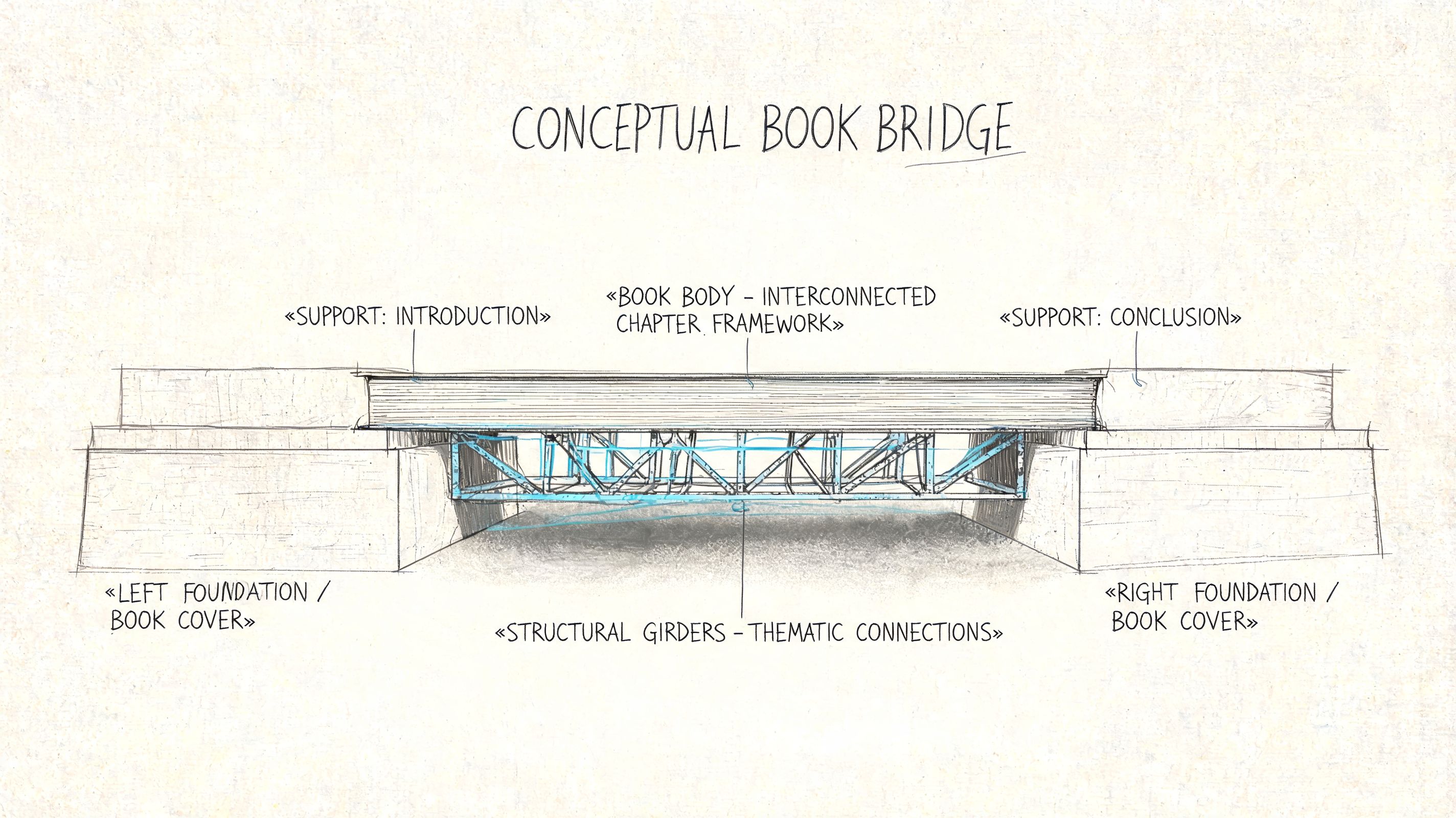
A stronger approach is to design the body as a sequence of actionable content assets. Each chapter should do a job. It should help the reader make a decision, solve a problem, avoid an error, or implement a method. That shift matters for non-fiction experts who want a book to support consulting, speaking, advisory work, courses, or premium services. The book is not only there to inform. It is there to transfer trust through usefulness.
Find the golden thread
Strong books have a clear line of argument running through every chapter. Call it your thesis, your core method, or your golden thread. It gives the reader a reason to keep going because each chapter feels like progress, not a detour.
Without that thread, even good material feels assembled rather than built.
Use these questions to test for it:
- What belief is this book trying to change?
- What order does the reader need to move from problem awareness to action?
- What idea should keep showing up so the book feels coherent?
This gets harder when the manuscript comes from existing material. Talks, newsletters, workshop notes, podcast ideas, and LinkedIn posts often sound strong on their own but carry different assumptions. The golden thread is what turns those pieces into one strategic asset.
Build chapters people can use
A chapter earns its place by moving the reader forward.
In practice, that usually means each chapter includes at least one reusable element:
- A framework: A named model, process, or diagnostic lens.
- A checklist: A practical list for planning, review, or execution.
- A decision tool: Criteria or questions that help the reader choose well.
- A case example: A realistic situation that shows the method under pressure.
- An exercise or prompt: A way to turn reading into implementation.
Here is the standard to aim for:
| Weak chapter | Strong chapter |
|---|---|
| Explains a concept broadly | Teaches a concept and gives a tool to apply it |
| Uses examples only to illustrate | Uses examples to help the reader make decisions |
| Ends with summary | Ends with actions, questions, or a repeatable model |
If a reader cannot name what changed after a chapter, the chapter is informing them but not building enough authority.
Use a chapter pattern that creates momentum
Chapters do not need to follow an identical template, but they should create a consistent experience. One structure works especially well for expert-led non-fiction:
Open with the problem
Name the friction, mistake, or misconception.Introduce the lens
Present the principle, distinction, or model that changes how the reader sees it.Show it in context
Use a realistic scenario, client pattern, or before-and-after example.Convert it into action
Add prompts, a checklist, reflection questions, or a planning tool.Set up the next step
Make the next chapter feel like the natural continuation of the work.
That final move is often overlooked. Strong chapter sequencing reduces reader effort. It also strengthens the sense that your method is complete and thought through.
This short walkthrough can help you visualise how content progression works in practice.
There is a real trade-off here. Some authors want the body to be exhaustive. Others want it to be sharp and commercially useful. In most authority-building books, usefulness wins. A reader who applies one clear method, gets a result, and recommends the book is more valuable than a reader who respects the range of ideas but never uses them.
Designing the Back Matter to Drive Action
A reader finishes your final chapter, feels convinced, closes the book, and then asks the question that determines whether the book creates business value: what do I do now?
That moment is what back matter is for.
The strongest non-fiction books treat the closing pages as part of the content asset, not publishing housekeeping. If your book is meant to build authority, start conversations, support delivery, or move readers into a service ecosystem, the back matter needs a job. It should help the reader apply the material, return to it during real work, and take a clear next step with confidence.
I often see experts put all their effort into the body chapters and leave the final pages thin. That choice weakens the book's commercial function. A strong ending does more than complete the reading experience. It turns the book into something usable after the first pass.
Treat the ending as a handoff
Your conclusion can create clarity. Your back matter should create follow-through.
That means giving readers a practical way to keep working with your ideas. If your method includes tools, collect them in one place. If readers need to translate concepts into decisions, add worksheets, prompts, or implementation notes. If your book introduces a framework you use in consulting or training, include a guided next step such as a book planning canvas for shaping your reader pathway.
This is a design decision, not an afterthought. Every extra page in the back matter has a trade-off. More tools can improve usefulness, but they can also create clutter if they repeat what the chapters already did. The right test is simple. Include what helps the reader act, revisit, or reach out.
A non-fiction book keeps earning trust when readers use it at the point of decision, not only at the point of reading.
What strong back matter includes
The best mix depends on the role your book plays in your business, but a few components consistently pull their weight:
- Appendix: Place worksheets, scripts, templates, diagnostics, or reference tables here when they support action but would interrupt chapter flow.
- Resource list: Curate further reading, tools, organisations, or examples. Give a short note on why each one matters.
- Glossary: Reduce friction for readers who are new to the field or unfamiliar with your terminology.
- References or endnotes: Useful for evidence-led books, regulated topics, and credibility-sensitive subjects.
- Author bio: Write it as a relevance statement. Readers need to understand why your experience helps them solve this specific problem.
- Call to next step: Offer one clear continuation, such as a worksheet, assessment, implementation guide, workshop, or community.
One caution matters here. Authors often use the bio and final CTA to talk about themselves rather than extending the reader's progress. That misses the point. The back matter should answer three practical questions: Where do I find the tools again? What should I do next? Who can help me go further if I want support?
When those pages are built well, the book does more than inform. It keeps working.
A Content Planning Blueprint for Your Book
A familiar scenario plays out at the start of many non-fiction books. The author opens a blank document, types “Chapter 1,” and starts arranging ideas in the order they come to mind. That usually produces a manuscript. It does not always produce a useful business asset.
Stronger books start with design.
The job here is to shape your knowledge into an actionable content asset that helps a specific reader solve a specific problem, while also strengthening your authority in a specific area. That changes how you plan. You are not just asking, “What should go in the book?” You are asking, “What must this book help the reader understand, do, and trust by the end?”
Start by gathering the raw material you already have. Pull in workshop outlines, article drafts, keynote themes, client questions, podcast episodes, frameworks on whiteboards, and explanations you give repeatedly. Then sort that material by reader need, buying-stage relevance, and business goal. Some content builds credibility. Some content creates clarity. Some content leads naturally to a service, programme, or speaking topic. Good planning separates those roles before you draft.
That step matters because a strong non-fiction book needs a clear organising logic. Readers can feel the difference between a book built from accumulated content and a book built around a deliberate promise. The second one is easier to use, easier to recommend, and easier to connect to your wider body of work.
In practice, I find three planning models cover most expert-led books.
Template one for a signature framework book
This model suits consultants, coaches, facilitators, and advisers with a named method or repeatable process.
A practical structure looks like this:
- The persistent problem your audience faces
- Why familiar approaches keep falling short
- The framework at a high level
- Principle or stage one
- Principle or stage two
- Principle or stage three
- Common mistakes, resistance, and failure points
- Real-world application
- Using the framework across teams or contexts
- Implementation and next steps
This structure earns its place because it gives the reader the right sequence. First, they understand the problem. Then they understand your method. Then they see how to apply it. That order supports authority because it shows both diagnosis and solution.
Good fit: books built around a planning method, leadership process, diagnostic model, or teaching system.
Template two for a big idea book
This model works when your contribution is a distinct point of view rather than a staged process.
A useful sequence is:
- Opening provocation: Name the assumption that no longer holds.
- Why it persists: Show the habits, incentives, or systems keeping it in place.
- A better lens: Present the idea that changes how the reader sees the field.
- Implications: Explain what shifts for leaders, teams, clients, or institutions.
- Application: Turn the idea into decisions, behaviours, and practical use.
This kind of book needs disciplined examples. A conceptual argument can win agreement without producing action. Case material, scenarios, and practical consequences close that gap.
Template three for a field guide book
This model suits experts whose readers need help in live situations, often under time pressure.
Useful chapter types include:
- Situation chapters: “When the client pushes back” or “When the strategy stalls”
- Decision chapters: “How to choose the right option” or “How to diagnose the underlying issue”
- Recovery chapters: “What to do when progress breaks down”
This format serves busy professionals well because they can enter at the point of need. It also creates strong opportunities for checklists, scripts, prompts, and troubleshooting tools. If your business goal includes training, advisory work, or team adoption, that utility can matter more than a linear read-from-start-to-finish experience.
Before you commit to a full outline, map the concept. The Book Screening Canvas helps you test the core promise, identify gaps, and clarify how the book supports your positioning. If you want structured support while shaping the manuscript, Expert Author Community (EAC) is one option that combines author coaching, feedback, and curriculum for non-fiction experts building books from existing expertise.
Your Book Is More Than Words It Is an Asset
The content of a book isn't just information arranged into chapters. It's a deliberate architecture.
The front matter earns attention and trust. The body converts expertise into usable tools and clear thinking. The back matter extends the value beyond the final page. When those parts work together, the book becomes more than a manuscript. It becomes a practical asset for the reader and a strategic asset for your business.
The cleanest way to build that asset is to use a four-stage workflow: ideate, create, revise, optimise, as described in this publishing workflow reference. That sequence matters because it separates planning from drafting, drafting from revision, and revision from final optimisation. It reduces avoidable rework and helps you make stronger decisions earlier.
You don't need more scattered content. You need a blueprint that turns your knowledge into a book people can use, trust, and act on.
If you're ready to turn your expertise into a non-fiction book with stronger structure, sharper positioning, and practical support, explore Expert Author Community (EAC). EAC helps experts, consultants, coaches, executives, and business owners shape, write, publish, and market books that build authority and support real business goals.

Find Your Non-Fiction Book Purpose: A Strategic Guide


Your Non Fiction Book Purpose: From Idea to Impact

7 Author Bio Examples to Build Authority in 2026