

You've got the idea. You may even have the chapters half-formed in your head already. But one small question keeps slowing everything down: what kind of book is this, exactly?
That question sounds basic until you're the one trying to answer it. A consultant with a proven client method might wonder whether they're writing a how-to guide, a business book, or a thought leadership book. A founder with a hard-won story might feel pulled between memoir and practical advice. An academic or practitioner might have deep expertise, but still struggle to decide whether the manuscript should explain, persuade, instruct, or narrate.
Many expert authors lose momentum at this stage. They think they're stuck on naming. They're stuck on positioning.
If you're still shaping your concept, it can help to pair this article with practical guidance on how to write your first book. And if your challenge is earlier than structure, and more about narrowing the right concept, this round-up of good book ideas is useful for pressure-testing whether your expertise can carry a full manuscript.
Table of Contents
- Your Book Idea Is Clear But What Kind of Book Is It?
- A book of truth, not invention
- Why that matters in Australia
- Start with the reader's job
- Choose the structure that matches the promise
- Check the market without copying it
- Different categories build different authority
- The business trade-off behind the genre
- Position the book before you draft it
Your Book Idea Is Clear But What Kind of Book Is It?
A leadership adviser once told me, “I know what I want to say, but I don't know what shelf it belongs on.” That's a common problem. The expertise is real. The stories are real. The reader need is real. But the packaging is still fuzzy.
That fuzziness creates practical problems fast. You can't decide on a structure. Your chapter list swings between personal stories and workshop-style exercises. Your back cover promise sounds broad because you haven't decided whether the reader should feel moved, informed, or equipped.
Your book category isn't a tidy label added at the end. It shapes the manuscript from page one.
This is why the question of what books are non fiction matters more than people think. You're not just identifying whether your work is factual. You're deciding how readers will use it, how publishers or clients will understand it, and what kind of authority it will build for you.
A memoir can build trust through lived experience. A prescriptive business book can turn a method into a service pipeline. A big-idea book can open doors to speaking, commentary, and strategic positioning. They all sit under non-fiction, but they do different jobs.
Here's the practical test. If someone asked, “What will this book help me do or understand?”, could you answer in one sentence?
- If the answer is emotional and story-led, you may be writing narrative non-fiction.
- If the answer is implementation-led, you may be writing a practical or technical book.
- If the answer is insight-led, you may be writing an explanatory or analytical book.
When authors skip that decision, the manuscript usually gets baggy. It starts to read like three books competing for space. When authors make the decision early, the writing gets cleaner and the positioning gets sharper.
The Core Promise of Non-Fiction
A book of truth, not invention
Non-fiction isn't defined by being “serious” or “educational” in a narrow sense. Its core feature is simpler than that. It makes a promise to the reader that the material is grounded in reality.
That doesn't mean every non-fiction book sounds academic. It doesn't mean all non-fiction avoids storytelling. A memoir can be vivid. A history book can read with pace. A business book can use scenes, interviews, and personal anecdotes. The difference is that the writer is still working with real people, real events, real ideas, or real instructions.
Think of it this way. Fiction can invent the house. Non-fiction has to build on the actual site. You can choose the layout, style, sequence, and voice, but the foundation must hold.

That promise affects every writing decision:
- Evidence selection: You need material that supports your claims, examples, or guidance.
- Reader trust: If you overstate, blur facts, or force certainty where none exists, the book weakens.
- Voice choices: You can be warm, bold, funny, or reflective, but you still need to stay anchored to reality.
- Structure: The organisation has to help readers understand truth, not hide it.
Practical rule: If a reader finishes your book unsure whether they were meant to believe, feel, or act, the promise wasn't clear enough.
Why that matters in Australia
In Australia, nonfiction books are best understood as the broad category of books that are primarily written to inform, explain, or document real-world topics rather than to tell invented stories. This includes biographies, memoirs, history, politics, business, self-help, science, and reference works. The Australian Bureau of Statistics tracks publishing activity by book type, and its publishing data shows that nonfiction is a major part of the country's book output rather than a niche format, as summarised in this overview of nonfiction's recognised publishing role in Australia.
That matters because many expert authors still treat non-fiction as if it were a side project, a marketing extra, or a polished set of blog posts. The industry doesn't treat it that way. It treats non-fiction as a recognised publishing category connected to learning, professional development, and public knowledge.
For authors, this changes the mindset. You're not only “writing a book about your topic”. You're entering a category that readers already use for instruction, interpretation, expertise, and authority.
A strong non-fiction manuscript earns trust because the category itself carries a clear expectation. Readers approach it wanting something usable. That usability might be emotional, intellectual, practical, or professional. But they expect substance.
Exploring the Spectrum of Non-Fiction Genres
Non-fiction is a broad field, which is why the question what books are non fiction often gets answered too vaguely. “Books based on facts” is technically right, but not useful when you're trying to shape your own manuscript. A better approach is to look at the main modes of non-fiction by reader purpose.
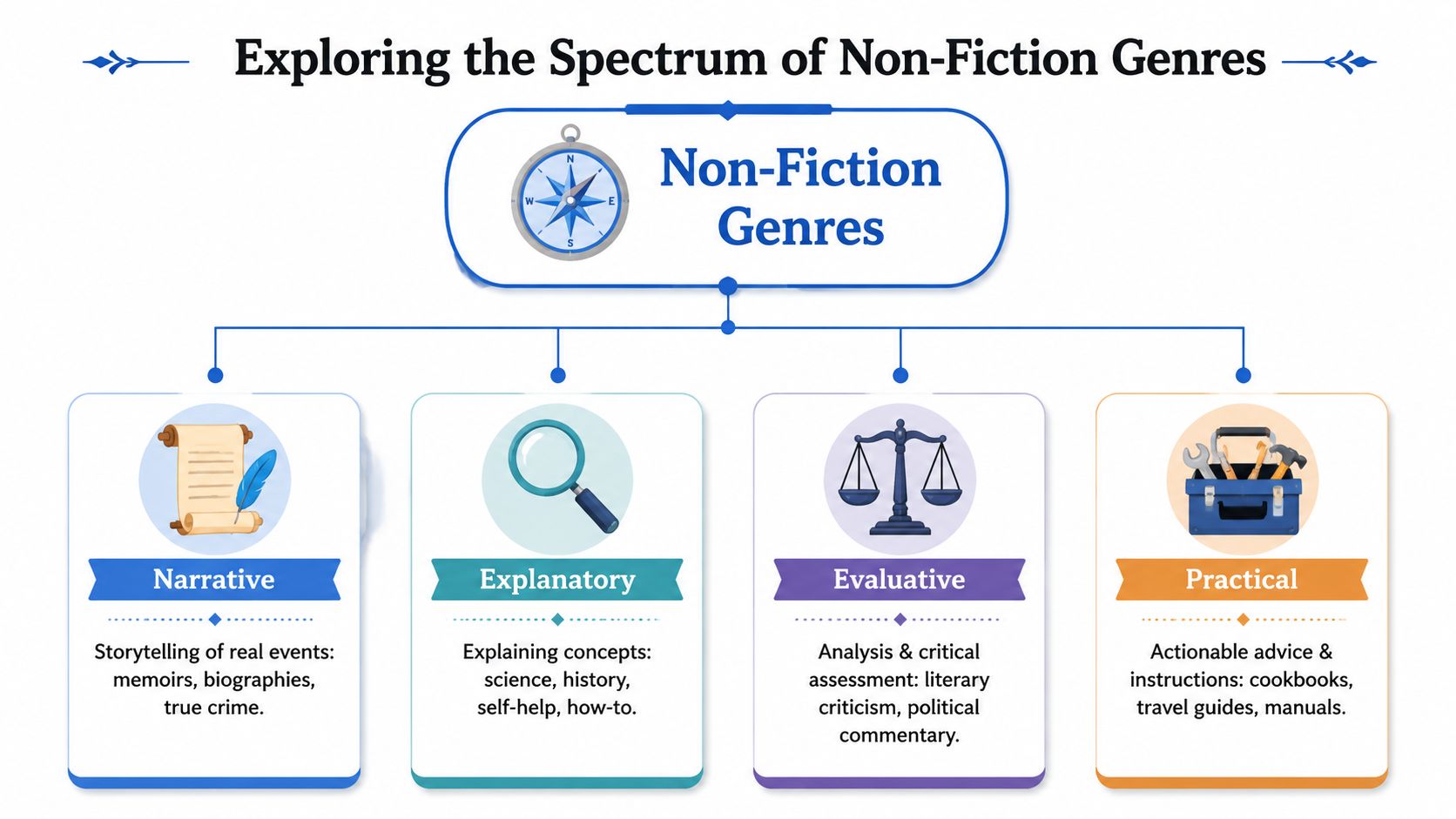
Narrative books
Narrative non-fiction tells a true story. It still informs, but it does so through sequence, scene, character, and consequence.
Common forms include:
Memoir
A memoir focuses on a slice of lived experience rather than covering an entire life. It usually has a strong internal arc. The reader comes for perspective as much as event.Biography
A biography interprets the life of another person. It relies on research, documentation, and selection. The challenge isn't only accuracy. It's deciding which parts of a life carry the meaning.History and reportage
These books often combine facts with narrative momentum. The writer's task is to help readers understand what happened and why it mattered, without flattening complexity.
Narrative non-fiction works well when your authority comes from observation, experience, investigation, or interpretation over time.
Explanatory books
Explanatory non-fiction helps readers understand a topic, system, or idea. It answers questions like “How does this work?” and “Why should I think about this differently?”
Here, many expert authors naturally sit.
A few common types:
| Type | What it does | Best fit for |
|---|---|---|
| Business book | Explains a framework, trend, method, or leadership approach | Consultants, operators, founders |
| Science or psychology for general readers | Translates specialist knowledge into accessible ideas | Researchers, clinicians, educators |
| Self-help | Connects insight to personal change | Coaches, therapists, practitioners |
These books don't need to be dry. In fact, they usually improve when the explanation is carried by sharp examples, clear contrasts, and memorable frameworks.
If you want to study how practical books in a crowded category position themselves through framing and promise, a list like these top books on productivity is useful because it shows how similar subjects can still target different reader needs.
Some non-fiction books win because they tell the strongest story. Others win because they explain the mess in a way readers can finally use.
Evaluative books
Evaluative non-fiction makes an argument. It doesn't just explain a subject. It assesses it.
This category includes:
- Political commentary that interprets events and proposes a viewpoint
- Cultural criticism that examines media, trends, institutions, or ideas
- Analytical thought leadership that challenges accepted practice in a field
These books often attract experts who have spent years noticing patterns others miss. They can be powerful authority-builders, especially for speakers, advisers, and public thinkers. But they require discipline. A strong opinion alone won't carry the manuscript. The reader needs a coherent case.
A weak evaluative book sounds reactive. A strong one feels considered, evidenced, and structured.
Practical books
Practical non-fiction is built for action. The reader wants to apply, implement, decide, improve, fix, or build something.
Typical forms include:
- How-to books with step-by-step guidance
- Manuals and instructional books organised for easy reference
- Guidebooks, cookbooks, and field-specific handbooks designed around use rather than continuous reading
These books are often the most commercially useful for service-based experts because they map neatly onto client problems. But they also have the harshest clarity test. If the reader can't follow the sequence, locate what they need, or act on the guidance, the book has failed its core job.
A practical book needs:
- A narrow reader problem.
- A clear order of operations.
- Language that favours clarity over flourish.
- Examples that reduce friction, not add tangents.
Many first-time authors often overcomplicate things. They try to sound profound when the reader wants the next step. In practical non-fiction, elegance comes from usefulness.
How to Classify Your Book Idea
Most authors don't need more genre theory. They need a decision method. If you're trying to classify your book idea, start with function, not identity. Ask what job the book needs to do for the reader.
A helpful visual can sharpen that thinking:

Start with the reader's job
In Australia, the most operationally useful definition of non-fiction is books written about real people, events, ideas, or instructions rather than invented narratives. In practice, that splits into at least two market-relevant modes: narrative nonfiction and expository or technical nonfiction. That distinction matters because the writing architecture changes what readers expect, as outlined in this guide to nonfiction structures and reader purpose.
So ask these questions first:
Do readers need transformation through story?
If yes, narrative forms such as memoir, biography, or reported non-fiction may fit.Do readers need direct implementation?
If yes, a technical, how-to, or prescriptive structure is usually stronger.Do readers need interpretation or a framework?
If yes, explanatory or analytical non-fiction may be the right home.
One useful planning tool for this stage is a structured book canvas. It helps separate the message you want to share from the promise the reader needs.
Choose the structure that matches the promise
Writers often classify too early based on bookstore labels. A better move is to inspect the manuscript's natural shape.
If your material depends on chronology, cause and effect, turning points, and scenes, you're probably in narrative territory.
If your material depends on definitions, frameworks, chapters built around concepts, and repeatable guidance, you're likely in expository or technical territory.
Use this quick comparison:
| If your draft keeps doing this | Your book likely is this |
|---|---|
| Moving through events in time | Narrative non-fiction |
| Explaining a method or model | Expository non-fiction |
| Giving steps, tools, and checklists | Technical or practical non-fiction |
| Building a case or critique | Evaluative non-fiction |
Here's a useful test from the writing desk. Read your chapter headings aloud. Do they sound like episodes, arguments, or instructions? That usually reveals the category faster than your working subtitle does.
Later, when you want another perspective on structure, this video offers a useful prompt for thinking about how ideas turn into a book concept:
Check the market without copying it
Classification isn't only about your content. It's also about reader expectations in the market you want to reach.
Review comparable books and notice:
- What promise the title makes
- How the contents page is organised
- Whether the author is leading with story, insight, or instruction
- What kind of authority the book signals
If your book is trying to do everything, readers won't know how to use it.
What doesn't work is choosing a category because it sounds prestigious. What works is choosing the category that matches your strongest material and your reader's clearest need.
Beyond Categories Strategic Positioning for Expert Authors
The category you choose doesn't just shape the manuscript. It shapes your business outcomes. For expert authors, that's the part that matters most.

Different categories build different authority
A prescriptive book says, “I can help you do this.”
An analytical or big-idea book says, “I can help you see this differently.”
A memoir-inflected expert book says, “You can trust me because I've lived this and made meaning from it.”
Those are different authority signals. They attract different readers and create different follow-on opportunities.
For example:
- How-to and practical books tend to support workshops, consulting, programmes, and service offers because readers can see the method in action.
- Explanatory and big-idea books often support keynote speaking, commentary, and brand authority because they position the author as a thinker and interpreter.
- Narrative expert books can deepen trust, especially when the author's lived experience is central to the value they provide.
This is why genre choice is a commercial decision, not just a creative one.
The business trade-off behind the genre
Every category gives you something and asks something from you in return.
A practical guide is often easier to connect to an offer. The trade-off is that readers expect immediate usefulness. If the advice is vague, padded, or overly autobiographical, they'll lose confidence.
An explanatory business book can enhance your thinking and sharpen your point of view. The trade-off is that clarity has to do more work than personality. Readers need a clear lens, not just broad observations.
A narrative book can create deep emotional connection. The trade-off is that not every expert story belongs in book form. Story only works when it serves the reader, not when it functions as personal archive.
Here's a clean way to consider it:
| Book type | Strongest outcome | Main risk |
|---|---|---|
| Practical | Leads into services and implementation work | Feels generic if the method isn't specific |
| Explanatory | Builds thought leadership and intellectual authority | Becomes abstract if not grounded |
| Narrative | Builds trust and emotional credibility | Turns inward if reader relevance is weak |
| Evaluative | Positions the author as a sharp commentator | Sounds opinionated without enough support |
Position the book before you draft it
Before you write chapters, decide what role the book will play in your wider body of work.
Ask:
- What do I want this book to make easier for my reader to say yes to?
- What kind of authority do I want to be known for?
- What part of my expertise is strongest in book form?
- What should happen after someone finishes reading?
These questions usually bring hidden priorities to the surface. A consultant may realise the actual goal is to turn a delivery method into a repeatable framework. A founder may realise the story matters, but only as proof that a broader business idea works. A senior executive moving into advisory work may decide they need a thought leadership book, not a memoir.
That's also why authors often benefit from external feedback while positioning. Options range from peer masterminds to editorial strategists to structured coaching communities. One example is non-fiction book positioning guidance, which focuses on matching the book's promise to the author's broader authority goals. Expert Author Community (EAC) is another option in this space, offering coaching, feedback, and strategy support for experts writing non-fiction books tied to business and professional outcomes.
The market doesn't reward books for containing expertise. It responds to books that package expertise in a form readers can immediately recognise and use.
Your Book's Category Is Your First Promise
When authors ask what books are non fiction, they usually expect a shelf-based answer. Business. Memoir. History. Self-help. Reference. That answer is only the surface.
The deeper answer is that your category tells the reader how to approach your book. It tells them whether to expect a true story, a clear framework, a practical system, or an informed argument. That expectation shapes trust before they've read a full chapter.
That's why category choice deserves more care than most experts give it. If you classify the book well, the structure becomes easier, the positioning gets sharper, and the marketing starts to make sense. If you classify it poorly, the manuscript often feels mixed-purpose and the reader has to work too hard to understand its value.
Your first job isn't to make the book sound impressive. It's to make its promise unmistakable.
Choose the form that fits the reader's need, the material you have, and the authority you want to build next. That's the version of non-fiction that works.
If you want support turning expertise into a clear, strategically positioned non-fiction book, Expert Author Community (EAC) helps experts, consultants, coaches, executives, and business owners move from idea to manuscript with structured guidance, feedback, and coaching focused on authority-building books.

Find Your Non-Fiction Book Purpose: A Strategic Guide


Your Non Fiction Book Purpose: From Idea to Impact

7 Author Bio Examples to Build Authority in 2026