
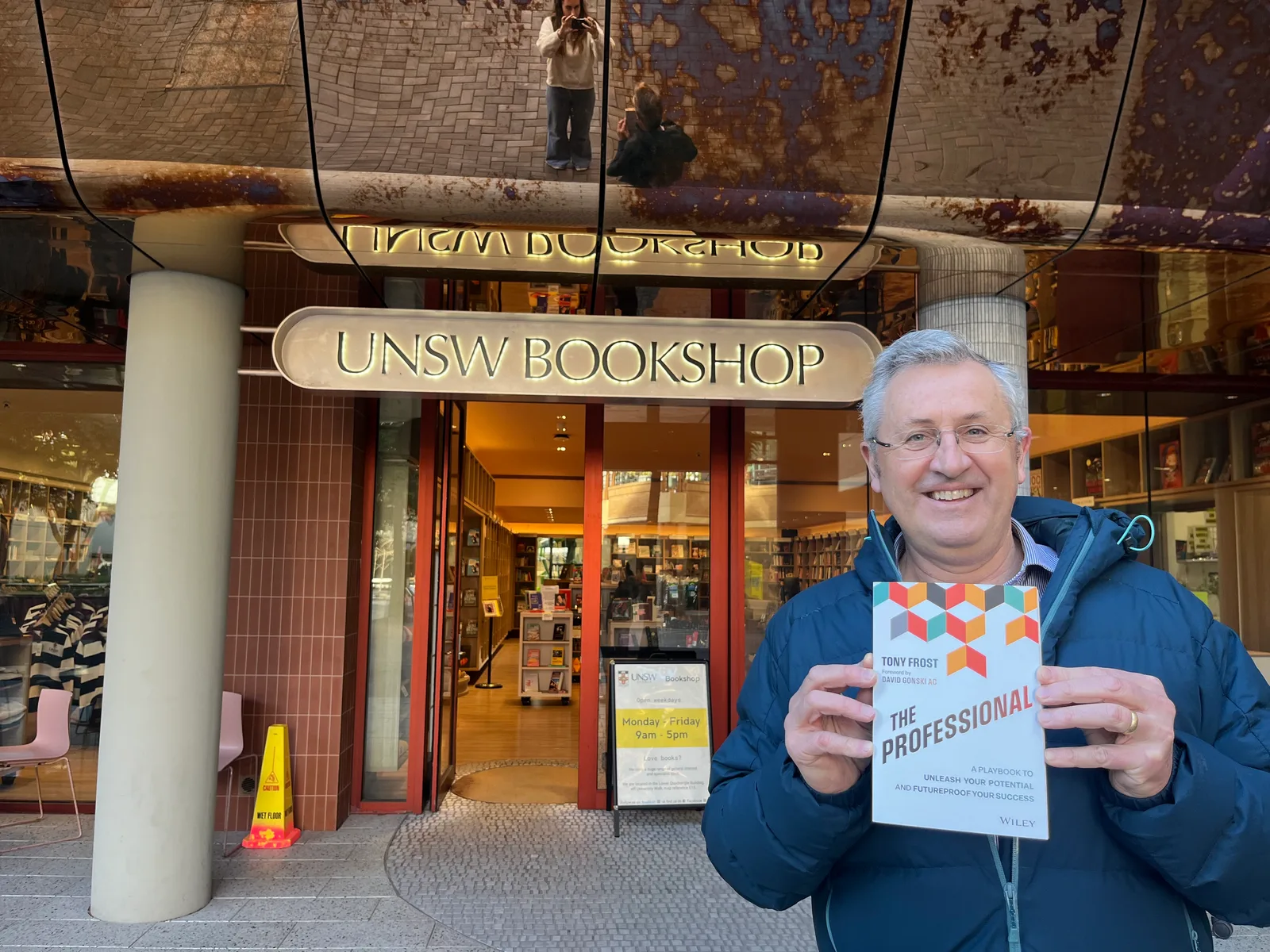
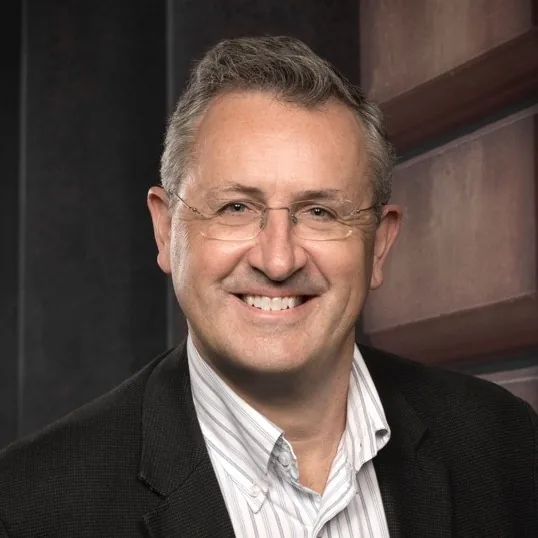
Tony Frost started The Professional in 2018, before ChatGPT and before the pandemic, and signed off the manuscript in early 2025 after repeatedly rethinking what AI and remote work would mean for early careers. He explains why he would now be in the office four or five days a week if he were starting over, and which chapter readers keep wanting to talk about.
You spent 34 years as a tax lawyer and Chartered Accountant before founding Frost Leadership Consulting, and The Professional draws on both halves of that story. What was the question you most wanted the book to answer for the reader?
Actually, there are two questions I want the book to help answer for my readers. I set out both questions in the Introduction, and come back to them a number of times throughout the book.
The first question is: How can I become my best possible professional? Presumably a reader wants to have a long and successful career and this is a key question for the reader to consider on a regular basis. Part II of the book provides a framework to help each reader answer this question in the context of their own career. These are the Five Factors of the framework that are discussed in Part II which is titled ‘Playbook’: self-care, motivation, learning, capabilities and what I call the Seven Accelerants.
The second question is: How can I add the most value in the age of artificial intelligence? I don’t attempt to define ‘value’, as it will be a personal thing and depend on each reader’s circumstances. I encourage readers to reflect regularly on the ‘value’ they are creating, and for whom. They will add value to individuals and organisations, starting with their clients. But they can also add value to their employers, colleagues, professional and industry bodies and associations, universities and other educational institutions, governments and regulators, society at large and, of course, to themselves.
The book is pitched as a playbook for staying engaged and motivated across a whole professional services career. Why does that particular problem, engagement over decades rather than skill or technical mastery, deserve a book right now?
Professionals building successful careers today face unprecedented challenges and opportunities as they service clients and solve their problems. Changes in client demands, technology, competition and the regulatory environment have always loomed large, but the pace of change has accelerated markedly in recent times and shows no signs of slowing down. Modern professionals need to address four interlinked challenges. In some cases, these are also potential opportunities. The first two challenges (complexity and increasing client demands) have been building for some decades, while the second two (remote work and artificial intelligence) are more recent.
The arrival of artificial intelligence in recent years is the primary reason why my book deserves to be read by busy professionals. Amongst other things, The Professional has a practical template to help readers determine the capabilities that will be of most use to them and their clients as the Age of AI continues to accelerate.
In the book, I ask this question: if you are a professional nearer the start than the end of your career, should you be worried, excited or both by the prospect of ever smarter machines? Based on my experience and the research, reading, reflection and interviews I undertook in the course of writing the book, the answer I give is that I am both worried and excited, but more excited than worried about the arrival of AI.
You coach people one-on-one, where you can respond to the person in front of you. Writing removes that. What did you have to change about how you give advice when the reader could be a second-year associate or a managing partner and you cannot tell which?
The Professional will be of interest to different readers in different ways at various stages of their careers. In the Introduction, I explain that younger professionals and students may find Part I of greater interest than more senior professionals who have already been around the block a few times. Part I is titled ‘State of Play’. It has four chapters addressing what it means to be a true professional, how AI is impacting the world of professional services, what clients want and will want, and Chapter 4, which is titled ‘What employers want (and should do)’. As I explain at the start of that particular chapter, it is very much directed at managing partners and other senior professionals as well as younger professionals.
As I note in the Introduction, I recommend my book, especially Chapter 4, to all employers of employed professionals, such as the partners of professional service firms. Its insights into how best to engage with the clever and ambitious professionals they have hired are crucial as, if they play their cards right and help the new recruits to grow and develop, they will become their organisations’ future leaders.
All professionals should find the Five Factors in the Playbook in Part II of great assistance in shaping their personal and professional development. I encourage every reader to review all of the Five Factors, then prioritise their implementation in a way that is most personally meaningful to them as their careers evolve.
Was there anything you believed about professional services careers at the start of writing that you found yourself revising by the end, once you had to set it down in print and defend it?
The main topics which I was constantly rethinking were the likely impact of artificial intelligence on professional services, and how the remote work revolution spawned by COVID-19 would affect the careers of young professionals. I started writing this book in 2018, more than four years before the release of ChatGPT by OpenAI in late 2022 and before the pandemic.
By early 2025, when I signed off on the final manuscript to my publisher, Wiley, a veritable plethora of so-called ‘generative AI’ (GAI) tools for professionals had been in use for more than two years. From my experience with these tools and after discussions with many professionals, it seemed clear in early 2025 that there would be need for human professionals exercising professional judgment on behalf of their clients for a very long time to come. As I write these words, 18 months after my book was released, this still seems to be case. However, there are signs that some employers of professionals have reduced, but not decimated, their graduate intakes as result of the arrival of GAI.
In years to come, humanity may or may not create the much, much more powerful artificial general intelligence (AGI) - technology that can think, make decisions and take actions in a way similar to, or probably better (way better) than humans do. If such a scenario eventuates, I note in my book that professionals as we know them today may or may not exist, and the book may or may not be of any use. For the record, The Professional was ‘hand-made’, and no part was subcontracted to ChatGPT or any other GAI bot!
As regards the remote work revolution, in the book I say that if I could turn back time and restart my first career today, I would be in the office as much as possible, four or five days every week. I think close proximity to more senior professionals, colleagues and clients, would provide the best platform not only to develop my capabilities but also to activate the Seven Accelerants. I can’t imagine developing at a good pace, let alone an accelerated one, if I was spending many hours a week at home, even if I were deeply involved in videoconferencing. In my world, face-to- face matters for a host of relationship, learning and feedback reasons.
Now that the book is out and people are responding to it, which chapter or idea are readers picking up on that you did not expect to be the one they'd want to talk about?
Chapter 1 of my book is titled ‘Are you a true professional?’. Although I was very happy with my ‘take’ on what is a much-written-about topic, I was pleasantly surprised by the amount of interest that this chapter has generated. There seem to be two aspects of this chapter that have generated reader feedback.
First, the chapter has three somewhat quirky lists: (i) What are the characteristics of a good professional; (ii) What additional characteristics make a professional great; and (iii) Cardinal sins of some professionals. I have had great fun discussing these lists with many readers.
The second aspect of Chapter 1 which has engaged readers is my emphasis on the (rather obvious) requirements that professionals always act with the highest level of integrity in the interests of their clients and keep utmost confidences. Sadly, in recent years there have been a number of instances where partners in major professional service firms have been found wanting in these respects.
You've described yourself as passionate about lifelong learning, and writing a first book at this stage of your career is its own form of it. What would you tell a senior professional who has a book in them but keeps putting it off?
The first thing I would say to such a professional is to ask them why, exactly, they want to write a book. More particularly, who do they envisage the readers of the book to be? Why will the proposed content engage readers? The answers to these questions will eventually be critical when the writer is trying to find a ‘traditional’ publisher for their manuscript or is confronted with a myriad other ways to get a book to market, including various types of self-publication options.
I would strongly recommend that the would-be writer ‘road test’ their book ideas with a range of people they know and trust, including potential readers.
In my case, in early 2019, I set up a focus group of professionals, who I knew well, to workshop my initial thoughts for The Professional. This group gave me terrific feedback, new ideas to consider and they commented on drafts from time to time. I thanked the group members in the Acknowledgments section of the book, and gave them each an autographed copy when it was released!
I would also strongly recommend that the writer-to-be join the Expert Author Community (EAC). I discovered the existence of the EAC just after I had finished writing what I thought was a perfect manuscript: a blockbuster in the making. After absorbing all of the EAC’s excellent tips and tools, I had just enough humility to realise that my draft manuscript needed a revision. I credit EAC with helping me get both my manuscript and my book proposal into a (very) fit state, such that I was able to land Wiley - my dream publisher.
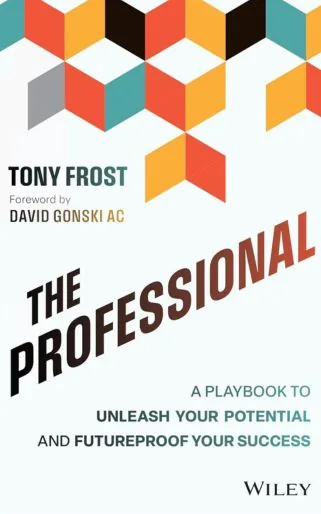
The Professional is available from Booktopia, Amazon or Tony's website.
You can find Tony at frostleadership.com.au and connect on LinkedIn.
TyAnn Osborn on A Life Aligned

Graeme Cowan on Great Leaders Care: Developing Safe, Resilient and Successful Teams
Jo Muirhead on The Entrepreneurial Clinician