


Salli Cohen's Rollercoaster argues that the policy cycle is a theoretical model mistaken for real work, and that listening to lived experience matters more than writing well. She talks about treating critique as a gift, why she wanted a subtitle that read nothing like the policy books she has never finished, and writing about a difficult period in her career without glossing it.
Rollercoaster takes aim at one of the most entrenched ideas in the field: that policy runs in a cycle. Now that you've had to argue that case at book length, what does the cycle model get most wrong about the work people actually do on a Tuesday morning?
Oh gosh, the bloody policy cycle. Or the policy wheel.
The fundamental clanger is that a theoretical model is taken to represent real life: how and what people are doing day in and day out, what they can access and what they can't.
What the cycle gets wrong, and keeps perpetuating, is that people craft policy without ever considering that they are about to change somebody's life, and it may not be for the better. Hundreds of lives. Thousands. Millions, if you're writing policy for a whole nation.
So we need to push the cycle away, get in, and understand the people whose lives we're about to impact, most of whom we will never, ever know.
You describe the book as the anchor you wish you'd had as a new practitioner. After 23 years of doing this largely by instinct, what did you find you knew but had never put into words until you had to write it down for someone else?
What I knew but had never put into words was the importance of truly listening to people's lived and living experience, so that we genuinely understand what's in front of us, be it a problem or an opportunity.
People often say to those of us who work in policy, "Oh, you must be a good writer." Sure, we write well. But at the end of the day, that's the very last thing. If we can't listen, and listen with empathy, we're not doing our job. In fact, we're causing harm.
A lot of your readers didn't choose policy. It arrived on their desk. What do those accidental policy people consistently get wrong at the start, and what did writing for them teach you about where the real confidence gap sits?
What many people get wrong in policy, whether they're newbies or seasoned professionals, is that we come to think of the policies we work on as our babies. That doesn't happen if you're against the principles of the policy, which will happen from time to time, whether you're in government or in an organisation. But otherwise we adopt it as our own, and we get defensive, sometimes downright cranky, when others critique it.
In fact, that critique is a gift. The real confidence gap sits there. Let's craft and create, and let's do it by working with and for others, constantly testing, stress testing, deconstructing. Let's ask people to give us the gift of telling us where we got it wrong, what we missed, what we overstated. Welcome it, because it's absolute policy gold.
The subtitle is "How to be a bloody good policy officer", which is not the register the policy world usually speaks in. What were you deliberately pushing against with that language, and did anyone try to talk you out of it?
It's funny, most people loved How to be a bloody good policy officer. It resonated, and it certainly resonates with an Australian audience. People overseas have bought it too, interestingly: in the States, Scotland, the UK and Germany. Maybe some of the Anglo-Saxon world gets a bit of a giggle out of it coming from an Australian author.
Nobody tried to talk me out of it. What I wanted was for it to stand apart from the top shelf policy books, by which I mean the ones written in language so dense they're inaccessible. I've been in this game a long time and I have many of those books, and I'm yet to read one in full, because I find them really hard.
How to be a bloody good policy officer grounds us. You pick it up and think, actually, maybe I can get something from this. Maybe this is about me and talking to me. It's good to shake things up. I love a bit of disruption.
You say your particular expertise is helping people when the proverbial hits the fan. Writing honestly about things going wrong is tricky in a sector where discretion matters. How did you decide which failures and messes were yours to tell, and was there anything you held back?
The failures and messes were the ones I made. I'm comfortable talking about those, because we all make mistakes.
I also write about a couple of others at a system level, to show how policy operates in systems that are complex and complicated, and there's a difference between complex and complicated. Those systems can get in the way of good policy, and they can get in the way of people becoming bloody good policy officers. There's a constant tension between crafting policy for the people we serve and crafting policy to fit a system.
And no, I don't think anything held me back. I write about a particular period in my career that was really difficult. It took me a while to write, because it still hits hard. But it was important to me to be genuine and not gloss over what can be a tough gig.
Since publication in March, you've been putting these ideas in front of policy teams rather than just on the page. What question keeps coming up from readers that you didn't anticipate, and has it changed how you'd explain your approach now?
There's been some fabulous feedback, both written, when somebody very generously drops you an email or posts something online, and in person when I'm running policy training sessions or masterclasses.
I love how people are surprised by the book. In a training room, during the breaks, people flick through the pages and you hear those little noises: "Oh. Oh, wow." Or, "Fuck me, bloody hell, never thought about it that way." I love those.
One of my favourite pieces of feedback came from a CEO who said publicly that Rollercoaster brought them back to earth, that they had forgotten so many things about not only what we're supposed to do, but who we're supposed to be. We get inside people's personal lives. We observe, we interrogate, we question, we compare a group of people here to a group of people over there. We can be very much in people's faces. That takes a certain skill set, and respect, and empathy, and the ability to ask it of those people as an invitation.
What that did was solidify that what I was writing, what I was doing and what I felt in my guts was right. So in terms of how I'd explain my approach now: I own it. That's the big difference Rollercoaster has made for me.
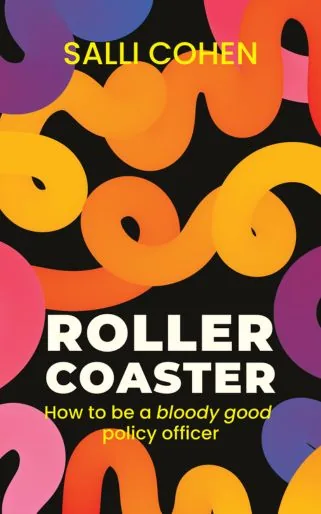
Rollercoaster is available from Booktopia, Amazon or Salli's website.
You can find Salli at thepolicyroom.com and connect on LinkedIn.

Sarah Gray on It's not you, It's Perimenopause

Dr Renee Rubin Ross on Inclusive Strategic Planning for Nonprofits
Benita Bensch on Seen Again