
Oscar Trimboli says the part of how to listen readers still write to him about is not the stories but the numbers: the gap between speaking, listening and thinking speeds, measured in words per minute. He talks here about why a transcript is a record of the past rather than listening, what he found common to more than 100 world-class listeners, and how having the book in print turned one-off workshops into nine-month programmes.
how to listen has been in readers' hands since 2022. Which part of it has proved most durable, the idea people still write to you about years later, and which part do you find yourself quietly qualifying when you teach it now?
Ironically, the stats rather than the stories.
Listening is perceived as more art than science.
Yet when a conversation is broken down to speaking, listening, and thinking speed in words per minute, readers consistently comment that the different speeds surprise, shock, and support their understanding of the topic.
If I was to rewrite the book, I would create a compelling graphic to illustrate the foundational nature of this formula.
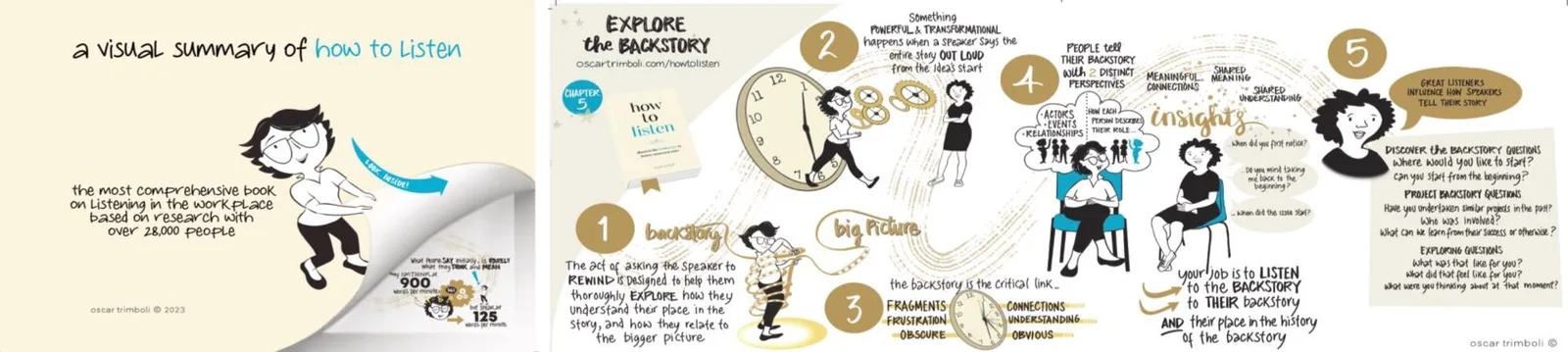
The one thing I would change around launch is the book's visual edition.
We launched this one year after the paperback, based on audience feedback. If I had my time again, I would have used it as a way to secure more interviews because the readers who love the visual edition value the concise nature of the chapter summaries.
Deep Listening came first, in 2019, and is a much leaner book. What had you learned, or earned, by 2022 that made how to listen possible, and what would have been wrong about trying to write it earlier?
By writing Deep Listening first, I could validate the concepts, appear on podcasts, test my message with an audience that doesn’t know me, and integrate the feedback into the next book.
Deep Listening was a mile wide and an inch deep, “how to listen” is a mile deep and an inch wide.
The timing between Deep Listening and “how to listen” provided the time to move from research of about 500 people mostly my clients to 14,000 people from across the English-speaking workplace.
You have spent years interviewing people about listening for the podcast alongside writing the books. How did that volume of conversation change what made it into how to listen, and did writing the book change the way you ran the interviews afterwards?
When you have interviewed over 100 workplace listeners, including Air traffic controllers, the blind and deaf, emergency respondents, foreign language interpreters, hostage negotiators, Judges, journalists, spies, and military personnel, you start to notice patterns about what world-class listeners have in common and what they do differently in their specific context.
All world-class listeners have
1. A ritual before they commence
2. An ability to be in and above the conversation
3. Understand that it’s not their job to understand; it's their job to help the speaker make sense of their thinking
I suspect the patterns emerged at around 50 interviews, and I felt comfortable that the patterns were consistent around 100 people.
With the research from 14,000 people at the time of publishing, I am now planning to shut down the research as we near 36,000 respondents, as the results vary little across professions, age, gender, industry, seniority or country.
Writing the book increased my curiosity about what the audience wanted rather than what I wanted to understand about listening at work. It meant the interviews were more organic, sometimes resulting in shorter recordings and sometimes much longer ones. I became much more comfortable with publishing episodes where I was the only speaker rather than the traditional interview format.
Since the book came out, meetings have become things that get transcribed, summarised and searched by software. Has that shifted what you think the human part of listening is actually for, or has it mostly confirmed what you wrote?
I was selling video conference technology 3 decades ago and worked for some of the largest software companies in the world; I am confident in these principles when it comes to human dialogue and technology.
1. Transcriptions are not listening; they are a recording of the past.
2. Human dialogue changes when it is recorded.
3. Humans change the direction, depth and distance of a discussion, NOT software.
4. Your presence as a leader has more impact than any question you ask or what software is being used.
5. Some software can change the participants' state of mind during a discussion; e.g., real-time in-meeting display of the Speaking to Listening ratio can change the presence of the participants
6. Technology can augment speaking, listening, questions, yet it can’t replace the presence of a human
You work with chairs, boards and executive teams, rooms where you could simply run a session and leave. What has having how to listen in print continued to make possible in that work that a workshop on its own never did?
“how to listen” has moved me from selling keynotes and workshops to implementing 6- to- 12 month programs that drive systematic change. Before the book, there was very limited impact after the presentation.
The book has enabled more sustained change.
1. We pair participants during and after the keynote or workshop.
2. They read one chapter of the book each month.
3. They regroup every 6 weeks for 30 minutes, either in their pairs, intact teams or projects, to reflect on their listening as it relates to the fundamentals of each chapter.
4. They do this over 9 months to embed the learning.
5. They scale the impact without your presence.
Before the book, a series of 13 emails was delivered once a week for individual reflection.
After the book, learning moved from individual to group learning, and they got to practice their listening with the tangibility of the book, which wasn’t possible with the previous email approach.
The book creates a bigger, more systemic change in how my clients listen, to each other and outside their organisation.
After two books on the same territory, what do you now know about writing that only shows up on the second or third attempt? And what would you say to an author who has just finished their first and is wondering whether there is another one in them?
1. I only discovered what the audience really needs to know about listening in the workplace after my second book.
2. I wrote too much detail in how to listen and could have written a book with 50% less.
3. I learned that listening is a function of the board and the executive team; if they don’t listen, their teams will never improve their listening.
4. As a result of this, I am now researching how boards and executive teams listen to each other as part of the process for the next book.
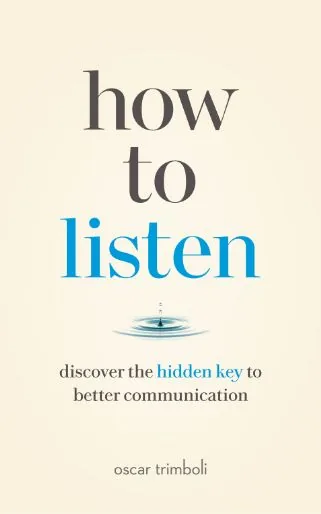
How to Listen is available from Booktopia, Amazon or Oscar's website.
You can find Oscar at oscartrimboli.com and connect on LinkedIn.
Faye Evans on Soulful Simplicity

Jacqui Clarke on Stop Worrying about Money

Monique Zytnik on Internal Communication in the Age of Artificial Intelligence