


Monique Zytnik deliberately wrote about principles rather than products, and says the one thing she did not see coming was how fast AI agents could absorb the tactical side of internal communication. She talks about why "content is cheap" shifts the weight onto leaders in the room, and what a traditionally published book does and does not pay.
Your book landed in May 2024, when generative AI in the workplace was still mostly novelty and nervousness. Looking back at it now, which parts of the argument have held up best, and what dated faster than you expected?
It's hard writing a book about technology that is moving so fast. I deliberately didn't go into the details of different products and kept to the overall principles. Reading back on it now, I am so proud of how well it has stood the test of time. People reading it now are still inspired.
At the time of writing, one thing I couldn't really have seen was how much impact AI Agents have had. It was still a concept that only those in the know knew about.
You built the book on global case studies and stories from practitioners rather than predictions about where the technology was heading. Was that a conscious decision about shelf life, and would you make the same choice if you were starting the manuscript today?
I focused on stories and case studies because they bring concepts to life. They make books interesting, and we (now) all know you can't get them from AI. Even the best forecasters haven't been able to predict the speed of AI development, so I'm glad I didn't. Toward the end, I share a framework for implementing AI in communication teams, and again, I'm glad I stuck to the principles rather than focusing on prompt writing. My method is still valid today, and I have also used it with clients.
What do you understand about AI's effect on internal communication now that you simply could not see from where you were sitting while writing it?
I used a quote from my book to open a keynote last week in Warsaw. "Content is cheap." Since writing my book, I've further developed my ideas on the skills and positioning internal communication practitioners need to focus on to be future-fit. I'm also seeing a lot of things unfold, such as leaders doing more of their own content, which is why I wrote my book for leaders.
The one thing I didn't see was how easily our tactical work as practitioners can be replaced by AI agents. I don't think I fully understood the impact of agents, nor the huge risk they bring or the degree of governance required.
You trained as a physiotherapist and changed direction when you saw how much motivation and persuasion shaped your clients' results. When you are in the room with an executive leading a transformation, where does AI genuinely change that conversation about motivating people, and where is it a distraction from the same human problem you noticed back then?
With the sophistication of AI, including people having AI twins and deepfakes, I see that exceptional and strategic executive communication is more important than ever. It is the in-person performance they need to excel in, as AI can do the rest.
AI can create a speech, be the person in the video, write the press release; however, on stage, in a room full of people, it is up to the leader standing there to deliver a persuasive and compelling narrative.
More than ever, we need to focus on the experience people are having. We need to deliberately use immersive communication to get cut-through.
Beyond the award and the keynote invitations, what has having the book actually made possible in your consulting and interim work? And what did you assume a book would do for you that it quietly has not?
Having published an award-winning book with a reputable publisher has contributed to securing interesting projects with big clients. My online presence, focused around my book, added to my credibility.
I assumed that I would earn money from the book - you do, but it is indirect through opportunities. People don't realise that each time you sell a traditionally published book, the author gets the price of half a coffee. I also didn't realise until the end of the process that all the marketing would fall on me. The publisher is only responsible for the distribution channels.
If a communicator came to you wanting to write a serious book about a subject that is moving as fast as this one, what would you tell them about structuring it so it still earns its place on a shelf two years later?
Always look up a level and go for principles. A book is not a blog article. It is not a keynote that needs to be relevant in the moment; a book is something that lasts.
An excellently written book that earns its place on someone's bookshelf and is quoted in future books focuses on the people, not the technology.
What is the one piece of advice you'd pass on to upcoming authors.
A published book is something that no-one can ever take away from you. I never expected how it would feel to open the first box of my own book, nor how it feels to hold it proudly above my head to show the world. My one piece of advice, and something another author passed on to me, is that you only have your first book launch once. Enjoy every second of it. I did!
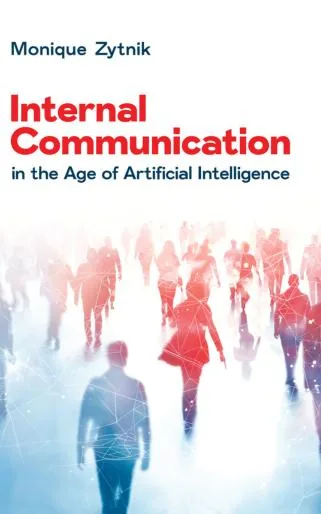
Internal Communication in the Age of Artificial Intelligence is available from Booktopia, Amazon or Monique's website.
You can find Monique at moniquezytnik.com and connect on LinkedIn.

Faye Evans on Soulful Simplicity


Jacqui Clarke on Stop Worrying about Money
Maree Burgess on Level Up