
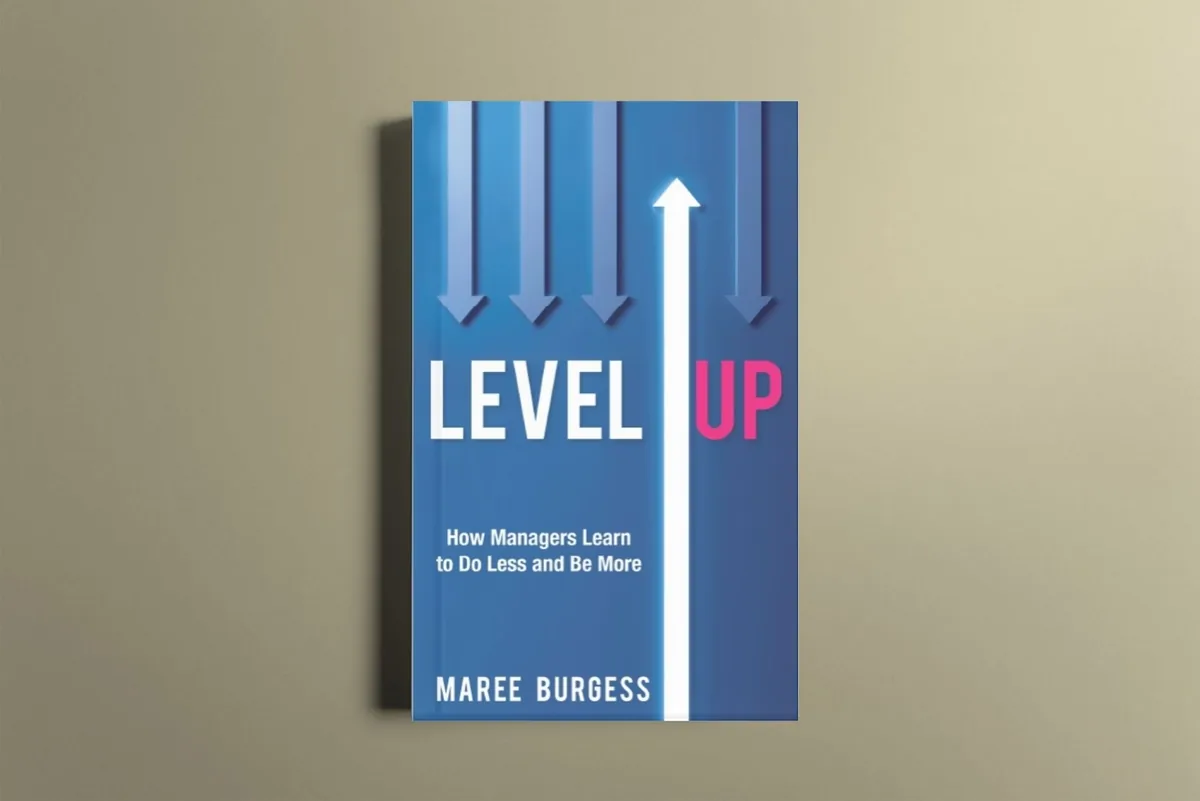

Four years on from Level Up, Maree Burgess says delegation is the change leaders actually hold on to, while a couple of the book's models have not survived her own rethinking. She talks about moving from what leaders do to what they believe, and why a book still builds trust in a way years of posts and newsletters have not.
Level Up rests on the idea that small changes in how you lead and work with others make a large difference to the people around you. Four years on, which of those small changes have proved to be the ones that actually stick for leaders, and which turned out to be harder to hold than you expected?
The biggest change that I found sticks for leaders - is the art of learning to delegate effectively which is a big chunk of Level Up. A couple of models I include in the book, haven't stood the test of time - and my thinking has definitely evolved since then.
Your work now is framed heavily around delegation and leading at the right level. Was that thread already running through Level Up, or is it something that sharpened only after the book was out and you kept testing the ideas with managers?
Delegation and leading at the right level is a thread running through Level Up - and as my thinking has evolved these two areas are much smaller components of what I talk about to leaders.
You describe middle managers as the bridge between strategic vision and daily operations, and the ones who cop the blame from both directions. What do you understand now about why they get stuck there that you would have written differently in 2021?
My thinking about middle managers is pretty much the same as in 2021. I'm not saying they get stuck there, more around what is happening when they are there. I focus a lot now of how they can influence - up to senior levels, and down to their team.
Your career ran through the Forestry Commission, nursing in a trauma hospital and senior banking roles before coaching. When you were writing Level Up, how did you decide which of those experiences earned a place in the book and which ones you had to leave out?
I'm always grappling to find enough stories to include in my writing - and with Level Up I was constantly stretched to find more stories. So I tended to add everything LOL. My decision on what to include or not, was more around asking myself 'did it have a leadership lens?'
Much of your current writing is about busting limiting beliefs and perspective shifting, which feels like a layer underneath the behaviours Level Up teaches. Has your thinking moved from what leaders do to what leaders believe, and if so, what prompted the shift?
Agree - my thinking has really started evolving. I wrote Level Up initially because I kept being told 'I was all about teaching people to delegate'. And now I realise that I'm more about 'helping people see things differently - so they have more choice' hence the leaning towards perspective shifting and limiting beliefs. The change is more because I think I'm understanding myself more, and where my strengths really lie (I know it's taken this long - and keeps emerging)
Leadership advice is now being generated at enormous volume, much of it by machines. What do you think still makes a leadership book worth the years it takes, and what has Level Up continued to open up for your practice that a stream of posts and articles never would?
Level Up continues to open up 'trust' with the people I work with. A book (or three) really adds to credibility. I've been writing posts, articles, and newsletters for years now - and I still think that a book creates more credibility about what I do that any of those have.
Level Up is available from Booktopia, Amazon or Maree's website.
You can find Maree at mareeburgess.com and connect on LinkedIn.

Faye Evans on Soulful Simplicity

Jacqui Clarke on Stop Worrying about Money

Monique Zytnik on Internal Communication in the Age of Artificial Intelligence