
 Penelope Barr spent her career in technology, transformation and product leadership before running around 150 experiments on her own sleep. She talks about why she stopped treating the day as the unit of productivity, and why she won't give anyone a list of five rules.
You've spent your career in technology, transformation and product leadership, and you coach people through what you call the messy middle. Of all the things you could have written a book about, why sleep?
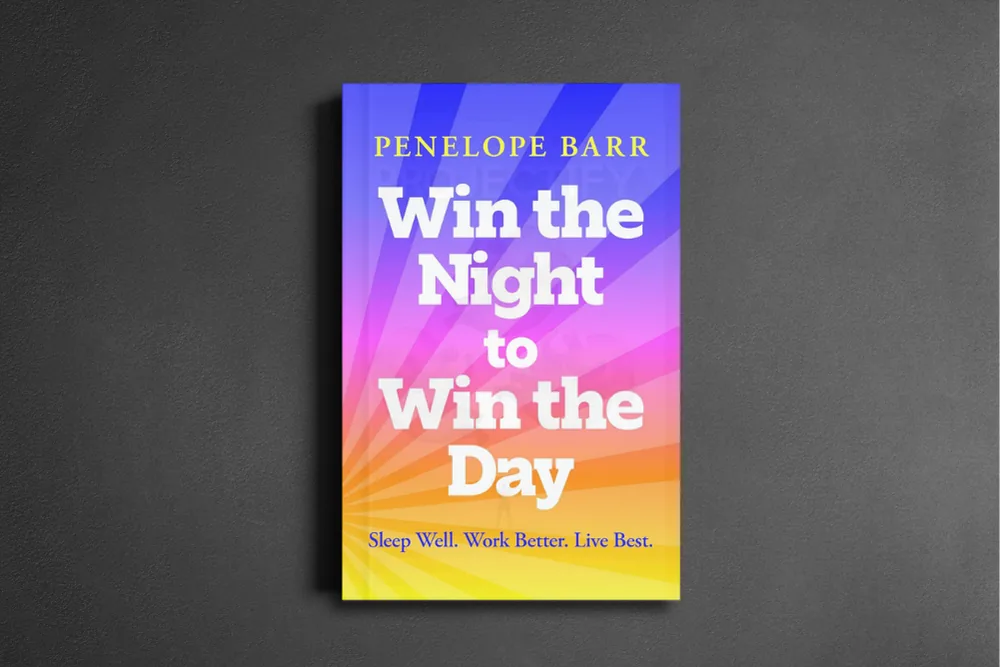
The book is titled: "Win the Night to Win the Day. Sleep Well. Work Better. Live Best". It starts by exploring the importance of sleep as the foundation of it all. I realised I'd been treating sleep as the thing that happened after the important work was done. But the book is also about working well so you can live your personal best.
For most of my career, I've been fascinated by performance, transformation, productivity and the question of how we move from where we are now to where we want to be. But I was operating under a contradiction: trying to perform better by squeezing more into the day, while largely ignoring the thing that determines how well we show up.
Sleep kept coming up in my own life. I'd experienced those 3am moments when your brain decides that tomorrow's problems need solving immediately. I also had a husband and a dog who weren't exactly helping my sleep!
So I started experimenting.
What began as a personal curiosity became around 150 experiments, conversations with experts and a much deeper exploration of the science and behaviour of sleep.
The more I learned, the more convinced I became that sleep isn't a wellness issue sitting on the sidelines of performance. It's foundational.
I've spent my career helping people and organisations transition from "now" to "next". I realised sleep is part of that transition too. If you want better days, better decisions, better leadership and ultimately a better life, you have to start by asking what happens the night before.
That became the premise of Win the Night to Win the Day: the best days aren't made in the morning. They're made the night before.
The title puts the night first, which is the reverse of how most productivity advice is framed. What convinced you the causality runs that way, and what did you have to unlearn from your own working life to believe it?
I actually don't think of night and day as separate at all. That's the bigger idea behind the title.
We tend to think about the day as the productive bit and the night as the recovery bit, as though we finish work, switch off, sleep, and then start again with a clean slate in the morning. But we're not machines that reset at midnight.
The night influences the day, and the day influences the night. What we do, think about and experience during the day affects how we sleep, and how we sleep affects how we experience the following day. It's a continuous cycle.
So "win the night to win the day" isn't really saying the night is more important. It's saying that if we want a better day, we need to pay attention to what we're carrying into the night and if we want a better night, we need to pay attention to how we're living during the day.
That was a significant shift in my thinking.
I'd spent much of my career treating the day as the unit of productivity: What can I achieve today? How much can I fit in? How can I make tomorrow more productive? I've spent decades being 'always on'
I had to unlearn the idea that every day should simply be maximised and find ways to be 'intentionally on'
Instead, I started thinking in cycles: work and recovery, effort and restoration, focus and release, day and night.
And that changed the question from "How do I get more out of my day?" to "How do I design my days and nights so that each one sets up the next?"
For me, that's where sustainable performance lives. Not in endlessly optimising the day, but in understanding the rhythm between the two.
What did writing the book teach you about sleep that you didn't know when you started, and did anything in the research force you to revise advice you'd already been giving clients?
The biggest lesson was that sleep is much more individual and much more contextual than I initially appreciated.
There isn't a single perfect bedtime routine or magic sleep hack that works for everyone. Sleep sits at the intersection of biology, behaviour, environment, mindset, relationships, work and the realities of your life. That changed how I think about advice generally.
I'm much less interested now in telling people, "Here's the five things you must do to sleep well," and much more interested in helping people become curious about their own sleep, or their own issues or problems in any domain.
I did 150 experiments over a couple of years while writing the book. Some things worked brilliantly for me. Others didn't. And some things that sound ridiculously simple can make a surprisingly big difference when you do them consistently.
The research also reinforced something I already knew from my transformation work: small experiments are often more useful than grand intentions. You don't have to redesign your entire life on Monday morning.
You can change one thing, observe what happens, learn from it and adjust.
That's the same approach I use with people navigating career and life transitions. Don't wait until you have the perfect answer. Run the experiment.
Sleep sits awkwardly inside organisational cultures that still quietly reward exhaustion. When you raise it with executive teams, where does the resistance actually come from?
Most executives know they should sleep more and work less. The resistance rarely comes from people thinking sleep is unimportant. Instead it comes from the gap between what organisations say they value and what they actually reward.
We can talk about wellbeing, but if the person who responds to emails at midnight is seen as more committed, or if being permanently available is treated as leadership, an organisation is sending a much stronger message.
That's why I talk about performance.
If you want people making good decisions under pressure, thinking creatively, navigating ambiguity, managing relationships and leading through change, then you need people who have the capacity to do those things. Sleep is part of that capacity.
Writing the book has given me much stronger language for that conversation. I'm not asking organisations to be kinder to people because it's nice to do so. I'm asking them to recognise that workplace exhaustion is not a strategy.
High performance without recovery eventually becomes endurance.
And endurance is not the same thing as sustainable performance.
Your 6:3:3 model builds in a rejuvenating season, which suggests rest was already central to how you structure your work. Did writing this book change how you personally sleep, or did it mostly give you language for something you were already practising?
Both.
The 6:3:3 model sees me working and living in seasons I call Generate, Create, and Rejuvenate. I've created freedom within structure by recognising I don't want to live in one permanent mode of productivity. The philosophy of recovery is inbuilt in this model.
Writing the book made me more intentional about what happens at the end of every day, not just across the year.
I became much more aware that rejuvenation isn't simply about taking a holiday. You can't run yourself into the ground for eleven months and expect two weeks in Italy to magically restore you. Recovery has to happen at multiple levels: across the day, across the week, across the year and across the way you design your life.
That has probably been the biggest personal shift for me.
I've become much more protective of sleep because I now see it as part of my operating system, rather than something that competes with my work.
And, yes, I've also given up coffee which may be the most concrete evidence that writing a book about sleep can have consequences!
Now the book is out and people are responding to it, what question are you getting most often, and what would you say to someone at the very beginning of writing about a topic this personal?
The question I hear most often is some version of: "What's the one thing I should change?"
And my answer is usually: there isn't one thing.
- Start by getting curious.
- Notice what happens to your sleep. Notice what affects it. Notice what happens to your energy and your work when you sleep well and when you don't.
That's actually the philosophy behind the book. I'm not interested in creating another list of rules that people feel guilty about failing to follow. I'm interested in helping people find what works for them.
And to anyone at the beginning of writing about something personal, I'd say: don't try to write the book you think you're supposed to write. Write the book only you could write. Your personal story is what invites people into your world. Your experience gives the subject texture and credibility. But the key thing is to turn that experience into something useful for the reader.
I didn't set out to become a sleep expert. I started with a problem I was experiencing, got curious, experimented, researched, asked a lot of questions and followed the thread. I believe how you do anything is how you do everything and it was the same in how and what I wrote. I had a problem, experimented, sought experts and others' experiences, and combined new information with other areas of expertise to effectively integrate the learnings into my day-to-day.
.webp)
Win the Night to Win the Day: Sleep Well. Work Better. Live Best. is available from Penelope's website.
You can connect with Penelope on LinkedIn.

Why Are You Writing a Book? The Purpose Question Most Authors Only Half Answer
Thinking About Writing a Parable or Business Fable? Here’s What to Know First
What have I learned about Book Awards by being a judge?