
How our Community Book Launches work
Our Community Book Launches celebrate the audience as much as the authors. Friends, colleagues and anyone curious about writing a book are welcome.
The format has a twist.
The authors swap books. Each one reviews a fellow panellist's book, then the audience asks questions (and the people who ask win prizes).
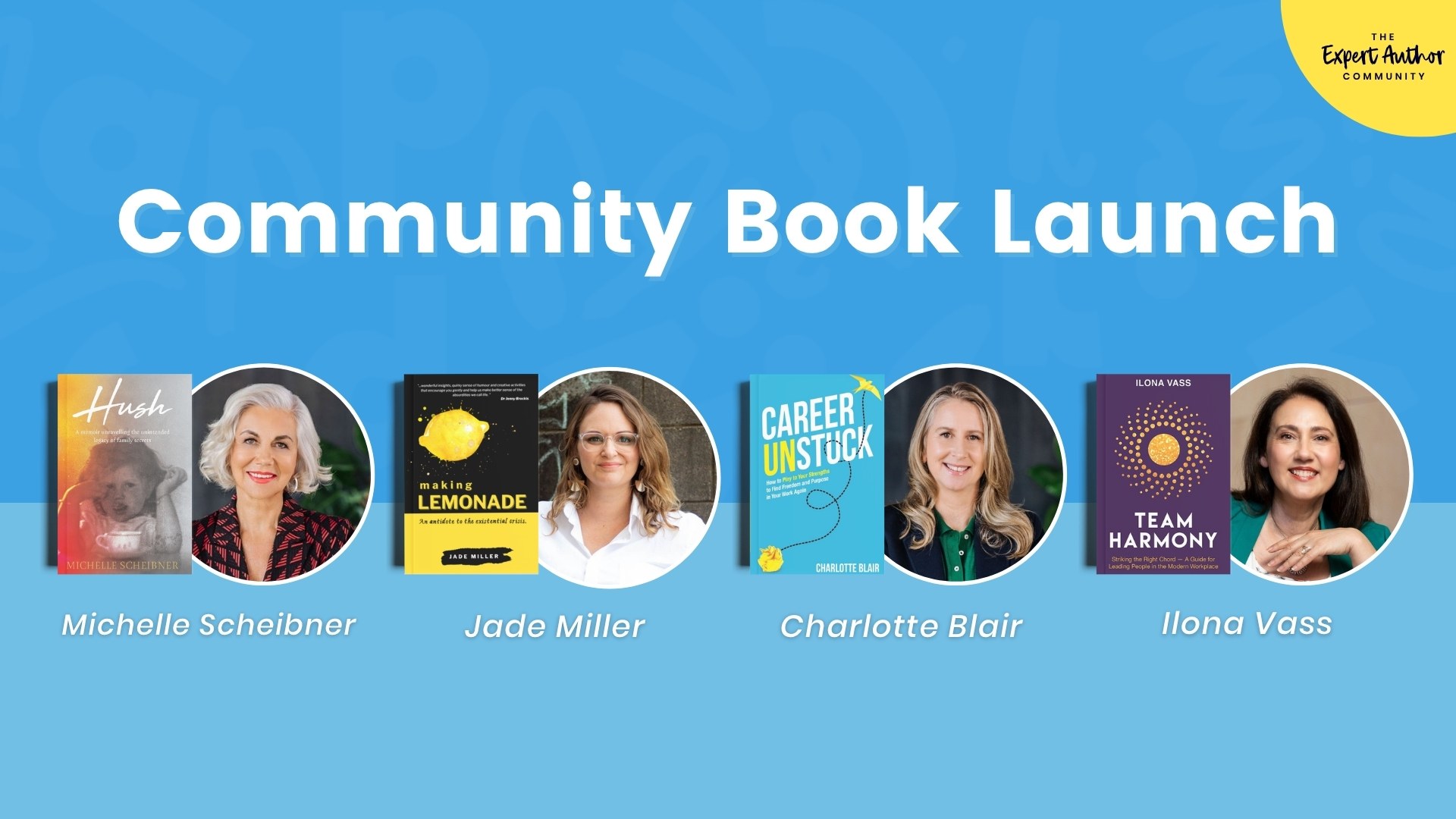
This time the reviews ran in a circle. Kelly Irving hosted, with Penelope stepping in as co-host at short notice. Three of the books were already out in the world. Michelle's was still on its way.
Around the circle:
- Hush by Michelle Scheibner
- Making Lemonade by Jade Miller
- Team Harmony by Ilona Vass
- Career Unstuck by Charlotte Blair
Watch the full launch
Hush by Michelle Scheibner
Charlotte Blair met Michelle soon after joining the community, and Michelle was "always there as... part of a writing sprint".
Michelle works with clients in the world of personal brand. Hush is her memoir about family secrets and the legacy they leave behind.
The book wasn't yet published when Charlotte reviewed it, and she was "one of the first people outside of the publishing" to read it.
"I don't think I've ever read a memoir before. But now I have read Michelle's book. I feel like I'm hooked."
She called it "such a kind of page turner, it's so well written. It's beautifully captivating".
"I love how it bounces between dates and events. It's not, am I saying the right word? Chronological."
The book took Michelle three and a half years, and this is its third version.
"The surprise for me is that I had no idea that I was gonna be writing Hush three and a half years ago."
Writing it changed how she thinks about identity, from labels and skills to the generations who came before her. And she was clear about what she hopes readers take from it.
"It isn't the details of my story that are important. It's what it opens up for you, for the reader."
For Michelle, telling the story has been freeing.
"Un-hushing has lifted a load off, and that's what I want for the reader."
Making Lemonade by Jade Miller
Jade is a communication strategist with 20 years in communications and marketing, and a background in visual thinking, strategic problem solving and coaching. Making Lemonade is her antidote to the existential crisis.
Michelle reviewed it and found it joyful to read, despite the serious subject.
The illustrations anchor the ideas. The phone becomes a "dark rectangle". The old frog-in-boiling-water idea gets redrawn as "all these people lined up in a pot, like the cannibals pot over the fire, over the flame."
"You've taken a lot of things and put a new freshness to them."
Jade also challenges her readers' thinking. "I don't know if I agree with that... but it was okay because I felt like it, I felt like I was being invited to do that anyway."
The chapters are uneven in length, and that's deliberate.
"I sort of wanted to create an experience that gives people an insight into my brain. There's longer, deeper parts, and then there's some really short, sharp, funny parts."
Her "secret list" of quirks, like combat boots whose thread colour doesn't match her wardrobe, is there "as a way of opening up vulnerably so other people feel okay about their quirks too."
Michelle had one more question. "Why isn't there a recipe for lemonade?"
"I did have lemonade at the book launch, spiked or sober you could choose."
Michelle's verdict was that the matrix in the final chapter is "kind of the recipe".
Team Harmony by Ilona Vass
Jade introduced Ilona as "a very experienced expert in leadership and team development". Ilona is from Austria and teaches at a college.
Team Harmony is Ilona's guide for leading people in the modern workplace, built on musical analogies from her own relationship with music.
Jade said it comes "from a place of compassion and with connection", and that it "in itself is a very harmonious book. It's really beautiful to read. It feels like music".
The book is organised in three sections: resonance, dissonance and consonance. Its central idea is "for leaders to take that responsibility to conduct the orchestra of their team into harmony."
The idea came from a night at the Vienna State Opera. Sitting high above the orchestra pit before The Magic Flute, Ilona watched each musician prepare in their own way. Only later, while researching harmony at work, did she realise that was the spark. "It all fell into place all of a sudden... it had to be a musical concept."
When an audience member connected harmony to remote work, Ilona said harmony isn't about everyone being nice.
"We can't have harmony if everyone sings the same note. We need to have that dissonance."
What matters is how a leader handles it. "...how we go about this dissonance makes or breaks teams and it makes or breaks a company culture."
Career Unstuck by Charlotte Blair
Charlotte was born in England and now lives in rural Victoria. She spent years in IT sales with multinationals including Canon and Verizon, until a 7 Habits of Highly Effective People course in 2011 prompted her to change direction.
Today she's a coach's coach, facilitator, speaker, mentor and CliftonStrengths coach. Career Unstuck is her book about playing to your strengths to find freedom and purpose in your work again. She published through Grammar Factory.
Ilona said the book supports the belief that 10 out of 10 fulfilment at work is achievable.
"You bring in so many stories which are often very, very touching and especially I love the graphics."
Her favourite was the "community of selves" graphic, inspired by Inside Out. Every self has a gift, and none should run the show.
Charlotte's advice for dealing with a critical inner voice is to name it, talk to it, thank it, and tell it you've got this. One person in the book named theirs Kevin. "Zip it Kevin."
Charlotte knows that voice well. Writing a book sat on her to-do list for about four years.
"I had this voice in my head that said, you're dyslexic, Charlotte. You can't write a book."
She was upfront that it isn't a job-application guide.
"I think my book is a little bit more about if you are stuck where you are, how do you get unstuck?"
Instead of job hunting, she encourages job crafting: "Go have a conversation with how might we job craft this so that I get to use my strengths more."
What this panel taught us about writing a book
Writing is only the first of three projects
Ilona's timeline shows how the projects stack up.
"The writing was about three, four months. Then the whole structural editing designing process was another four months."
Then came the third. "What you do after your book kind of hits the Amazon shelf... Or the bookstore shelf. That is where I felt dissonance."
Jade felt the same. "I almost felt like writing was the easy part, and then getting to the publishing and all the things you have to do, and then that's a whole project. And then the next part, the publicity part is a whole nother project as well."
Ilona was candid that this is the phase she's still working through, and she wants to find "how I can keep it up".
Shape your structure around your reader
For Ilona, structure was a lifeline. "It really helped me to focus, it helped me to follow a structure... for me, it was kind of a saving grace."
Jade structures things for a living, and still chose to let her own book breathe.
Kelly pointed out that the shape of a book follows its reader. A memoir like Hush is read cover to cover as a story. Making Lemonade is one you dip in and out of, "a book that you keep on your nightstand and you keep coming back to time and time again."
As she told Michelle and Jade, "you've both, you've given people permission to do what feels right for you."
Tell people what you're doing
When an audience member asked Michelle how she found the tenacity to start new drafts, community came first.
"I had the support of this community, I would say is the first thing... I wasn't sort of drifting around on my own."
A fellow member, Robert, kept her honest: "Now, have you written a chapter yet? You've gotta start writing."
"When you put it out there and you tell people, this is what I'm doing, the support comes from surprising places."
Charlotte found stories for her book the same way, with a call-out on Facebook. "It was really just putting the call out and putting a invitation and then transcribing it."
Your title and cover are worth the extra rounds
Charlotte's working title was "Don't Stop Me Now", her favourite song. When Career Unstuck came up, she didn't like it at first, because the book is about your job, not your career.
She polled a Facebook community and came round to it.
"Job Unstuck just doesn't sound the same as Career Unstuck."
The cover took even longer. She saw about 40 versions she didn't love.
"How can I publicise a book that I really don't love the cover, it just doesn't feel right."
Brighter blues and yellows helped. Charlotte narrowed four favourites to two and polled LinkedIn and Facebook, where about 90 per cent chose the same one.
Why the third project matters
Ilona's radio story is what the third project looks like when it works. A host invites an author on air, and a fellow author happens to be listening.
It's also where community counts. Charlotte now points readers to fellow authors' books when a topic isn't her area.
"I now have a host of other people that I can suggest... Go play to their strengths."
Kelly closed with a reminder for everyone on the call: "It's not easy asking people to buy your book or support your book. So I'm gonna do that for them."
"$15, $20, $30 goes a long way in an author's life."
Writing a book of your own? The Expert Author Community is where authors like Michelle, Jade, Ilona and Charlotte plan, write, publish and launch their books alongside each other. See how the community works.

Sarah Gray on It's not you, It's Perimenopause

Salli Cohen on Rollercoaster
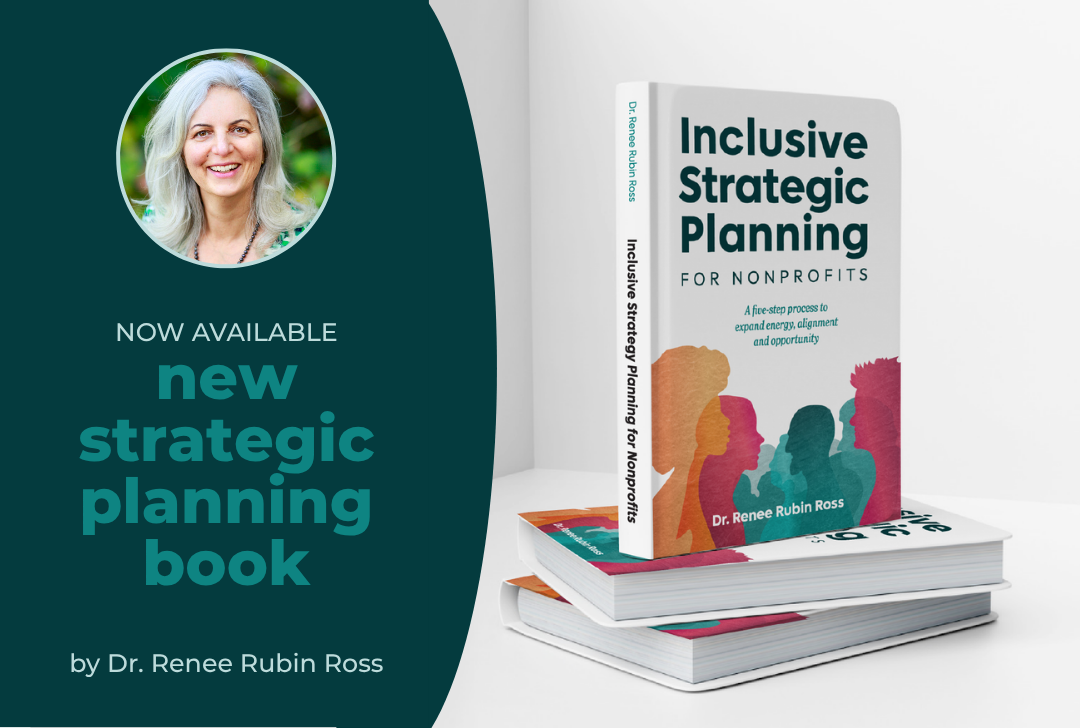
Dr Renee Rubin Ross on Inclusive Strategic Planning for Nonprofits