

You've probably lived this moment already. You hand a client a sharp report, full of logic, models, and recommendations. They nod politely, thank you, and do very little with it. Then, in a later meeting, you tell a simple story about a manager who kept solving the wrong problem, and suddenly the room changes. People lean in. They repeat your point back to you. They remember it.
That is the appeal of business fables.
For expert authors, consultants, coaches, and advisers, business fables aren't a side project for people who secretly wish they were novelists. They're a way to make an idea travel. A good fable gives your expertise a shape that readers can hold onto long after they've finished the chapter. Instead of presenting a framework in abstract terms, you let readers watch someone struggle, decide, fail, learn, and apply the lesson.
If you're trying to build authority, that matters. Thought leadership isn't just about having a strong idea. It's about making that idea memorable, teachable, and usable. If you're refining your broader positioning, this guide on how to become a thought leader is a useful companion to the book strategy side of the conversation. And if you're still weighing whether your concept has enough substance for a full manuscript, it also helps to browse examples of good book ideas.
The important question isn't whether business fables exist as a genre. It's whether they're the right vehicle for your message, your market, and your commercial goals in Australia.
Table of Contents
- Stories help readers rehearse decisions
- The real weakness of the format
- Why some lessons belong in a fable
- Start with the business problem not the plot
- Build the turning points readers can use
- Make the book teach as well as tell
- A quick draft test
More Than a Story The Authority of Business Fables
A strategy consultant I once worked with had a common problem. His advice was sound, his process was organised, and his clients respected his expertise. But his recommendations often landed as paperwork. People agreed with them intellectually, then went back to their habits.
What changed his results wasn't a better slide deck. It was a story.
He started describing a fictional business owner who kept hiring more people to solve a delivery issue that was caused by unclear decision rights. That character wasn't real, but the pattern was. Clients could see themselves in the mistake without feeling exposed. They stopped arguing with the diagnosis and started discussing what to do next.
That's the authority of business fables. They don't replace expertise. They package it in a form people can remember, repeat, and act on.
Why experts reach for stories
When an expert writes a conventional how-to book, the value usually sits in the framework. When an expert writes a business fable, the value sits in the interaction between framework and narrative. The story does some heavy lifting that diagrams and bullet points often can't do on their own.
A business fable can help you:
- Lower resistance: Readers often accept a lesson more easily when they watch a character discover it.
- Make abstract ideas concrete: Culture, leadership, trust, change, and strategy become visible through scenes and choices.
- Create a signature teaching tool: A strong fable gives you a repeatable story you can use in workshops, keynotes, sales conversations, and client work.
Practical rule: If people understand your idea but still don't apply it, a story may carry the lesson better than another explanation.
Authority comes from usefulness
Some writers worry that a fable will make them look less serious. Usually the opposite is true, if the story is built properly. Readers don't judge authority by how dense your prose is. They judge it by whether your book helps them make better decisions.
A business fable works best when your audience needs clarity, not complexity. If your expertise solves a repeated human problem inside organisations, such as misalignment, poor communication, stalled change, weak accountability, or confused leadership, a story can often carry that lesson with more force than a manual.
The key is to treat the book as a business tool, not a creative detour.
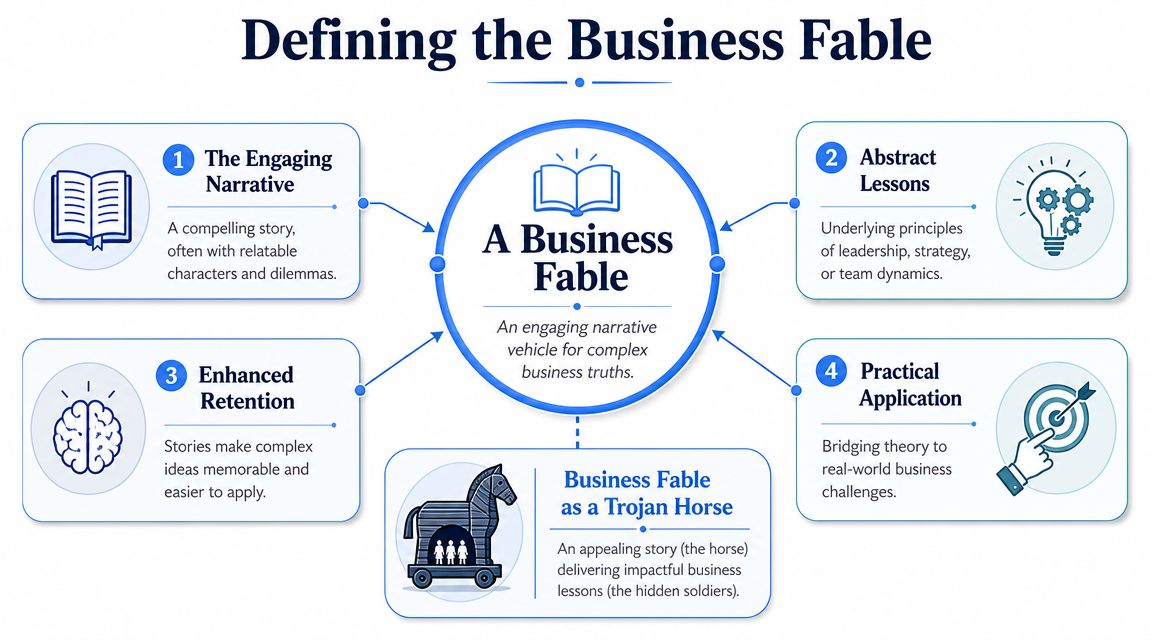
Defining the Business Fable
A CEO has a sound framework for delegation. She explains it well in keynotes. Clients nod, agree, and then go back to micromanaging by Friday. Put that same lesson inside a story about a founder whose growth stalls because every decision bottlenecks at her desk, and the idea starts to travel differently. Readers can see the cost, feel the tension, and recognise themselves.
That shift explains what a business fable is.
A standard business book often presents the model first, then proves it. A business fable puts the reader inside a work problem and lets the model reveal itself through choices, consequences, and change. The teaching is still deliberate. The delivery system is narrative.
What makes a book a business fable
A business fable is a short, purposeful story built to teach a practical lesson about work. It sits between pure non-fiction and pure fiction. The story is not decoration. It carries the method.
That distinction matters because expert authors often confuse a fable with three nearby formats:
- A business parable: usually shorter, more symbolic, and less tied to realistic workplace detail
- A case study book: based on real examples, usually explained rather than dramatised
- A novel with business themes: driven mainly by plot or character, without a clear teaching framework
A strong business fable usually contains four working parts:
ElementWhat it doesSimple exampleA relatable protagonistGives the reader someone to measure themselves againstA founder who cannot delegateA business conflictCreates pressure that makes the lesson matterTeam growth exposes hidden dysfunctionA guide, principle, or discovery pathMoves the reader from problem to insightA mentor, process, or repeated challengeA clear takeawayTurns the story into something usableA leadership model or decision rule
Remove any one of those parts and the structure weakens. Without real conflict, the book reads like a lesson dressed up with scenes. Without a clear takeaway, it reads like a competent short novel that happens to be set at work.
A useful test is this. If the story could be swapped for a list of tips with no real loss, it is not yet a business fable. If the lesson stays fuzzy after the final chapter, it is not doing enough teaching.
Why the format matters in Australia
For an Australian expert, choosing a fable is not only a writing decision. It is a positioning decision.
Readers buy business books for different jobs. Some want a manual they can dip into between meetings. Some want a framework they can hand to a leadership team. Others need help seeing a stubborn human problem clearly enough to act on it. Business fables serve that third job especially well.
This is why the format can be commercially smart. A consultant, adviser, speaker, or founder is rarely publishing only to inform. The book also has to support authority, sales conversations, workshops, referrals, and strategic visibility. In that setting, a fable can work like a memorable client story that scales. It gives your audience a shared reference point they can repeat long after they have forgotten a diagram on page 42.
You can see this same teaching pattern in well-chosen stories for work, where the lesson becomes easier to recall because it is attached to action, tension, and consequence.
That does not mean a fable is always the right choice. If your subject depends on technical precision, regulation, or detailed how-to instruction, a traditional non-fiction format may do the job better. If your challenge is behavioural, cultural, or relational, a fable often gives the reader a clearer path from insight to action.
The easiest test for confusion
Readers often ask whether a business fable is storytelling.
A clearer answer is that storytelling is the method, while the fable is the book's structure. An anecdote inside chapter one does not make a book a fable. A true business fable is organised so the reader learns by following a character through a business problem that has been designed to teach something specific.
For expert authors, that design question matters more than the label. The issue is not "Could I write a fable?" It is "Would a fable help my audience apply this idea better than a prescriptive book would?"
That is the definition worth using. A business fable is a teaching tool in story form, best used when you need readers to grasp behaviour, judgement, and consequences, not just information.
Why Fables Make Complex Ideas Stick
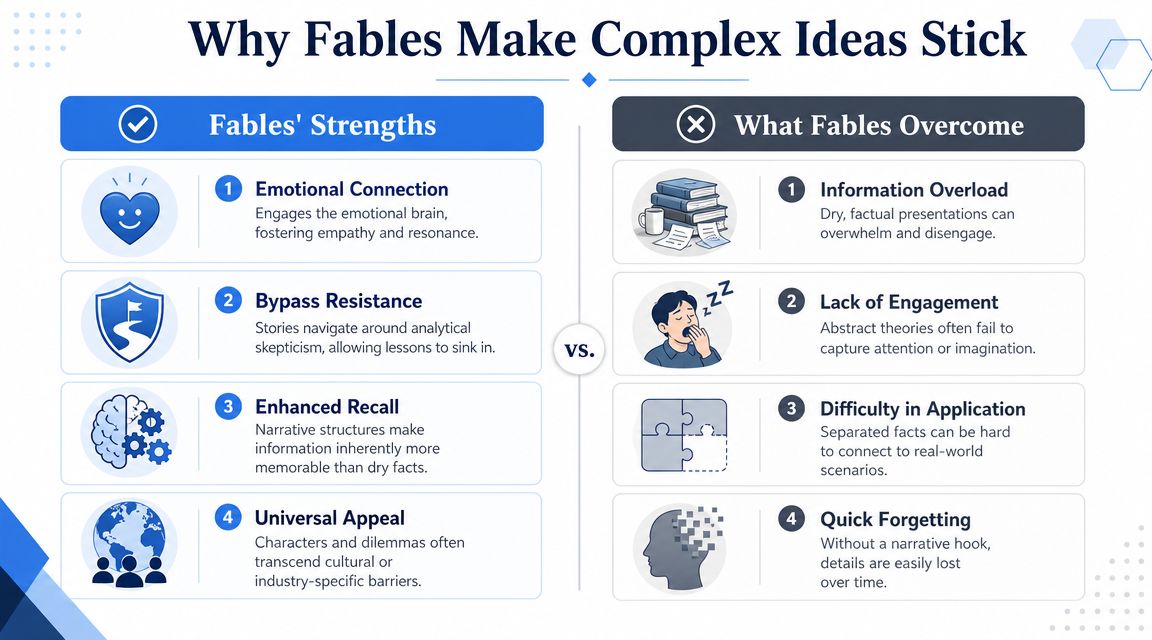
Some ideas are hard because they're technical. Others are hard because they involve behaviour. Business fables are especially useful for the second category.
You can explain trust, accountability, culture, or strategic focus in neat language. But those lessons often remain slippery until a reader watches a person make a poor choice, feel the cost, and change course.
Stories help readers rehearse decisions
A useful way to think about business fables is that they create a low-risk rehearsal space. Readers can test a decision inside the story before they try it in their own business.
That matters because most experts don't only teach information. They teach judgement.
When a reader follows a protagonist through a bad meeting, a delayed decision, a hard conversation, or a failed initiative, they are not only collecting facts. They're building a mental pattern. They start to recognise, “I've seen this before.”
That's one reason many experts find stories so useful in workshops and books. If you want examples of how stories can be used in professional settings, this collection on stories for work is worth exploring.
The real weakness of the format
There is a real critique of business fables, and serious writers should respect it. Harvard Business Review argued that “fiction and how-to just don't mix” in its critique of business fables and instructional clarity. That tension is real. Some business fables become too obvious, too preachy, or too thin on practical application.
The problem isn't that story and instruction can't work together. The problem is that many authors let one damage the other.
Here's where business fables usually fail:
- The story is flat: Characters exist only to deliver lessons.
- The teaching is clumsy: The author interrupts the narrative to lecture.
- The conflict is artificial: No genuine business pressure exists, so the lesson feels staged.
- The takeaway is vague: Readers finish the book entertained but unsure what to do differently.
The best business fables don't smuggle in a sermon. They let readers arrive at the lesson through consequence.
Why some lessons belong in a fable
Not every business topic wants a story.
A fable usually fits best when your subject involves:
- Human behaviour: leadership, trust, conflict, motivation, delegation
- Cross-functional tension: teams working at cross-purposes
- Change and transition: people resisting a new way of operating
- Repeated judgement calls: moments where the right move depends on reading the situation
A straight framework book often fits better when the reader needs detailed instruction, technical detail, or a thorough operating manual.
That's the strategic choice many writers skip. They ask, “Can I write a fable?” The better question is, “Will a fable help this lesson land better than a direct practical book?”
Learning from Bestselling Business Fables
If you want to understand business fables, don't study them as fans first. Study them as architects.
The useful question isn't whether you enjoyed a popular title. It's how the book was built.

A simple way to deconstruct a business fable
When you analyse a well-known title such as The Five Dysfunctions of a Team or Who Moved My Cheese?, look for five structural pieces:
Story partWhat to examineProtagonistWho carries the reader's attention?Core conflictWhat business problem creates pressure?Guide or forcing mechanismWho or what moves the character toward insight?Aha momentWhen does the underlying lesson become visible?Actionable resolutionWhat can the reader apply after the ending?
That lens stops you from copying surface features. You don't need another executive fable set in a boardroom just because one famous book used that setting. You need a structure that can carry your expertise.
What popular examples teach expert authors
Take The Five Dysfunctions of a Team. Its central power isn't just the leadership model. It's the social pressure inside the team. The reader watches dysfunction in motion. Absence of trust isn't presented as a definition first. It appears as behaviour, hesitation, politics, and missed conversations. That makes the framework easier to teach later because the reader has already seen the cost.
Who Moved My Cheese? works differently. It strips complexity out of the setting and leans on allegory. That gives it speed and memorability, but it also shows one trade-off of the form. The simpler the story world, the broader the metaphor can become. The downside is that some readers may want more nuance than the fable provides.
A third useful pattern appears in books where a manager or founder must lead a change effort. These stories often succeed because the external problem and internal growth happen together. The business challenge is visible, but the deeper lesson sits inside the protagonist's shift in judgement.
A short example helps. Say your expertise is about decision bottlenecks in growing firms. Your fable doesn't need ten subplots. It needs one leader who keeps becoming the bottleneck, one team that loses confidence, one pressure point that forces change, and one operating principle that solves the pattern.
This kind of breakdown is easier to see when you watch authors discuss story-led business writing in action:
Reading move: When you study a business fable, mark every scene where a decision changes. That's where the teaching usually lives.
The practical lesson is simple. Don't imitate the tone of a successful business fable. Borrow its mechanics.
How to Write Your Own Business Fable
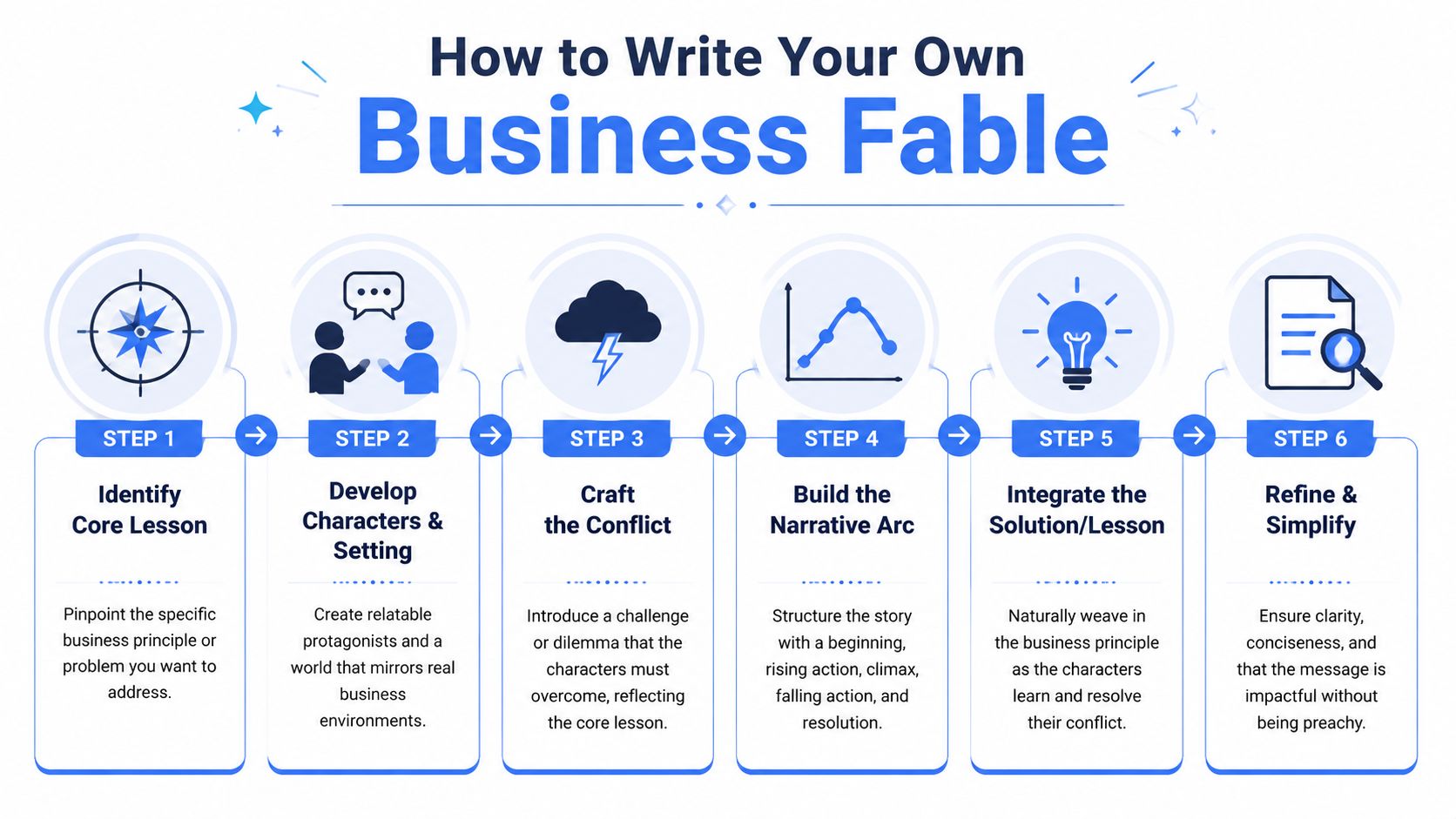
Most experts make the same early mistake. They begin with a scene, a character, or a title idea. A stronger approach starts with the business problem your book must solve.
An expert business fable should be built around a durable business process or transformation journey. The most useful specification is to define one core business problem, map it to 3–5 decision points, attach observable outcomes to each turning point, and include a short implementation layer after each chapter, based on guidance from Kimball's discussion of fables and facts.
Start with the business problem not the plot
If your expertise covers ten problems, choose one. Business fables get weak when authors try to smuggle an entire consulting methodology into a single story.
Start by answering these questions:
- What recurring problem do I solve?
Not a broad field. One concrete pattern. For example, “leaders create confusion because they make too many decisions personally.” - Who experiences that problem most clearly?
Pick a reader-facing character. This is your everyman protagonist. They shouldn't be extraordinary. They should be recognisable. - Why does the problem matter now?
Give the character pressure. Growth, conflict, poor performance, role change, client dissatisfaction, or internal friction all work.
A useful planning companion here is this guide to the 9 pillars of crafting a winning business book, especially if you're deciding how much of your intellectual property belongs inside the manuscript and how much belongs in your delivery model.
Build the turning points readers can use
Once the problem is clear, map the story through decision points instead of chapters alone. Many experts suddenly feel relief using this method. You don't need to become a novelist. You need to design meaningful moments.
Here's a practical pattern:
- Opening strain: The protagonist sees symptoms but misreads the cause.
- Failed first response: They apply a familiar fix that doesn't work.
- Disruptive insight: A mentor, event, or consequence exposes the underlying issue.
- Harder second choice: The character must adopt a new principle under pressure.
- Visible result: The shift produces an outcome the reader can recognise.
Those outcomes don't need made-up metrics. In many books, they can be qualitative and still powerful. A meeting becomes shorter and clearer. A team starts surfacing issues earlier. A founder stops rescuing every decision. A client conversation becomes more direct.
If the turning point doesn't change behaviour, it's probably only a scene, not a teaching moment.
Make the book teach as well as tell
This is the part experts often resist because they fear “breaking” the story. Don't think of it that way. Think of it as adding an implementation layer.
That layer can appear in several forms:
After-story deviceWhat it gives the readerShort chapter reflectionNames the lesson plainlyQuestions for the readerHelps transfer the scene into their own contextMini framework summaryGives language they can reuseAction promptEncourages one immediate application
A business fable becomes an authority asset rather than a pleasant read. Your reader shouldn't need to reverse-engineer your expertise from the plot.
If you want support turning your expertise into a structured non-fiction book, options include a developmental editor, a ghostwriter, a book strategist, or a community-based coaching model such as Expert Author Community, which provides curriculum, feedback, and coaching for experts developing authority-building books.
A quick draft test
Before you write the whole manuscript, test your concept in one sentence:
A stressed operations director learns that the business isn't failing because people are lazy, but because decisions are trapped at the top, and each chapter follows one choice that frees the team to act.
If your sentence gives you a protagonist, a conflict, a lesson, and a path of change, you have the bones of a viable business fable.
Turning Your Fable into a Business Asset
You finish the manuscript, order a box of copies, and take the book to a conference in Sydney or Melbourne. People like the story. They mention the characters. Then the core business question appears. Does this book lead to speaking invitations, consulting conversations, workshop sales, or stronger client trust, or does it sit on the table as an interesting brand piece?
For Australian experts, that question has extra weight because the market is smaller and more relationship-driven than the US. A book usually needs to do more than sell copies. It needs to travel well across keynote stages, LinkedIn content, association events, client roundtables, and referral conversations. That is where a business fable can be a smart commercial choice. It gives you a story people remember, then repeat to colleagues after the event.
One useful framing of that issue appears in this discussion of custom business fables for leadership and authority, which examines whether a fable can support consulting and coaching outcomes. In practice, the answer depends on fit. If your work helps leaders change behaviour, improve decisions, or shift culture, a fable often does that job better than a dense idea-led book because clients can recognise themselves in the story before they need to agree with your framework.
A useful way to choose the format is to compare the buying context.
If an Australian consultant is trying to win corporate work, a framework-led book can signal depth and method. It suits buyers who want a clear process, especially in procurement-heavy settings. A business fable works better when the sales barrier is not "Do you have a model?" but "Will our leaders absorb this and use it?" Industries with busy senior teams, such as professional services, healthcare, construction, and education, often respond well to a short story they can discuss in a leadership offsite or book a speaker around.
That gives the fable a practical advantage. It is easier to use.
You can build several commercial assets from one narrative spine:
- Conference and association speaking: Open with the protagonist's problem, then connect each turning point to a lesson your audience can apply on Monday. This suits chambers of commerce, industry associations, and leadership events where attention is short and practical value matters.
- Corporate workshops: Use one chapter as a case study substitute. Teams can discuss the character's decision without becoming defensive about their own behaviour.
- Business development meetings: A short retelling helps a prospect name the pattern they are stuck in. That shortens the path to "we need help with this."
- Content for Australian business media and LinkedIn: A chapter theme can become an article, a founder post, or a newsletter issue aimed at decision-makers who are not ready to buy yet.
- Client onboarding: Send the fable before the first session so clients arrive with a shared language for the problem.
The mechanics matter too. In Australia, many expert authors do not need a national retail breakout for the book to pay for itself. They need the book in the hands of 200 right readers. That might mean past clients, conference organisers, association partners, board members, or leadership teams inside mid-market firms. A fable is often strong in that kind of targeted distribution because people finish it, pass it on, and remember the core idea without needing to study a full technical argument.
Publishing choice should follow that commercial plan.
If your goal is speed, control, bulk sales to clients, and tight integration with consulting or speaking, self-publishing often makes sense. If your goal is trade distribution, airport-bookshop visibility, or the positioning that can come with a traditional deal, the route changes. For authors weighing that decision, this practical guide to mastering book self-publishing is a useful resource because it explains production and release choices in a business-focused way.
Use a business fable when the story format helps the reader adopt your idea faster, discuss it more easily, and connect it to the service you sell. That is the test.
If you are deciding between a fable, a framework-led book, or another non-fiction format, Expert Author Community (EAC) offers support for experts developing practical books that build authority and support business growth.

Find Your Non-Fiction Book Purpose: A Strategic Guide


Your Non Fiction Book Purpose: From Idea to Impact

7 Author Bio Examples to Build Authority in 2026