

Allan Sicard spent 40 years in policing, including commanding at the Mosman collar bomb incident and the first two hours of the Lindt Cafe siege. He explains why he now believes the leadership that mattered in those hours happened long before them, and why he reads turnover, sick leave and retention figures as signals to ask questions rather than numbers to improve.
The Courage to Lead has been out since 2023. Which idea in it has turned out to have the longest shelf life with readers, and was it the one you expected to land?
The idea that has had the longest shelf life is that the true measure of a leader is how many other leaders they create.
When I wrote The Courage to Lead, I was challenging something I had experienced throughout 40 years in policing: the assumption that leadership comes with rank and that the person at the top needs to have the answers.
For many years, I thought my job as a leader was to have those answers. I eventually learned that my real job was to create an environment where the answers could emerge.
That idea has only become stronger since the book was published. Through executive coaching, speaking and more than 100 interviews on The Courage to Lead Interview Series, I have seen the same principle repeatedly: the strongest leaders build formidable teams, give people permission to lead and create other leaders around them.
I expected the critical incidents to attract attention. I am not sure I expected this quieter idea about empowerment to have such longevity. But it has become the foundation of almost everything I do today.
You wrote about a commander empowering others to lead inside policing, an arena you describe as autocratic. What was the hardest thing to put on the page about that culture while you were still part of it, and how do you feel about that choice now?
The hardest thing was acknowledging that I had been part of the problem.
Policing is necessarily command-driven in emergencies, but that does not mean an organisation should be autocratic every day. Early in my time as a Superintendent, I thought leadership meant making decisions, providing direction and having the answers. I disempowered good people without necessarily recognising I was doing it.
Putting that on the page required me to acknowledge my own leadership failures rather than simply criticise the culture around me.
I am very comfortable with that decision today. In fact, I think leadership becomes more credible when we stop pretending we always got it right.
My experience since leaving policing has reinforced that view. Whether I am coaching an executive, working with a leadership team or interviewing someone for the podcast, I am interested in leaders who are prepared to learn, change and create environments where other people can succeed.
Leadership is not about demonstrating how important you are. It is about what becomes possible for other people because you were there.
Readers will always gravitate to the Mosman collar bomb and the first two hours of the Lindt Cafe siege. Having now told those stories many times since publication, has your own understanding of what actually mattered in those hours shifted?
My understanding has definitely shifted.
When people hear those stories, understandably they focus on the extraordinary circumstances: a young woman with what appeared to be an explosive device around her neck at Mosman, or arriving as Forward Police Commander during the first two hours of the Lindt Café siege.
But after telling those stories many times, I increasingly believe the most important leadership lessons occurred before the incidents.
You cannot suddenly manufacture trust, relationships or a formidable team when a crisis begins.
At Mosman, I was confronted with information suggesting the device could be fatal, that there was potentially a two-hour timer and that attempts to resolve comparable incidents elsewhere had not been successful. At Lindt, decisions had to begin before I even arrived at the scene, including establishing the inner perimeter and managing traffic so Sydney could continue functioning around an unfolding crisis.
What mattered was not one person having every answer. It was having capable people, trusting their expertise, remaining calm enough to listen and creating the conditions in which the best available decisions could emerge.
The incidents were extraordinary. The leadership principles were not. That is probably the most important thing I understand about them now.
Organisations now come to you with high turnover, sick leave and low retention, and you treat those as symptoms rather than the problem. What do you understand about the root causes today that you had not yet worked out when you were writing the book?
When I wrote the book, I understood the importance of culture, trust and relationships. What I understand much more clearly today is the value of using data to care.
High turnover, excessive sick leave, psychological injury, disengagement and poor retention are data points. Too often organisations treat them as problems to be managed or numbers to be improved.
I now see them first as signals.
They tell leaders where to look and, more importantly, where to ask questions: What is happening to our people? Which teams are struggling? Who needs support? What is happening in this workplace that makes good people no longer want to be here?
Through my coaching work and the Courage to Lead Case Study Series, I have become increasingly interested in the difference between measuring people and understanding people.
One of the simplest examples came from a leader I coached. I encouraged him to ask his team three questions: What keeps you awake? What could we do better? What can I do to support you?
Those questions produced information that no dashboard could provide on its own.
Data should tell us where to look. Relationships allow us to understand what we find. Leadership determines what we do about it.
That connection is much stronger in my thinking today than when I wrote the original book.
Beyond the sales and the speaking, what has having a book continued to make possible in your work, whether that is the conversations you get invited into, the way clients arrive already understanding your position, or your own clarity about what you believe?
The greatest value of the book has not been the sales. It has been what happened because the book existed.
The Courage to Lead became the catalyst for The Courage to Lead Interview Series. That has now grown to more than 100 conversations with leaders and an audience across more than 80 countries.
Those conversations have introduced me to people I may never otherwise have met and, more importantly, exposed me to leadership experiences far beyond policing.
The book also means clients often arrive already knowing what I stand for. They understand that my approach is built around Relationships, Reputation and Resilience:
Relationships - because leadership begins with people.
Reputation - because trust is earned every day.
Resilience - because the future belongs to those prepared for change.
More recently, the book, podcast, coaching and keynote work have led to The Courage to Lead Case Study Series. I wanted to create something leaders could access at any time - a free and growing resource examining real leadership situations, what worked, what failed and what we can learn from them. Those case studies are the chapters for my next book. The Courage to Lead - Resilience, Reputation and Resilience. Drawing on my own experiences and 100+ Leaders on The Courage to Lead Interview Series.
Perhaps most importantly, the book forced me to articulate what I believed. Everything since has forced me to keep testing whether I was right.
If you were writing The Courage to Lead now, with forty years of policing still behind you but several years of coaching and interviewing other leaders in front of you, what would you do differently, and what would you refuse to change?
I would keep the stories. I would keep the mistakes. And I would absolutely keep the belief that leadership begins with people.
What I would change is the lens through which I examine them.
Since publication, I have spent several years coaching leaders, working with organisations and interviewing more than 100 people for the podcast. I have heard from military leaders, emergency-service leaders, CEOs, academics, advocates, community leaders and people who have led through circumstances they never expected to face.
That has broadened my understanding enormously.
If I were writing the book today, I would spend less time asking, “What makes someone a good leader?” and more time asking, “What does a good leader make possible for everybody else?”
I would explore much more deeply how leaders use data to identify people who need support, how psychological safety and trust are built, why power sometimes prevents organisations from seeing uncomfortable truths, and how leaders deliberately build formidable teams capable of operating without constantly looking upwards for permission.
What I would refuse to change is the humanity of it.
Leadership is still about relationships. Trust still matters. Character still matters. Resilience still matters. And I remain convinced that the true measure of a leader is not how many followers they accumulate, but how many other leaders they create.
“What have you learned since writing the book that might become the next book?”
When The Courage to Lead was published in 2023, I was drawing largely on 40 years of policing and the leadership lessons that came from that career.
Since then, something unexpected has happened.
The podcast has given me more than 100 opportunities to test those ideas against the experiences of other leaders. My coaching work has allowed me to watch leaders change in real time. The Case Study Series has given me another way to examine why leadership succeeds, why it fails and what happens to people when organisations get it wrong.
A new theme has emerged.
I increasingly believe leadership is about creating the environment in which other people can succeed.
That means using data to care rather than simply measure. It means recognising that trust is a form of organisational currency. It means building a small, formidable leadership team united around a common purpose. It means being prepared to challenge power when systems are harming people. And it means creating other leaders rather than creating dependence on yourself.
My first book asked what courage looks like when you lead.
I suspect the next one asks a different question:
What becomes possible when leaders genuinely care about the people they lead?
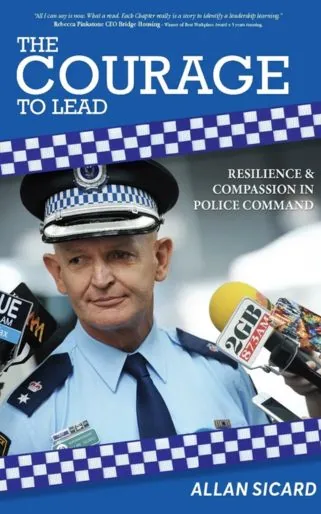
The Courage to Lead is available from Booktopia, Amazon or Allan's website.
You can find Allan at allansicard.com and connect on LinkedIn.

Faye Evans on Soulful Simplicity

Jacqui Clarke on Stop Worrying about Money

Monique Zytnik on Internal Communication in the Age of Artificial Intelligence